
The Viking Project
We begin to explore the planet Mars
|
Scan by Hamish Lindsay. |
Some Mars Facts: |
|
| Distance from Sun | 227,943,820 kilometres |
| Orbital speed | 84,008 km / h |
| Diameter | 6,791.4 kilometres |
| Tilt of axis | 25° |
| Mars year | 687 Earth days |
| Mars day | 24 hours 37 minutes |
| Gravity | 0.375 that of Earth |
| If your weight is 70 kg on Earth, on Mars it would be |
26.3 kg on Mars |
| Moons (2) | Phobos, Deimos |
The first attempt to communicate with the inhabitants of Mars goes back to 1820 when the distinguished astronomer and mathematician Karl Gauss suggested growing a huge triangle of wheat surrounded by green pine trees, but the scheme fell through when the sensible Russians would not cooperate with those looney Germans. In 1850 French astronomer Charles Cros wanted to focus beams of sunlight from giant mirrors onto Mars and send messages in Morse code. (Now how would the Martians read Morse code in French??).
However it was in 1877, when Mars was at its closest approach to Earth, that Italian Giovanni Schiaparelli focussed his telescope on Mars and began to draw the first map of the surface of Mars. Peering into the telescope’s eyepiece he could see large blurred dark areas connected by what appeared to be a network of dark, narrow lines. “Canali,” he gasped. When this was translated into English as canals and not the more literal channels, Earthlings were convinced – there must be Martians.
Then in 1894 the American astronomer Percival Lowell studied these features and he was sure he could see these ‘canals’ criss-crossing the whole surface of Mars, and wrote, “On Mars we see the products of an intelligence. There is a network of irrigation... certainly we see hints of beings in advance of us...”
H.G Wells and the War of the Worlds.
Despite the results of spectroscope observations indicating a whisper thin atmosphere of carbon dioxide, and the derision of Lowell’s colleagues, countless stories were written about the Martians, among them H.G.Wells’ shocker War of the Worlds, first published in a magazine in 1897. The concept of the story is attributed to the genocide of the Tasmanian aboriginals. Wells wanted to illustrate to the British Empire what it would feel like to be confronted by a much superior force.
Actor Orson Welles had read the story as a youngster and was intrigued with it all his life. He was running a successful radio program in New York called the Mercury Theatre and for Halloween on Sunday 30 October, 1938, decided to broadcast an adaption by Howard Koch.
Koch remembers, “After listening to the broadcast in my apartment, I went to sleep blissfully unaware of what was happening outside. The next morning when I walked down to the barber I was aware of an air of excitement among the passers-by. When I asked the barber he broke into a grin and said, ‘Haven’t you heard?’ and held up the morning newspaper with the headlines NATION IN PANIC FROM MARTIAN BROADCAST.”
Welles had made the broadcast sound as though it was a news item, and began with a reference to Professor Farrell of the Mount Jennings Observatory observing several gas explosions occurring at regular intervals on the planet Mars. Then he said, “The spectroscope indicates the gas to be hydrogen and moving towards Earth at a tremendous velocity.”
Next a series of flaming objects were reported to have fallen on the village of Grovers Mill in New Jersey, and reporters from the site describe some cylindrical objects buried in the ground. While they are watching the cylinders, something like a grey snake with tentacles emerged and the horrified reporters witness a sudden jet of flame and several of the assembled crowd were reduced to grisly corpses.
Welles now announced, “Ladies and Gentlemen. I have a grave announcement to make. Incredible as it may seem, both the observations of science and the evidence of our eyes leads to the inescapable assumption that those strange beings who landed in the Jersey farmlands tonight are the vanguard of an invading arm from the planet Mars... the monsters are now in control of the middle section of New Jersey and have effectively cut the state through the centre. Communication lines are down from Pennsylvania to the Atlantic Ocean. Railroad tracks are torn and services from New York to Philadelphia discontinued. Highways to the north, south and west are clogged with frantic human traffic...”
1,200,000 of the estimated 6,000,000 listeners took the broadcast literally, and reacted accordingly. Several million more who had not heard the broadcast were caught up in the mass hysteria. The next day the newspapers were choked with wild stories of hysterical reactions to the broadcast.
Households were disrupted; many fled homes to escape the gas raids from Mars; church services were abandoned; thousands called the police, newspapers and radio stations all over the country seeking protective measures from the gas; weeping and hysterical women swamped the switchboard of the Journal for details of the massacre; and electricity companies received scores of phone calls to turn off the electricity supply so the cities would be safe from the enemy. One man returned home to find his wife with a bottle of poison in her hand screaming, “I’d rather die this way than like that!”
Welles’ assistant, John Houseman, described the scene in the studio, “During the playing of the final theme the phone started to ring in the control room and a shrill voice in the receiver announced itself as the mayor of a big Midwestern city and began screaming for Welles. Choking with fury he reported mobs were in the streets, women and children huddled in churches, violence and looting...
Welles hung up quickly, for we were now off the air, and the studio door burst open. The following hours were a nightmare. The building was suddenly full of people and dark blue uniforms. We were hurried out of the studio, downstairs, to a back office. Here we sat while network employees were busily collecting, destroying, and locking up all scripts and records of the broadcast. Hours later, instead of arresting us, they led us out of the back way, and we scurried away like hunted animals.”
……………………………………………………..
First attempts at landing on the surface of Mars.
The Russians were the first to attempt to land on the Red Planet. Their rocket genius, Sergei Korolov, was a Mars freak, so it was natural he would try and land a spacecraft at the first opportunity in 1960. Launched from Baikonur on 10 and 14 October, 1960, for two fly-bys, both his Molniya rockets failed to reach Earth orbit.
Then in 1962 they tried again at the next opportunity with a launch on 24 October 1962 of Mars 2MV-4 #1, for a fly-by, but it was destroyed in low Earth orbit. Next was 2MV-4 #2, also called Mars 1, launched on 1 November 1962. It was successful in reaching Mars, but suddenly without warning, signals just stopped before it reached the planet, and it silently sailed past at a distance of 193,000 km. Three days later 2MV-3 #1 set off to land on the surface of Mars, but never left low Earth orbit.
Just on two years later, on 5 November 1964, NASA entered the Mars stakes with Mariner 3, but it too, suffered a failure when telemetry indicated a below normal velocity inferred that the fairing had not separated properly. Eight hours after launch the batteries in the probe died, and the mission was officially terminated.
The first attempts to reach Mars were fraught with difficulties, the first string of Russian spacecraft and Mariner 3 vanishing off the radar screens so much so that the JPL Deputy Manager for Mariner 4 jokingly said there must be a Great Galactic Ghoul resident between us, gobbling our spacecraft as they headed for Mars.
Mariner 4 sends the first pictures of Mars.
NASA’s 261kg Mariner 4 spacecraft, launched on 28 November 1964 by a Lockheed Atlas-Agena D booster, was the first spacecraft to return pictures from deep space and Mars. It was DSS42 Tidbinbilla’s first major mission.
Mariner 4 had its problems: the spacecraft experienced trouble acquiring the star Canopus, losing lock six times in three weeks. Engineers investigating the problem determined it was due to the Sun shining on small dust particles from the spacecraft, confusing the sensor. Mariner 4 managed to continue on to become the first operational spacecraft to arrive at the red planet at 01:00:57 UT (1100:57 AEST) on 15 July 1965, flying within 9,846 kilometres of the surface after a journey of 230 days.
Bruce Window was on the receivers at Tidbinbilla,
“It was a muck-up from the start with people in a panic everywhere. To start with there were incorrect predictions, so it took 8 minutes to find the signal after it had come over the horizon – not that anything was lost because Goldstone was also tracking at the same time.”
From a mean altitude of 10,000 kilometres, Mariner 4 snapped 21 television framelets of 40,000 pixels each (which meant with the primitive technology of those days it took 8 hours to transmit one picture!) before slipping behind the planet for its signal to allow analysis of the atmosphere. The pictures were 150 times more detailed than any telescope views from Earth and revealed that the ‘canals’ were really ridge systems and mountain chains.
JPL Director Bruce Murray admitted,
“When we first had the pictures from Mars we couldn’t recognise a thing! We couldn’t even be sure we were looking at Mars. Evidently some dust had collected on the optics, which created instrumental glare. Nothing could be identified. Soberly, we began to invent computer image processing to remove the overriding glare and the planet’s haze.”
Mariner 4 went behind the planet at 0219:11 UT (1219:11 AEST) for 53 minutes 53 seconds. Bruce Window was pleased to remember, “We were the first station to make contact after the encounter.”
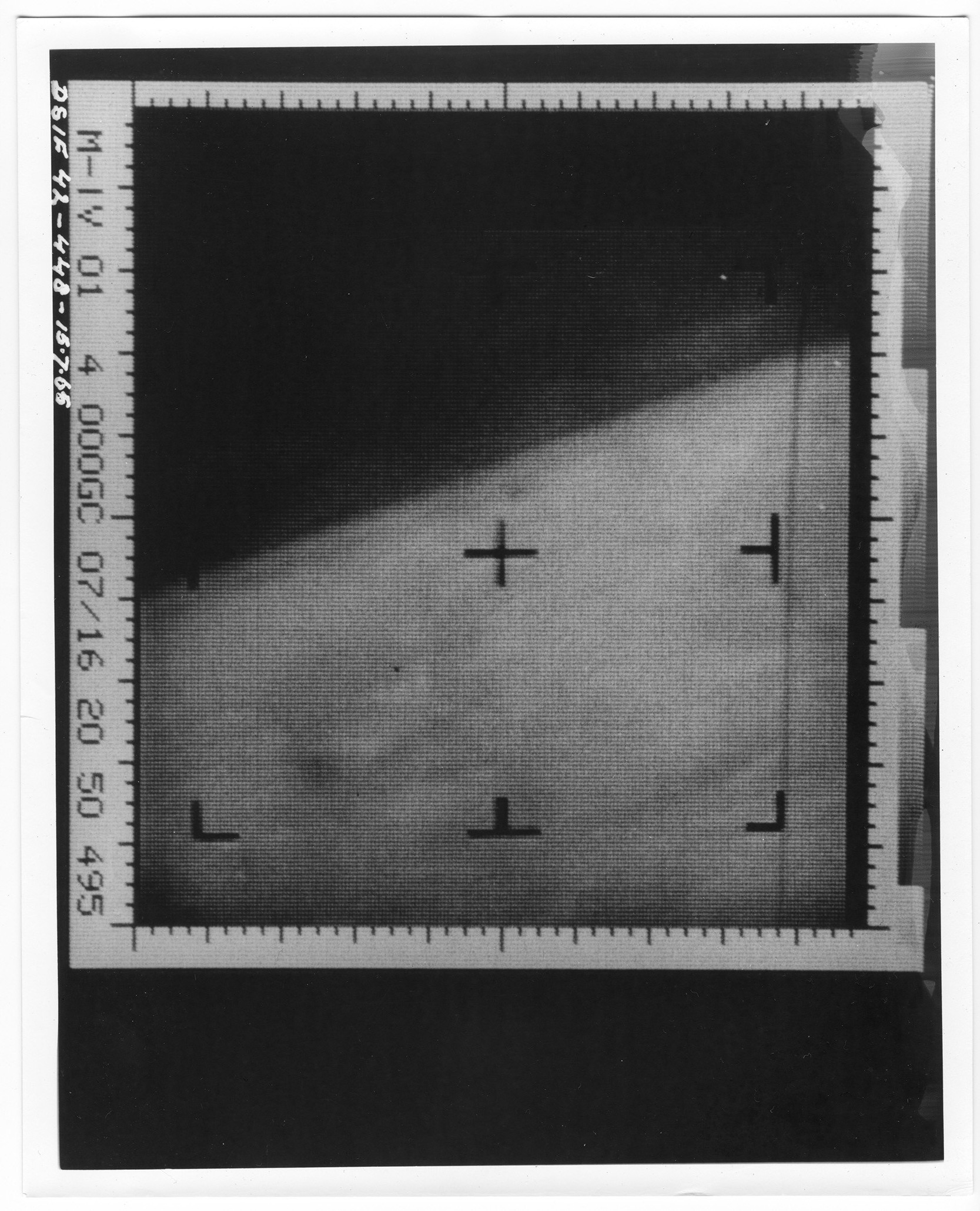 |
The first ever close up image of Mars. Note the haze layer. Preserved by Les Whaley. Scanned by Colin Mackellar. |
The results were disappointing – no signs of advanced technology, no ruined castles, no canals, just a desolate bare surface. Multiple library shelves of books on Mars and its people were suddenly complete fiction and no longer relevant.
The Mariner 4 mission was terminated on 21 December 1967, and the spacecraft is now lost in a heliocentric orbit.
America followed up with Mariner 6 and 7 flybys in 1969.
The 380kg Mariner 6 sped past Mars on 30 July 1969, ten days after Armstrong had walked on the Moon, and provided 24 images of Mars.
Mariner 7 had a crisis when a rechargeable battery exploded and the signals died. Communications were re-established and after the scientists had reprogrammed the spacecraft to avoid the damaged sections of the spacecraft, a near normal fly-by provided 31 good views of the southern seasonal frost cap of Mars.
These Mariners confirmed there was a weather system on Mars.
The first landing on Mars.
On 19 May 1971 at 16:22:44 UT Mars II, the Russian Orbiter and Lander spacecraft, were sent off and arrived safely at Mars, to go into orbit on 27 November 1971, though the Lander crashed onto the surface while trying to land.
Nothing daunted, the Russians launched Mars III on 28 May 1971 at 15:26:30 UT, and this time the Lander actually reached the surface.
The descent module was released at 09:14:00 UT (1914:00 AEST) on 2 December 1971, and 4 hours 35 minutes later dropped safely on the surface at coordinates 45°S by 202°E, and for nearly 15 seconds started sending data – the very first image (partial only) from the surface of another planet. But suddenly the signals just stopped.
There was a small Rover connected by an umbilical cord, planned to explore around the Lander on skis, but with the communications cut so soon, it was never released.
The Russians suspect the poor little spacecraft was overwhelmed by a dust storm that was raging at the time, with winds over 320 kilometres (200 miles) per hour.
Mariner 9 Orbiter.
First spacecraft to orbit another planet.
With the view that Mariners 4, 6, and 7 had only provided ‘snap-shot’ views of the planet as they passed by, in 1971 NASA’s much bigger Mariners 8 and 9, weighing 1,020kg, were designed to go into orbit and work as a team to map the whole planet’s surface. But when Mariner 8 failed at launch, a compromised mission with only one spacecraft began when Mariner 9 was launched on 30 May 1971, to reach the planet after 167 days on 14 November 1971, and a journey of 390 million kilometres. It beat the Russian Mars II into orbit by 13 days. It took 6,786 images of the planet. Initially the scientists were disappointed to find a huge global sandstorm covering the surface, so, initially there were no pictures.
However, they were able to implement the new technology of being able to program the spacecraft in real time, so they arranged for the spacecraft to orbit the planet and wait until the storm cleared. It was a long wait (over two months) but then after mapping 100% of the planet, the pictures revealed an unexpectedly exciting terrain – mountains and canyons to knock the socks off our biggest Earthly features. Mount Everest is only half as high as the volcano Olympus Mons, and our impressive 350 km long Grand Canyon is only a scratch alongside the 5,000 km long Valles Marineris, so wide (up to 200 km) in places you can’t see the other side. If you stood on the edge, you would look 7 km down to the bottom! These enormous features are part of the Tharsis Bulge, a region where the planet’s sphere is pushed out of shape by past internal pressures from within. The Mariner pictures gave us the first hint of watercourses on Mars. More was to come later with the Viking and surface rover missions. Mariner 9 also returned quite good pictures of the two moons, Phobos and Deimos.
Mariner 9 entered Earth’s history books after orbiting the planet for nearly a year, with the last transmission on 27 October 1972, when the internal guidance systems failed and the spacecraft began to drift out of alignment with Earth and could no longer be tracked.
Robert Leighton, a member of the imaging team, said during a September 1969 press conference, “Each Mariner spacecraft in its turn had revealed a new and unexpected, and no doubt significant, kind of terrain. Now I leave it to you to figure out how many new surprises there are still waiting for us on Mars.”
The Viking Project.
The Viking Project began in 1968. It was managed by NASA’s Langley Research Center with James Martin chosen to lead the project. Harold Klein from the Ames Research Center led the biology team. Martin Marietta was the principal contractor, while the Jet Propulsion Laboratory (JPL) built the Orbiters, and later managed the missions.
Dr. Tom Young, Viking Mission Director, said, “I don’t think there was anyone on the program – be they engineer, administrator, or scientist – who didn’t really appreciate, respect and agree it was a science mission.”
Dr Gerald Soffen, the Viking Project Scientist, admitted they were not quite sure how to search for life on Mars, so they began by searching for small creatures always associated with higher forms of life – they decided to search for micro-organisms.
Mission Objectives.
The specific objectives of the Viking Mission included:
1. Evolution and structure of Mars’ interior.
2. Characteristics of the surface, including its chemistry and physical nature.
3. Evolution and current composition and structure of its atmosphere.
4. Nature of the climate.
5. Whether life is, or ever has been, present.
After seven years of intense planning, research and manufacturing, and budget frights threatening to kill the project, the spacecraft were ready to launch. The Orbiters were shipped to Cape Kennedy in February 1975.
Each spacecraft was far more complex than any deep space spacecraft ever launched at the time. They contained the equivalent of two power stations, two computer centres, a television studio, a weather station, a seismometer, two chemical laboratories, three incubators for any Martian life, a scoop and backhoe for digging trenches and collecting soil samples. Also technological progress was bouncing along a fast clip – for example each tape recorder in Viking had 3.6 times the capacity but weighed 3.3 kg less than the Mariner spacecraft’s recorders.
Before the Viking missions we had a visit from Jerry Soffen at Honeysuckle Creek. Jerry and I got on very well and had some good talks. I asked him what would they do if there was a patch of green just out of reach of the scoop, or they saw some signs of life just a few metres away? “Nothing,” he said with a shrug, “All we can do is stare at it with the camera.”
He was also very surprised to discover our station handover procedures – he wasn’t aware of the long delays and the tricky handing of the spacecraft signal from one station to another as the Earth turned.
As a token of our friendship he gave me a Scientific American magazine and signed it “……..from a planetary friend.”
 |
Honeysuckle Creek Station Director Station Don Gray (left) and Jerry Soffen, Viking Project Scientist, from Langley Research Center – at Honeysuckle. Photo: Hamish Lindsay. |
In the NASA Press Release before the mission, dated February 1975, there was a certain amount of optimism to find life, to quote, “Life could exist in the harsh climate of Mars, and if it does, we will know that on planets with comfortable climates - similar to that on Earth – the chances of finding life are substantial. Viking exploration may also settle a question of equal importance for determining the probability of life arising out of non-living chemicals.”
Ground Tracking.
The Deep Space Network (DSN) was the primary support, with three stations of 26 metre antennas, and three stations of 64 metre antennas in Goldstone, California; Tidbinbilla and Honeysuckle Creek, Australia; and Madrid, Spain.
Once at Mars the round trip light time was a minimum of 40 minutes, meaning all manoeuvres and operations by the spacecraft had to be automated.
The Viking Project came at the end of NASA’s first flush of manned space flights. Skylab had finished its manned phase and was an empty hulk spinning around the Earth waiting for its demise. The political Apollo-Soyuz mission had just ended in July 1975.
Honeysuckle Creek joins the Deep Space Network (DSN).
In April 1975, just four months before Viking 1 was launched, Honeysuckle Creek had left the Manned Space Flight Network and joined the Deep Space Tracking Network, and had undergone its first tests in DSN procedures. Andre Cattechio of the DSN Network Operation System Support Group sent a letter of praise, “Recently they (Honeysuckle Creek) were requested to conduct MCT system level tests in support of the Viking mission. The quality of their test reports are unsurpassed in the entire Network. They include everything required to ensure a successful mission.”
Viking was Honeysuckle Creek’s the first major DSN mission after joining the JPL Deep Space Tracking team.
 |
Angel Ioannou took this photo of the Honeysuckle Creek (DSS44) antenna as Viking 1 neared Mars in June 1976. Transparency scan by Colin Mackellar. |
John Saxon, Operations Manager at Honeysuckle Creek:
“Vikings 1 and 2 were among the first spacecraft that we supported as a full DSN station. The four spacecraft and various uplink handovers etc. were enough to keep us busy. But after the adrenalin fuelled Manned Spacecraft flights such as Apollo where we could see many spacecraft parameters (astronaut respiration and heartbeats, spacecraft temperatures and pressures, etc.) from up to 7 or 8 separate sources, the DSN missions seemed rather “tame”.
There was little real-time visibility, and we had to rely on reports from JPL and the projects about what had been learnt weeks before.
So the DSN seemed like short periods of frantic activity (turnarounds between missions – JPL constantly pushed to reduce this time, of course), and long periods of little activity during cruise phases except to monitor the ground equipment and to make sure that the spacecraft predicted frequencies and signal levels were close to predictions.
Later we regained some of the excitement when planetary encounters and landings were scheduled, which required very different support techniques. Even the DSN simulations seemed more like data flow tests – gone were the simulated contingencies (heart attacks, fire alarms, equipment failures) of the manned spacecraft simulations. The feeling was that if something went wrong in real-time in the DSN, the spacecraft would probably still be there the next day.
So it was quite hard for us to retain the same enthusiasm - but eventually we grew to love some of the spacecraft and missions (particularly Voyager for me) where those remote places were revealed for the first time – everything was new.”
Viking was originally scheduled to launch in 1973, when, with favourable conditions, it would use a Type 1 trajectory, taking around 5 months to get there, such as the Mariners used. However budget considerations dictated a 1975 launch, but 1975 was not a good time to go in terms of launch energy requirements and encounter velocities, so a Type 2 trajectory had to be used, travelling a heliocentric angle over 180° and taking twice as long to reach Mars.
Viking 1.
Launch.
Viking I was launched by a Titan IIIE-Centaur rocket from the Kennedy Space Center at 21:22:00 UT on 20 August 1975 (0722:00 AEST 21 August), followed by Viking 2 on 9 September 1975.
 |
Viking 1 leaves for Mars, 20 August 1975. |
Once on course for Mars, the spacecraft were stabilized in flight by locking onto the Sun for pitch and yaw references, and the star Canopus for its roll reference.
Arrival at Mars.
After a 304 day (10 month) cruise to Mars, Viking 1 arrived at the planet, 320 million kilometres from Earth at the time, on 19 June 1976. The spacecraft began transmitting global images of the planet’s surface about 5 days before insertion into orbit. On 21 June it was inserted into a 1,510 by 32,600 kilometre, 24h 39m 36s hour orbit with an inclination of 37.9º.
A Fourth of July landing on Mars had been planned, but an unexpected snag delayed the landing. The prime landing area had been chosen from the Mariner 9 images, but when Viking arrived at Mars its superior cameras revealed it was too rough to chance a successful landing. There were large boulders scattered over the whole area, as well as endless cracks and gullies, rifts and holes. The chances of landing a spacecraft safely were highly unlikely.
So, could the Viking Orbiter cameras find another spot? It wasn’t only a flat area the scientists wanted, they also wanted somewhere that would have the best chance of finding something interesting geologically, and most important of all, somewhere with the best chance of finding some sort of life, such as a river bed. The scientists would have liked to drop into the bottom of Valles Marineris, where the atmosphere would be heavier and warmer, but the flat ground team won the day.
What if the ‘flat ground’ area turned out to be talcum powder-like dust, and the spacecraft vanished from sight into a sea of powder? Many JPL controllers spent sleepless nights tossing possibilities and chances around while Viking 1 patiently orbited the red planet.
With a lack of news, Viking status reports disappeared off the front pages of the newspapers as flight controllers wrestled with seemingly impossible decisions from the limited data available. Viking 2, perhaps a backup in case of an accident to Viking 1, was still a fortnight away. As the days rolled by, the strain of trying to choose a safe landing area and exhaustion among the flight controllers increased the likelihood of human error in planning and implementing the descent instructions to the spacecraft. Finally, on 12 July a show of hands in the control room settled the new site – Chryse Planitia (Plains of Gold), about 587 kilometres west of the original spot. Unfortunately, in the interest of safety the target was a long way from the confluence of the four river beds originally chosen.
Al Treder, a member of the Flight Control Team:
“It was a dark and stormy night … No, it wasn’t, this was summer in southern California, so it was just dark. And warm and humid, but we were comfortable in the air-conditioned Mission Control building. We members of the Viking flight team had been adjusting our work schedule to Martian time, so that the daily sequence of command generation followed by uplink of the next day’s command load would stay in synchronization with the Martian day. Since the Martian day was a little longer than the 24-hour Earth day, we had to start our work day an hour later each week or so, and on Landing Day the team activities started something like Oh-Dark-Thirty, the middle of the night. Our families had to put up with this, so Viking management had made special efforts to make presentations to families in the JPL cafeteria (with cake and soft drinks, as I remember). It was a big deal for everybody. We were initially planning on landing on the Fourth of July, 1976, the official 200th birthday of US independence, but this was reluctantly delayed until 20 July to allow sufficient assurance that the chosen target area on Mars was smooth and flat enough to avoid any tipping-over danger during this very first landing.
I was on an analysis team that prepared the pointing command values the previous day for execution this day, so strictly speaking I did not have to be there for the landing sequence execution. However, I and every member of that analysis team was bound and determined to BE there in the room next to the mission control room and hear everything happen in real time. This was HISTORIC. We were allowed to plug into the mission control team net as long as we didn’t add any words of our own, so we put on our headsets switched to mute and listened intently.
The first event was reorientation of the combined Viking Orbiter/Lander vehicle to the correct attitude for Lander separation, followed by blowing of the explosive bolts and release of the springs that pushed the Lander away from the Orbiter at the right time. Then the Lander was on its own, coasting down toward its entry into the tenuous Martian atmosphere, on an angle sharp enough to ensure it would slow down quickly enough to burrow deeper, and not so sharp that it would burn up before it was slow enough to pop the heat shield and release the atmospheric decelerator (supersonic parachute).
For us waiting in the room, it took a long time to start feeling the atmosphere. It was the middle of the night, and then early morning. A lot of coffee was drunk. At Mars’ distance from Earth, one-way signal delay was several minutes, so we knew by the timeline when things were supposed to happen, but we also knew they would have happened well before we heard anything in telemetry from the Lander. As a matter of fact, we were commenting to each other that the landing must have already happened, one way or another, and we still had no data. But then things started happening amazingly fast. Amazing to us, at least; the mission control folks had practiced this so they knew what to expect. On the net we heard the telemetry guy giving us altitude and velocity. The speed was so high initially that I thought it could not possibly slow down fast enough, there wasn’t enough time, altitude divided by speed said crash was imminent. But speed kept dropping dramatically, and the Lander was traveling mostly horizontally so altitude was not dropping that fast, and then the parachute was out and altitude was still high enough, and then the retro motors started firing and speed dropped to near zero, and it landed.”
Down in the southern hemisphere, at Honeysuckle Creek, Angel Ioannou remembers the moment,
“I was on Tony Salvage’s A team. We were on the afternoon shift.
We got in about 2:30 pm and I rang the power house to make sure there was extra power for the antenna servos. I sent the antenna to point at Mars and monitored the receivers.
I picked up Viking 1 Lander’s signal and told Tony we had lock. He advised JPL (Track) that we were locked onto Viking 1 Lander’s signal.
JPL Track, Pasadena.
Transparency sourced by Hamish Lindsay, scan by Colin Mackellar.
John McLeod checked the data quality was okay then it was like any other track we did. As I recall we never lost lock through the landing – from my point of view it was an uneventful track. I remember Tony put the line from JPL on our speakers and they were getting the first pictures and I remember the cheering in the background.”
Tony Salvage’s Team A at Honeysuckle Creek.
Henry Field, Peter Gavin, John McLeod, Tony Salvage, Angel Ioannou.
Photo: Hamish Lindsay. Scan: Colin Mackellar.
Angel Ioannou took this photo of Tony Salvage at the DSN Ops Console at Honeysuckle Creek in June 1976.
2021 Transparency scan by Colin Mackellar.
Lander Separation.
On 20 July 1976, the flight controllers at JPL sent commands to the Viking 1 Orbiter to separate, and the Lander to begin its descent to the surface. Shortly after separation the Lander had to flip around and point four small thrusters at exactly the right angle and fire them for 27 minutes to decelerate from orbital velocity and begin a three-hour arc down to the surface. At entry interface, when the Lander touched the wispy top of the atmosphere, the heat shield would have to protect the spacecraft from the 1,500°C temperatures, and begin to slow the spacecraft down to 900 kilometres per hour.
Entry Science.
These investigations were divided into two phases:
The aeroshell phase (entry), and the parachute phase (descent).
During the aeroshell phase, atmospheric composition, temperature, pressure and density were observed. To accomplish this phase of the study, temperature and pressure sensors, a magnetic sector mass spectograph and retarding potential analyzer were mounted on the aeroshell.
After aeroshell separation, temperature and pressure sensors mounted on the Lander itself continued the measurements to the Mars surface and provided supporting data on the surface for the duration of the mission.
The mass spectrometer measured the relative amounts of the gases making up the atmosphere, as well as identifying the molecules. The retarding potential analyzer measured both the concentration and the energies of upper atmosphere ions and electrons. Atmospheric density was derived from the pressure and composition data together with the aero-dynamic drag on the spacecraft as indicated by the accelerometers.
Chute Deployed.
At an altitude of 7,000 metres the heat shield peeled off and the parachute burst out and three legs sprouted out of the bottom. At 800 metres three retro rockets fired to slow the spacecraft and there were 55 seconds left for the onboard computer to cast off the parachute (so it wouldn’t land on top of the spacecraft) and prepare for a landing. The landing radar switched on to detect big rocks and select a smooth site.
The leader of the Lander imaging team, Dr. Thomas Mutch, described the supreme moment of the project – this was the big test,
“It is 5 am. The final descent begins. Conversation stops – an overwhelming silence. We listened to the Flight Controllers as they called out each event –
“400,000 feet”
“74,000 feet”
“2,600 feet”Then Flight Controller Richard Bender yelled out, ‘Touchdown! We have touchdown!’ and the control room erupted with joyous and excited mission controllers cheering and shaking hands.
Eight years of hard work suddenly realized.”
James Martin:
“We got the telemetry from the Lander all the way down close to the surface, so we knew that the parachute had worked and we knew the thrusters had worked. We knew the guidance system was working and that the radar was working. But there was a period of those 19 minutes when we didn’t know whether the Lander had landed successfully. That was nail-biting.”
Landing on Mars.
The Lander separated from the Orbiter on 20 July 1976 at 08:51:00 UT (1851:00 AEST). It touched down 3 hours 2 minutes 6 seconds later on Chryse Planitia at 11:53:06 UT (2153:06 AEST) at location 22.697°N by 48.222°W, exactly 7 years after Armstrong stepped onto the Moon.
Local Mars time was 1613:00.
The Flight Controllers in Mission Control held their breath as they hung onto the signals coming from their robot as it deployed and aligned the dish antenna and sent a successful landing signal back to base.
The Controllers were watching events that had happened 19 minutes ago – the time it took a signal to travel the distance between Earth and Mars at the speed of light at the time, and why all the instructions had to be loaded into the Lander’s computer ahead of time. Reminded of the Russian experience when their Mars III probe failed after only 15 seconds on the surface, the mission controllers had programmed the cameras to grab a contingency picture as soon as possible. Within the hour, strip by steady strip of the first black and white image of one of the footpads was scanned onto the monitor.
Then that dramatic moment of the first black and white picture. Thomas Mutch again,
“I studied the black screen, waiting for that narrow strip that will signal the first few lines of the first picture. And it appeared. A sliver of electronic magic. Areas of brightness and darkness. The picture begins to fill the screen. Rocks and sand are visible – and finally at the far right one of the spacecraft footpads. Time and again I repeated, ‘Its incredible.’ An explorer would understand.
We have stood on the surface of Mars.”
James Martin agreed, “That picture was really worth a thousand words.”
Al Treder continued to tell us about the landing, and that first picture,
“So, we knew the landing was apparently successful, finally. However, then the Lander had to check itself out and take a picture of the landing foot to prove it was all OK. That seemed to take forever, but I think it was half an hour.
Finally the first picture began to form on our TV monitor. Since the Lander camera was a simple facsimile device that took a picture line by line, slowly scanning across its field of view like an arthritic Xerox machine, the picture we saw on the screen was also line by painful line building as we watched. The lines were vertical, so the left side of the screen began to fill slowly. As it built, we tried to make out what it was showing us. For the first 10-15% of the image, it really resembled a Western dry wash, like the arroyo next to the JPL campus. We were imagining that maybe somebody went out and took a picture of that arroyo and were scanning it into the system we were watching, instead of a picture from Mars. But it turned out to be some transient lighting effect apparently caused by Martian dust, and the rest of the scene was unexciting, boringly normal.
We were finally on Mars, in good shape. I think somebody broke out cigars, as if for a new baby celebration, but smoking was prohibited in the Mission Control building even then, so it probably didn’t happen. There WERE lots of cheers and back-slappings. It was a happy occasion. I went home and slept, but others celebrated differently.”
Viking 1 was safely down, if tilted a few degrees due to a footpad sitting on a small rock, while another was buried in a patch of soft soil. Anxious controllers waited for any movement from the spacecraft, but it remained stable and began to send a steady stream of pictures and data back to Earth.
“Gee, we were lucky,” breathed Gentry Lee when one of the pictures showed a large boulder only metres away. Nicknamed Big Joe, the two-metre long boulder would have destroyed the spacecraft if it had landed on top of it.
Big Joe.
This big, coarse-grained rock lies 8 metres from the Viking 1 Lander. It has a topping of reddish fine-grained silt that spills down its sides. It seems to be part of a field of large blocks which may be part of the rim of an ancient degraded crater.
Martian skies are pink!!?
I remember before Viking landed on Mars everyone was conditioned to blue skies – “Skies are always blue…” and artists happily painted imagined Martian scenes with dark blue skies to be published in learned journals, including the prestigious National Geographic Magazine.
As soon as the Viking 1 spacecraft landed, the JPL scientists were so anxious to get a colour picture of the Martian landscape before anything happened, they took a picture, filtered the sky blue, and issued the photograph to the waiting world… but when they checked their colour patch later they found that the carbon dioxide sky was really pink, and they had to send out a corrected copy of the picture.
After landing, two problems were found. The seismometer had failed to uncage, and a sampler arm locking pin was stuck, which took 5 days to shake out, dropping to the surface in front of the cameras.
The first four soil samples were scooped up during 28 July (Martian day Sol 8) - the first poured into the biology instrument, the next two into the Gas Chromatograph processor, and the fourth into the X-Ray Spectrometer. Four days later James Martin reported that biology data was becoming available.
Viking 2.
Launch.
Viking 2 was also launched by a Titan IIIE-Centaur rocket from the Kennedy Space Center at 18:39:00 UT on 9 September 1975, (0439:00 AEST 10 September).
After a 333 day voyage to Mars, Viking Orbiter 2 was inserted into a 1,500 by 33,000 kilometre, 24h 36m orbit during 7 August 1976, before being trimmed to an orbit with a periapsis of 1,486 and an inclination of 55.4º with a 24h 37m 12s period on 9 August.
Orbiter 2 began scanning the terrain below, looking for a suitable landing area. The chosen spot, Cydonia, turned out to have a new phenomena; ‘inside out’ craters, sticking up from the surface instead of a hole in the ground. Cydonia was struck off the list of suitable landing sites.
Viking 2 Lands on Mars.
The next choice was Utopia Planita, so Lander 2 separated from its Orbiter on 3 September 1976, at 19:39:59 UT (0539:59 AEST 4 September). And after 3 hours 18 minutes 21 seconds touched down 200 kilometres west of the crater Mie in Utopia Planitia at 22:58:20 UT 3 September (0858:20, AEST 4 September) at location 48.269ºN by 225.99ºW, about 7,403 kilometres from Viking 1.
Local Mars time was 0949:05.
Due to a radar mis-identification of a rock, or a highly reflective surface, the thrusters fired an extra 0.4 seconds before landing, cracking the surface and raising some dust. The Lander settled down with one leg on a rock, tilted at 8.2°.
Viking 2 Lander dropped onto a flat plain almost half way around the planet from the Viking 1 landing place. It was another successful touchdown, and now JPL had four operational spacecraft independently studying Mars – with the two Orbiters relaying the Landers’ signals.
The cameras began taking images immediately after landing. The scene revealed was even more desolate and littered with endless cinder-like rocks than Chryse. The scoopful of soil turned out to be similar to Viking 1’s, with no trace of any organic compounds. Scientist Carl Sagan was very disappointed that the two sites, so far apart on opposite sides of the planet, proved so similar.
Mission Phases.
The Primary Mission.
The primary mission focused on the collection and analysis of the soil samples and characterization of the landing sites and atmosphere. The four primary missions began with the Orbiters entering Mars orbit, and the touchdown of each Lander spacecraft, and ended 11 days before the beginning of the solar conjunction (the planet passing behind the Sun) on 15 November 1976.
The Extended Mission.
The extended mission began on 15 November 1976. Data was received on Earth after the solar conjunction, with the resumption of telemetry and command operations.
During the extended mission the Orbiters continued to observe the surface and atmosphere of Mars, while the Landers analysed additional soil samples and dug three deep holes. All four spacecraft monitored the planet through its cycle of seasons. During winter, the Landers operated in an automatic mode designed to allow the spacecraft to survive the cold and still return some data.
In the end the Orbiters scanned the whole planet with a resolution down to 150 to 300 metres, with selected areas down to 8 metres.
The extended period ended on 31 May 1978.
The Continuation Mission.
The continuation mission began on 25 May 1978.
The primary objectives were to make orbital observations at times of the year that were missed due to the landing site selection and solar conjunction, and to collect high resolution images when the atmosphere was clear.
Lander activities consisted of measurements by the imaging, meteorology and XRFS instruments operating in a fully automated manner.
During this period Orbiter 2 dropped out of the mission. This phase finished on 26 February 1979.
The Interim Period.
This period began with the end of the Continuation Mission on 26 February 1979, the Landers continuing to operate in the automatic mode with imaging and meteorology observations. A final Lander 2 surface sampler sequence was conducted as an engineering test in the cold temperatures of mid-winter.
The Interim Period finished on 19 July 1979.
The Survey Mission.
Beginning on 19 July 1979, the prime objective was to obtain high resolution images of possible future landing sites. Because Lander 2 no longer had a direct down link capability, it meant that Lander 2 could transmit its data only so long as Orbiter 1 provided a relay – once every 7 weeks. During this period Lander 2 died, followed by Orbiter 1.
The Survey period ended on 7 August 1980.
The Completion Mission.
The remaining Viking spacecraft, Lander 1, continued to operate in its automatic mode during this phase, which began on 7 August 1980. Lander 1 continued sending images and meteorological data about once a week with image sequences repeating every 37 Sols.
The Viking Mission ended when Lander 1’s signals stopped on 19 November 1982, after a command sequence uplink.
The Moons of Mars.
As part of the centennial celebration of American astronomer Asaph Hall’s discovery of Phobos (fear) and Deimos (terror) in August 1877, an extensive exploration of the two Martian moons was conducted using the Viking Orbiters. These two dark (albedos of 0.06) moons were named after Greek gods. Both moons continually present the same face to Mars, as does our Moon to Earth.
The Viking 1 Orbiter flew within 300 kilometres of Phobos (mean diameter 22 kilometres) in May 1977, and took pictures of the larger, inner moon of Mars, revealing Stickney, at 10 kilometres diameter, the largest crater on the moon. Phobos is the closest moon to its planet than any other satellite in the solar system, circling around Mars faster than the planet rotates. Rising in the west at a distance of 9,377 kilometres, it only takes 7 hours and 39 minutes to orbit Mars.
In contrast to the smoother appearance of Deimos, the surface of Phobos is dominated by sharp, fresh looking craters of all sizes, and a vast network of linear features resembling crater chains.
Deimos (mean diameter 14 kilometres with a mean distance of 23,436 kilometres from Mars) was observed by Orbiter 2 on 15 October 1977 from only 30 kilometres, providing one of the highest resolution images ever taken at the time of any body in the solar system by a fly-by spacecraft, resolving features down to 3 metres. The surface is saturated with craters. A layer of dust appears to partially fill craters smaller than 50 metres, making Deimos look smoother than Phobos. Boulders as large as houses are strewn over the surface.
Radio Science.
Tracking the Landers allowed determination of their positions, the planetary rotation axis, the spin rate and moment of inertia.
Tracking the Orbiters’s signals allowed determination of Mars’ gravity field, while occultations yielded planetary radii and atmospheric temperature-pressure profiles.
The Viking Missions come to an end.
Viking Orbiter 2 was the first of the Vikings to fail when it ran out of gas to maintain its attitude after 706 orbits. When the spacecraft started to drift off the Sun line, the flight controllers sent commands to turn off the transmitter on 25 July 1978.
Viking 2 Lander operated for 4 years (1281 Martian days) and was switched off on 11 April 1980 when its batteries failed.
By 1978 Orbiter 1 was running out of attitude control gas and to conserve fuel, though with reduced scientific data, its orbit was raised from 357 by 33,943 kilometres to 320 by 56,000 kilometres with a period of 47h 15m 36s and a 0º inclination to prevent impact and possible contamination with Mars until the year 2019. Orbiter 1’s mission ended when the gas was exhausted, and the electrical power was turned off after 1824 Earth days, or nearly five years, and 1,485 orbits on 7 August 1980.
Contact was lost with the last spacecraft, Viking Lander 1, on 13 November 1982, after operating for 6 years, though only designed to last for 90 days. The Flight Controllers at JPL tried to make contact with the spacecraft through the tracking stations for 6½ months without success.
The Viking Mission officially ended on 21 May, 1983.
……………………………………………………………………………….
Air and Space Museum in Washington opened by Viking from Mars.
On the morning of 1 July 1976, the brand new Air and Space Museum of the Smithsonian Institution in Washington was opened by President Gerald Ford. A ribbon was cut by a signal sent from the Viking Lander from the surface of Mars.
Memorials.
In January 1982 the Viking 1 site was named the Thomas Mutch Memorial Station, in honour of the leader of the Viking Imaging team.
The Viking Lander 2 site was named the Gerald Soffen Memorial Station in honour of the Viking Project chief scientist.
Science Results.
The science results from the Viking missions revolutionised our view of Mars. Volcanoes bigger than anything on Earth, lava plains, enormous canyons, evidence of ancient rivers, craters, the effects of wind and water, dust storms and evidence of water in some of the Orbiter images. The planet seemed to be divided into two main regions – the northern low plains and the southern cratered highlands. The Landers took full 360º views of their sites; collected and analysed samples of soil, showing it was iron-rich clay, but with no definite signs of life.
The Biology Experiment Results.
Dr. Harold Klein, Viking Biology Team Leader, stated that there were three approaches for determining the presence of life on Mars – at one extreme were those that made assumptions about the chemistry and physiology of Martian organisms, while at the other extreme was based on the idea that chemical evolution on Mars would have produced a biota with biochemical properties similar to terrestrial organisms.
He wrote,
“At the time that the Viking payload was being determined, the information with which to plan for life detection experiments was much more fragmentary than it is now (1991). For example, there was no data on the presence of nitrogen anywhere on the planet; virtually nothing was known about the composition of its regolith; the radiation flux at the surface was poorly understood; and, most importantly, were questions about the availability of water for metabolic processes. Speculations about the possibility of extant life on Mars were thus predicated upon many
uncertainties.”
He summarised the biology results with,
“All three of the biology experiments gave results indicative of active chemical processes when samples of Mars were subjected to incubation under the conditions that were imposed on them. However no clear evidence was obtained that could reasonably be ascribed to biology.
Taken as a whole, the results obtained after 26 separate incubations of Martian surface samples indicate that adherence to the initial set of guidelines for the biological investigations did not adequately rule out artefacts. Thus, in the Pyrolytic Release experiment, small amounts of atmospheric CO/CO2 were apparently incorporated into organic compounds both in the lights and in the dark, initially suggesting some kind of biological synthetic activity. However, similar levels of incorporation were seen even after prior heating of the samples at 90°C for 2 hr.
In the Labelled Release experiment prior heating of samples eliminated, or greatly reduced, the observed rapid decomposition of added organic compounds to carbon dioxide, thereby satisfying the initial guidelines for a 'positive' result. Nevertheless, in conjunction with the data from the Gas Exchange experiment (which suggested that strong oxidants were present in the surface samples), and from the Gas Chromatograph-Mass Spectrometer experiment (which failed to detect organic compounds), the results of the Labeled Release experiment almost certainly represent another artefact.
These results merely underscore the fact that the Viking experiments were conceived and performed in the absence of adequate information about potential micro-environments on Mars. Furthermore, no one should be surprised to learn that Mars' surface material is probably much more complex than the simulated Martian 'soils' that have been formulated on the basis of spectroscopic observations and Viking chemical analyses of the Martian surface. Such analogs, while useful for many purposes, may be inadequate for duplicating the characteristics of actual Mars samples.”
Scientists believe the combination of ultraviolet radiation from the Sun, the extreme dryness of the soil and the oxidising nature of the soil chemistry prevents the formation of living organisms in the Martian soil.
For most of the Viking scientists, the final conclusion was that the Viking missions failed to detect life in the Martian soil.
Weather reports from the surface of Mars.
With the Landers on the surface of Mars, daily weather reports began, with regular measurements of temperature, pressure, and wind speed and direction.
The atmospheric pressure was found to vary between 6.9 to 9.0 mbars (the Earth has an average atmospheric pressure at sea level of a 1,013 mbars). Wind speeds varied from 7 to 25 kilometres per hour during summer, and 18 to 36 kilometres per hour during autumn. Although there were seasonal variations, winds were generally higher during the day. The wind speed during the dust storms could rise up to 108 kph. The average temperature was -63°C, varying from -73°C at night to 20°C on a summer day. Humidity varied from 100% at dawn due to the night frost turning to vapor, to dry during the day.
The Orbiters observed more than a dozen small dust storms. During the first southern summer two global dust storms occurred. Both storms obscured the Sun at the landing sites for a time and hid most of the planet’s surface from the Orbiter’s cameras. The strong winds that caused the storms blew in the southern hemisphere.
Seismic Experiments.
A miniature seismometer measured marsquakes or meteoroid impacts with a three-axis device capable of measuring tremors through the Lander legs. It had a high-speed mode for transmitting more data during seismic events.
The seismometer on Viking 1 failed to deploy so provided no results. Viking 2 only detected one local event that may have been seismic, indicating that Mars probably has low seismic activity, but the one reading did allow an estimation of crustal thickness and damping.
Martian Soil.
The surface of Mars is covered in a fine oxidised dust, littered with rocks and boulders. Beneath this dust the regolith consists mainly of volcanic basaltic rock, holding nutrients such as sodium, potassium, chloride and magnesium. It is a type of iron-rich clay that contains a highly oxidising substance that releases oxygen when wetted.
No organic molecules were detected by the Viking spacecraft.
……………………………………………………………………………..
The Viking Spacecraft.
The Orbiters.
The Orbiters consisted of two large spacecraft, each weighing 2,325 Earth kilograms loaded with their fuel. The weight of scientific instruments was 65.2 kg.
These Orbiters were a follow up to the Mariner class of planetary spacecraft. The combined weight of the Orbiters and Landers was a factor that contributed to a 10-11 month transit time to Mars, instead of the 5 months for Mariner missions. The longer flight time then dictated an increased life time for the spacecraft, such as additional attitude control fuel.
The Orbiters were 3.3 metres high and 9.7 metres across the extended solar panels. The basic structure was an octagon 2.4 metres across. The 8 sides of the ring structure were 45.7 centimetres high, with 16 compartments to house the electronics.
Power.
The combined area of the 4 solar panels was 15 square metres producing 620 watts of power, and provided both regulated and unregulated DC power. Unregulated power was provided to the radio transmitter and Lander.
Two 30 amp-hour nickel-cadmium rechargeable batteries delivered power when the solar panels were not aligned to the Sun.
Computers.
Two general-purpose computers in the command system decoded commands transmitted from Earth and either executed the desired function immediately, or stored the commands in a 4096-word memory. All Orbiter events were controlled by the command system, such as correction manoeuvres, engine burns, science experiment sequences and high-gain antenna pointing.
Data was stored on board the Orbiter on two 8-track digital tape recorders. Seven tracks were used for video data, and the eighth track for infrared or relayed Lander data. Each recorder could store 640 million bits.
Data collected by the Orbiter or sent from the Lander was converted into digital form, and routed to the communications system for transmission to Earth, or to the tape recorders for storage.
 |
Angel Ioannou took this photo of two operators relaxing in front of the receivers at Honeysuckle Creek in June 1976. 2021 Transparency scan by Colin Mackellar. |
Communications.
Three systems were used:
S-Band links for data, commands and tracking.
UHF for links between the Lander and Orbiter.
X-Band for science use between the Orbiters and Earth.
The main system was a 2-way, S-Band, high-rate radio link providing Earth command, radio tracking and science and engineering data return. It used either a steerable 1.5 metre high-gain dish antenna, or omni-directional low-gain antennas.
S-Band transmission rates varied from 8.3 or 33.3 bits per second for engineering data, or 2,000 to 16,000 bits per second for Lander and Orbiter science data.
Relay signals from the Lander passed through an antenna mounted on the outer edge of a solar panel. It was activated before separation and received signals from the Lander through separation, entry, landing and surface operations. The bit rate during entry and landing was 4,000 bits per second, and then the landed rate was increased to 16,000 bits per second.
 |
Angel Ioannou took this photo of the Servo Console at Honeysuckle Creek in June 1976. Transparency scan by Colin Mackellar. |
Imaging System.
The Orbiter imaging system weighed 40.05 kg including the two identical cameras with telephoto lenses and filters. They obtained pictures with a resolution down to 39 metres from an altitude of 1,500 kilometres, able to distinguish features down to about the size of a football stadium.
Once the Landers were safely down, the Orbiter imaging system was used to provide geological observations of the surface, high-resolution mosaics and maps at resolutions down to 100 metres. Stereo pairs of pictures derived local topography.
Water Detecting.
This instrument was an infrared spectrometer operating on the following principle: If water vapour was in the atmosphere, it absorbed a particular part of the infrared light that was produced by the Sun, much as a yellow filter absorbs all colours except yellow. This allowed scientists to determine and measure the amount of water vapour in the atmosphere.
Thermal Mapping.
This instrument measured the radiated energy from the planet’s surface day and night, so scientists could determine its temperature. The Viking Orbiter’s mapper covered large areas at a better resolution than the previous Mariner missions. Its use helped in determining landing sites and could locate features such as volcanoes.
The Landers.
The 576 kilogram Landers were five basic systems; the Lander body; the bio-shield cap and base; the aeroshell; the Base cover and the parachute system. The spacecraft measured 3 metres across and 2 metres high.
The body was a platform for the science instruments and spacecraft operational subsystems. It was supported by three landing legs 1.3 metres long, giving a ground clearance of 22 centimetres. At the bottom of each leg was a circular foot-pad 30.5 centimetres in diameter.
The Bio-shield.
The two-piece bio-shield was a pressurised cocoon that completely sealed the Lander from biological contamination until the spacecraft left the Earth’s atmosphere. It was made of coated, woven fibreglass 0.13 millimetres thick, and was vented to prevent over pressurisation and the possible rupture of its sterile seal.
The Aeroshell.
The aeroshell was an aerodynamic heat shield made of aluminium alloy in a flat cone shape stiffened with concentric rings, 3.5 metres in diameter, and 0.86 millimetres thick.
Bonded to the exterior was a cork-like ablative material that burned away as the Lander entered the Martian atmosphere with temperatures up to 1,500°C.
The interior of the aeroshell contained 12 small reaction control engines, in four clusters of three around the edge, and two spherical titanium tanks that contained 85 kilograms of hydrazine fuel. These engines controlled the pitch and yaw to align the Lander for entry, and help slow the spacecraft.
The aeroshell also contained science instruments – an upper atmosphere mass spectrometer and retarding potential analyser as well as pressure and temperature sensors.
During the long cruise phase to Mars, an umbilical connection through the aeroshell provided power and housekeeping data to the Lander.
The Parachute System.
The parachute was made of light-weight Dacron polyester 16 metres in diameter weighing 50 kilograms, with a 30 metre long suspension cable. It was packed into a mortar which ejected the parachute when the spacecraft reached a speed of 140 kilometres per hour.
The Lander Subsystems.
The Lander operations were divided into six subsystems:
Descent engines
Communication equipment
Power supply
Landing radars
Data storage
Guidance and control
1. The Descent Engines.
Three terminal descent Hydrazine engines provided attitude control during entry and reduced the Lander’s velocity after parachute separation. A grouping of 18 small nozzles in each engine spread the exhaust over a wide angle to minimise the impact on the planet’s surface environment during landing.
Four small reaction control engines used Hydrazine mono-propellant thrusters to control Lander roll attitude during terminal descent.
2. Communications.
The Lander was equipped to transmit data directly to Earth with an S-Band system, or through the Orbiters with a UHF relay system. The Landers could also receive commands from Earth through the S-Band system. Two S-Band receivers provided total redundancy in both receiving commands and data transmission. One receiver used the 76 centimetre diameter high-gain antenna, while the second receiver used a fixed low-gain antenna to receive commands from Earth.
The Viking S-Band antenna on the Viking mockup at the National Air and Space Museum in Washington. Photo: Colin Mackellar.
The UHF relay system transmitted data to the Orbiter with a transmitter using a fixed antenna. This UHF system operated during entry and for the first three days after landing, after which it was only used during specific periods.
3. Power Supply.
The basic power was provided by two SNAP 19, 35 watt radio isotope thermoelectric generators connected in series, mounted on top of the Lander. They provided a reliable source of electricity. Waste heat was conveyed by thermal switches to the Lander’s interior instrument compartment when required.
Four nickel-cadmium rechargeable batteries helped supply power in peak activity periods. These batteries were charged by the SNAP 19 power supplies.
4. Landing Radar Altimeters.
The radar altimeter measured the Lander’s altitude during the early entry phase, alerting the computer to issue proper entry commands. It used two antennas – one mounted beneath the Lander, and one mounted through the aeroshell. Its range was from 1,370 kilometres down to 30.5 metres.
The aeroshell antenna provided high altitude data for entry science; vehicle control and parachute deployment. The Lander antenna was switched into operation at aeroshell separation, and provided altitude data for guidance and control, as well as for terminal descent engine ignition.
The terminal descent landing radar measured the horizontal velocity of the Lander during the final landing phase turning on at a height of 12 kilometres with an accuracy of 1 metre per second.
5. Data Storage.
The data acquisition and processing unit collected the data and routed it to one of three destinations:
1. Direct to Earth through the S-Band system.
2. To the data storage memory.
3. To the tape recorder.Information was stored in the data storage memory (with a capacity for 8,200 words) for short periods. Several times a day the memory would transfer the data to the tape recorder or back to the processor for further transmission.
Data was stored on the tape recorder for long periods. The recorder could transmit at high speed back through processor and the UHF link to an Orbiter passing overhead. The recorder could store 40 million bits, record at two speeds, and play back at five speeds.
6. Guidance and Control Computer.
The brain of the Lander was its guidance control and sequencing computer, which commanded everything the Lander did from computer programs stored in advance, or updated instructions transmitted by the Flight Controllers at JPL.
The computers were two general-purpose computers with 18,000 word capacity. One channel was active while the second was on stand-by.
Among the programs stored in memory were instructions to automatically begin operations and organise the Lander’s first 22 days on Mars without any contact from Earth.
Imaging System.
Two facsimile cameras took high quality black and white, colour and stereo pictures. The cameras operated by using a small mirror scanning a vertical line and projected the image light intensity slowly onto a small detector. After that line was scanned, the camera was turned 0.1 degrees and another vertical line was scanned. This process was repeated many times to build up an image from the many scan lines. The detector was a small photocell that converted the light in the picture image to an electronic signal which was then transmitted to Earth. The picture was obtained by reversing the process on Earth, converting the electronic signal to a light which was scanned over a film to prepare a negative for printing the final photograph.
The cameras photographed the footprints of the Lander legs and the troughs made by the scoop, enabling scientists to study the cohesive properties of the soil; its porosity; hardness and particle size. Observations over time gave an indication of particle movement and the erosion potential of Mars’ winds.
Over 4,500 pictures were taken by the Lander cameras.
Mars Soil Magnetic Properties.
Small but powerful magnets mounted on the Lander soil sampler measured the magnetic properties of the planet’s soil. These magnets attracted any magnetic particles during soil sample acquisition, and then were manoeuvred in sight of the cameras to be viewed with, or without, a 4-X magnifying mirror. Pictures of clinging particles would be evidence of magnetic material in the soil.
The sampler magnets on Viking 2 Lander were cleaned and rapid saturation of the magnets confirmed evidence that the magnetic minerals in the Martian regolith is widely distributed, most probably in the form of composite particles of magnetic and non-magnetic minerals. A picture of the magnet using the 4x magnifying mirror demonstrated the fine-grained nature of the attracted magnetic material.
The Life Detecting Experiments.
The Viking life detection experiments were selected to expose Mars’ surface material to water environments ranging from dry to humid to moist to full immersion in water.
A soil distribution assembly common to all four systems received a bulk quantity of soil and rationed prescribed amounts to each of the four stations.
Gas Chromatograph – Mass Spectrometer (GC-MS).
A device that baked a sample of Martian soil in an oven to separate volatile gases chemically via the Gas Chromatograph, and fed the results into the Mass Spectrometer, which measured the molecular weight of each chemical. The result was it could separate, identify, and quantify a large number of different chemicals. It was used to analyse the components of untreated Martian soil, particularly those components that are released as the soil was heated to different temperatures.
It was hoped this experiment would resolve any ambiguities that may have arisen from the three biology experiments, but all its results were negative.
Later, it was determined that the Gas Chromatograph would probably have been incapable of detecting very small concentrations of organic material on Mars, even if they had been present.
The Biology Experiments:
Gas Exchange (GEX).
This experiment was designed to test for life under two different conditions. The soil sample was placed in one of three movable incubation cells. In the incubation chamber the atmosphere was replaced by the inert gas Helium.
In the first condition it was assumed that organisms that had been dormant for a very long time under the extremely dry conditions of Mars could be revived and stimulated back into metabolic activity by the addition of only moisture. The effect of any subsequent life processes would be to alter the composition the gases such as carbon dioxide, nitrogen and methane above the sample in a way that would be measurable by the Gas Chromatograph. During a 10-day incubation period the gas composition was determined five times.
In the second condition, a wet nutrient mode, a rich organic broth containing 19 amino acids, vitamins, and some other organic compounds and salts, was fed to the soil sample as a further encouragement to induce metabolism. Again, a change in the gas mixture might indicate some form of organism was stirring into life.
All results were negative.
Labelled Release (LR).
An experiment that put water and 7 organic nutrients labelled with radioactive carbon-14 carbon atoms on a sample of Martian soil in one of two movable incubation chambers to see if the soil contained microbes. A slight Helium overpressure and a temperature of 10ºC were maintained to ensure liquidity of the water during the experiment. If it did, then life forms would metabolise the nutrients and release either radioactive carbon or methane gas which could then be measured by a Geiger counter.
The biologists at the time were excited when the experiment showed carbon dioxide being released, hinting there could be some form of life.
Unfortunately this result was not backed up by the other two biology experiments, scientists interpreting this result could be attributed to chemistry not biology – but scientists were still keeping an eye on this controversial result many years later.
Pyrolytic Release (PR).
Of the three biology experiments, this was the only one to attempt to find signs of life in the absence of water and organic nutrients. It was assumed that any organisms on Mars would have developed the ability to assimilate carbon dioxide and carbon monoxide from the atmosphere and convert them to organic matter.
This experiment exposed a sample of Martian soil to these two gases that had been labelled with radioactive carbon-14. After 120 hours of incubation under a Xenon arc lamp the soil chamber was heated to 625ºC to break down, i.e. pyrolyse, any organic matter and release any organic products for later testing by a radiation counter.
Since any organisms present would be expected to carry out metabolic processes taking carbon-14 from the gas in the chamber, detection of carbon-14 would be a positive result. It would not necessarily be conclusively biological since a first peak of radioactivity might equally be due to chemical processes. In order to rule out this possibility other samples were sterilised by heating before the carbon source was admitted.
……………………………………………..


