(More audio to come)
During Apollo 11, Station Admin Officer Bernard
Scrivener recorded key parts of the mission as they were heard at Honeysuckle.
These recordings were passed to Mike Dinn and
the audio was digitised by Colin Mackellar.
To follow the events, you might find it helpful to use The Apollo
Lunar Surface Journal edited by Eric M. Jones.
The Landing
This recording is of Net 1 (i.e. the Air
/ Ground loop).
At the time of the landing, Goldstone and Madrid
were tracking, and Goldstone was almost certainly the source of the
audio.
While there’s nothing particularly unique about this recording,
it is generally clearer than the PAO-released audio and does not have any PAO (Public Affairs Office) commentary.
 The
Descent and Landing
The
Descent and Landing
63 min 15 sec / 14.5MB.
Starting at about 5:48am Monday
21st July 1969 (Eastern Australian Time). |
|
This segment begins with Bernard Scrivener announcing the content.
The mission audio starts just before AOS on the Command Module on lunar
revolution 14 – (102:14:58 GET) and runs right through until 32
minutes after the landing. It’s unedited – so there are plenty
of gaps where there is no speech.
The landing is at 30 minutes 50 seconds into this recording.
To follow the events, you might find it helpful to use this
page from the excellent Apollo
Lunar Surface Journal edited by Eric M. Jones. |
The Lunar Surface EVA
Recorded at Honeysuckle Creek from Net 1.
Audio from Goldstone until after the EVA (at which point Honeysuckle was two-way with the LM).
|
The
First Step
19 min 56 sec / 4.6MB.
Starting at about 12:53:18pm
on Monday 21st July 1969 (Eastern Australian Time). |
|
The tape segment starts just as Neil Armstrong deploys the MESA as
he is at the top of the ladder (109:21:18GET).
The First Step is 3 minutes into this recording.
This segment
ends as Buzz Aldrin partially closes the hatch as he begins his descent
on the ladder (109:41:28GET).
|
From plaque reading to deployment of the LRRR
64 min 03 sec / 15.5MB. |
The tape segment starts just as Neil Armstrong begins to read from the plaque (109:52:40GET) and runs right through to Buzz deploying the LRRR (110:56:51 GET). There’s an 11 minute break between this recording and the previous one.
Times are from the start of file:
03:00 Beginning of moving the TV camera to its new location.
07:00 Neil begins TV panorama.
10:00 TV camera in final position.
11:00 Buzz and Neil discuss the soil.
16:00 Mike Collins calls and is told the flag is now set up.
20:00 Buzz tries various styles of movement.
22:55 President Nixon calls.
34:00 Columbia should have VHF contact with the LM.
35:30 Buzz decribes colour of surface.
44:00 Mike has no success in looking for the LM.
47:00 Neil and Buzz working near the LM.
53:44 Neil says the LM seems to be in good shape.
54:25 Buzz – very little penetration of footpads.
60:00 Buzz and Neil visible under the LM at SEQ Bay.
62:45 Passive Seismometer deployed
63:30 LRRR deployed manually.
The speed of the tape (very slightly fast) has been corrected, using the Quindar tones as a reference. |
more to come
03 October 2006.
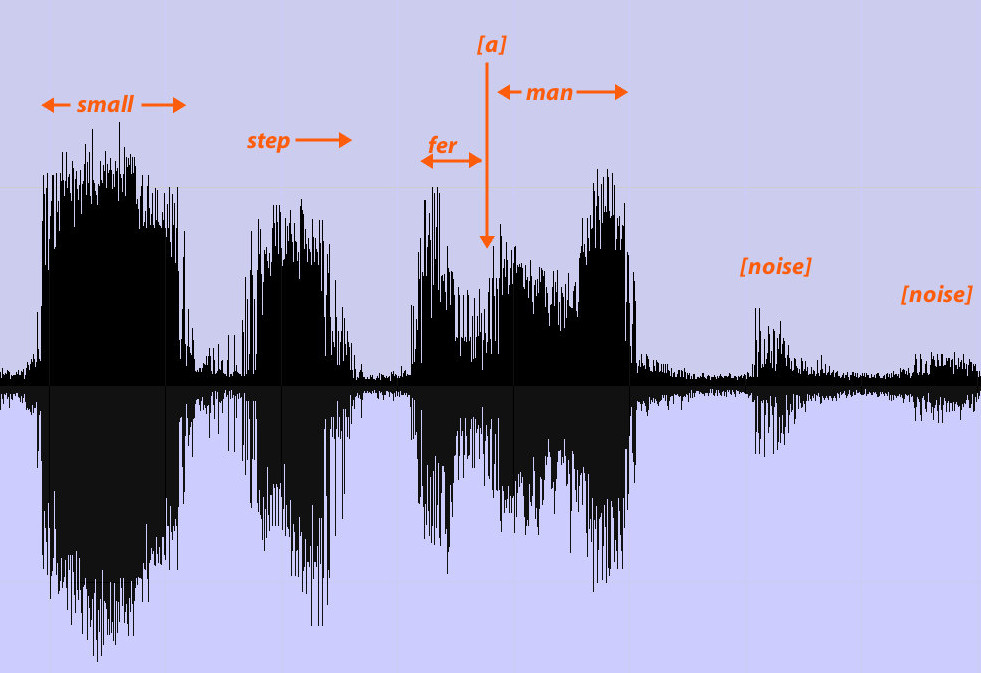
Did Neil Armstrong actually say the “a” in “one small
step for a man”?
Recent media reports (on some analysis by Peter Shann Ford) suggest it has been proven that he did, though
a closer look at the Honeysuckle recording does not support
that conclusion.
See the labelled waveform of the Honeysuckle recording below.
Although earlier I was persuaded that there was room for the ‘a’,
sadly, I am now not convinced. When the slowed-down
recording is heard, the ‘for’ seems to run right up to
‘man’, leaving little or no room for an ‘a’.
Bill Wood, Unified S-band Lead Engineer at Goldstone during
Apollo, suggests that Neil’s vox circuitry may have cut off the
‘a’ at this point. Vox problems certainly were apparent later
in the EVA with Buzz’s microphone, and some of Neil’s words
are clipped at the start.
However, there doesn’t seem to be any
room between ‘for’ and ‘mankind’ for that to have
happened at this point.
With or without the ‘a’, Neil’s words remain among the
most memorable and appropriate ever spoken – even if it is necessary
to supply the ‘a’ from context (which everyone does).
On this diagram, the expected position of the “a”,
if it was spoken, is marked with [a].
Goldstone
was the source of the audio on Net 1 at this point.
The handover from Goldstone to Honeysuckle Creek
took place not long after the astronauts re-entered the Lunar Module. i.e.
Voice communications with the LM was via Goldstone for the entire EVA, but
TV came from Goldstone, Honeysuckle and Parkes.
– Colin Mackellar, October 2006.
Back
to the Apollo 11 Mission main page.