
Apollo 15
26 July – 08 August 1971
 |
Index |
| AS-510/CSM-112/LM-10 J-1 Mission |
NCG 740 |
Originally planned as the last of the simpler “H” missions, with only
two excursions and no vehicular Rover, the cancellation of the last three Apollo
lunar landings made NASA anxious to make the most of the remaining missions,
so the more comprehensive scientific “J” missions were brought forward
to Apollo 15.
The Apollo 13 mishap introduced a convenient delay in the program to help incorporate the hardware changes, as the “J” missions were designed to use the Apollo system capabilities to the limit, and to change the role of the astronauts from test pilots to explorers, preferably scientific explorers.
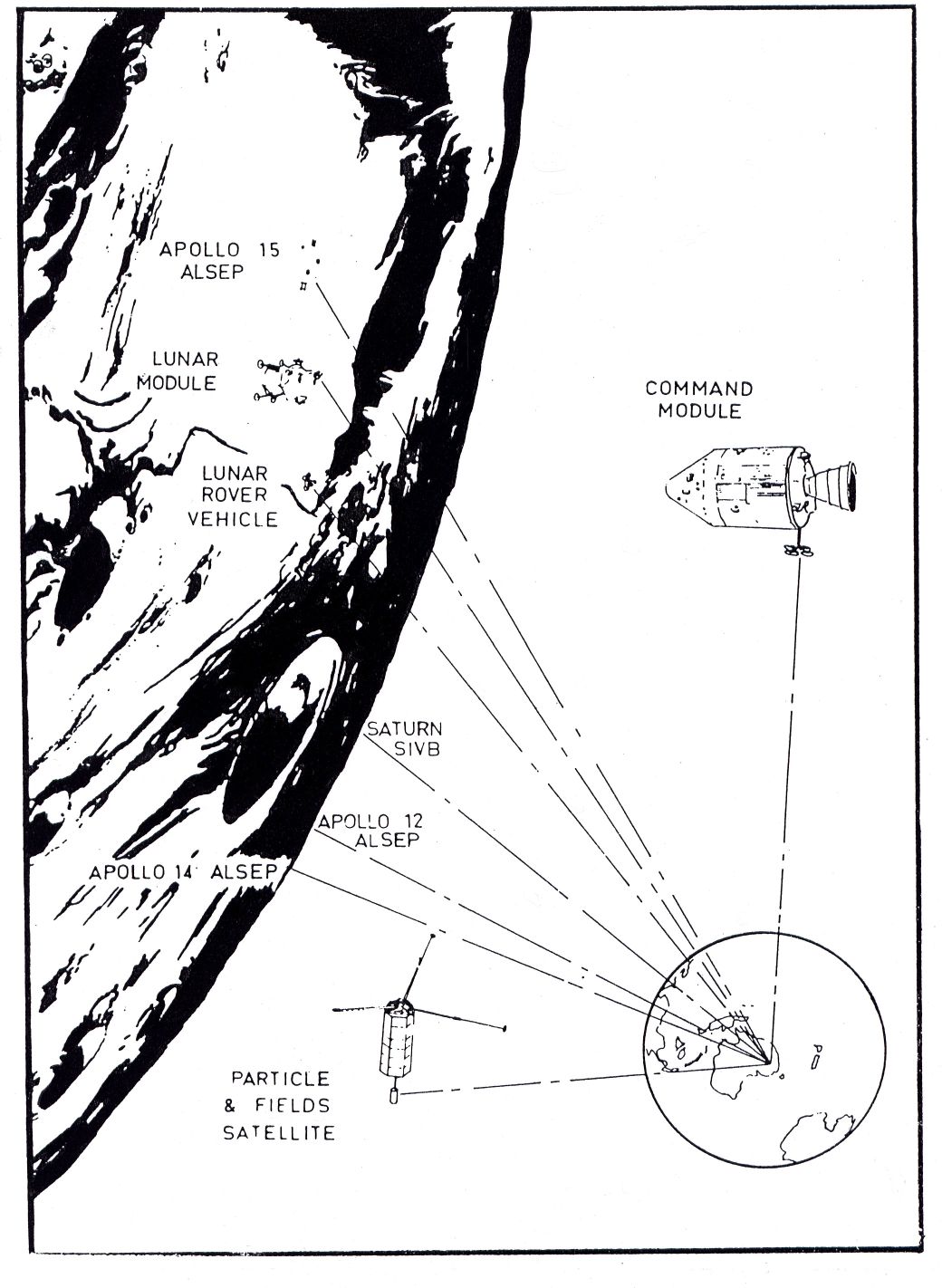
The Saturn V engines had been dramatically improved, allowing an additional payload of 3,175 kilograms. This was needed for the longer stays on the lunar surface; extra fuel for both the CSM and LM, more battery capacity for the LM, and the 209 kilogram weight of the Rover. In addition there was the Particle and Fields Satellite (P&FS), and a heavy SIM (Scientific Instrumentation Module) package built into the Service Module for detailed scientific observations of the Moon from lunar orbit.
Thought had been given to including a remote control for
the Rover so that after the astronauts had left the Moon Houston could have
driven the vehicle around and used the TV to explore the area. For instance,
it could have driven to the bottom of the Rille, but budget limitations meant
it was never funded.
 |
|
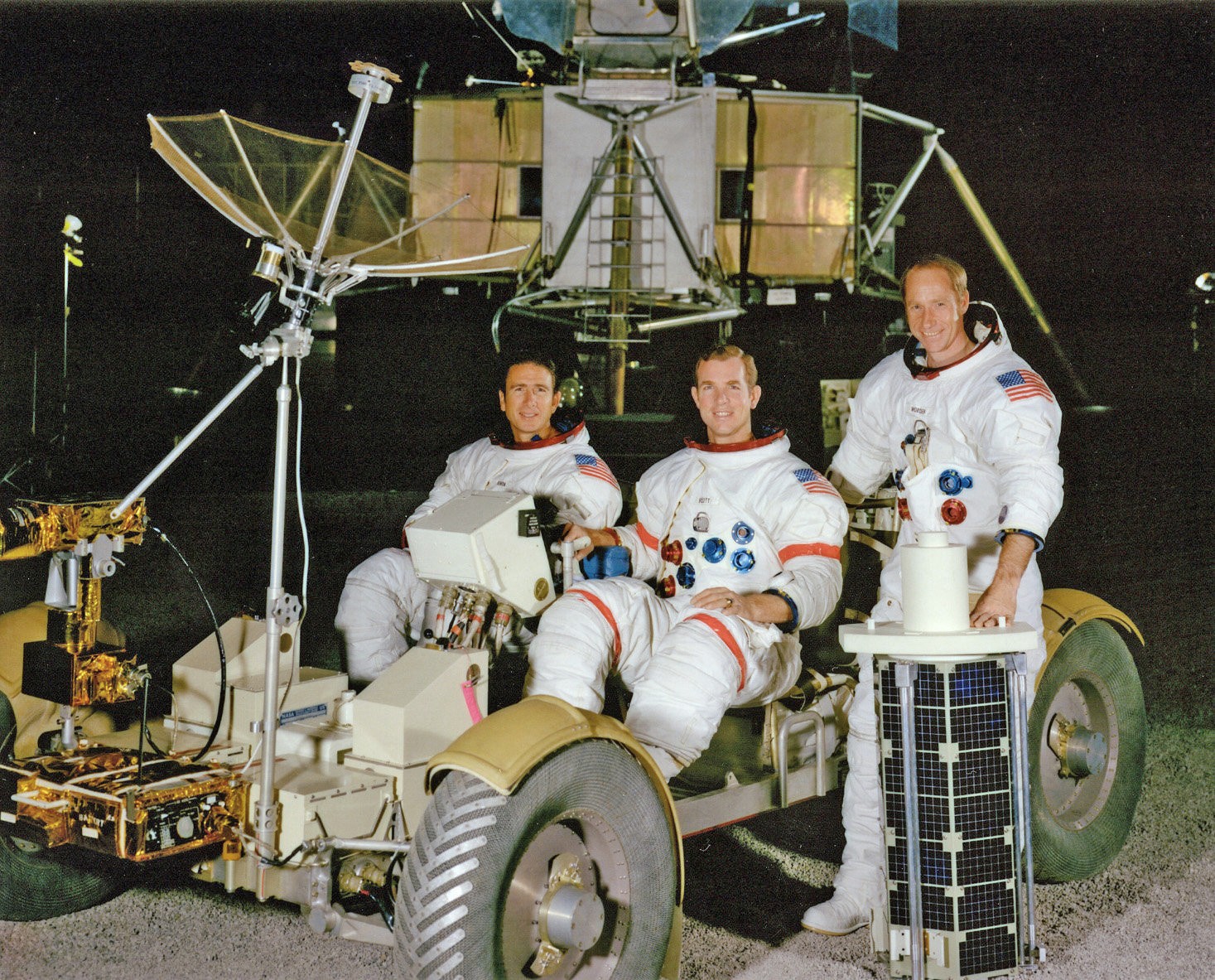
The Apollo 15 crew with the Lunar Rover before their departure for the Moon. |
Apollo Television comes of age with Apollo 15
Apollo television began as an after-thought, in the beginning
some even did not want it at all. The Apollo communications system had been
designed to handle only low-resolution, slow-scan TV fit to into a 500 kHz bandwidth.
In those days it was still black and white commercial television for the public,
and Apollo 11’s first step onto the moon reflected the limitations of the
time, the public glued to the fuzzy monochrome images, trying to figure out
what they were really seeing.
Apollo 12’s television never got off the ground – in the first EVA
the TV camera was inadvertently aimed at the sun and the camera’s SEC sensor
was destroyed. Apollo 13 never reached the Moon’s surface, and Apollo 14’s
television was limited to the landing site and had technical problems too, with
bloomy images of astronauts looking like Casper the Ghost. Except for Apollo
13, after Apollo 11 the commercial television networks coverage to the public
was apathetic, though the world did get to see Al Shepard’s golf swing
at Frau Mauro.
Now Apollo 15 could show what television could really do. It was the first of what NASA called the technically advanced ‘J’ missions where the astronauts could range far from the LM on an electrically driven Rover vehicle, with EVA time doubled to nearly 19 hours. This time there was a newly designed, remotely controlled television camera for the Rover that promised clear pictures of the exploration at each stop. Hooked into the camera was a new unit called the Ground Commanded Television Assembly (GCTA), nicknamed ‘Gotcha’, allowing an operator seated at a console in Houston to control the Rover’s camera on the Moon.
A special package was mounted on the front of the Rover to communicate directly with the Earth tracking stations wherever the Rover was parked. Called the Lunar Communications Relay Unit (LCRU), it was a suitcase-sized box with an umbrella-like antenna, making the Rover a completely independent mobile TV studio. Though the astronauts could not use the dish antenna while driving, they could still talk to Earth through the LCRU using a low-gain unidirectional antenna. However there were times when television pictures were inadvertently transmitted to Earth through the omni antennas while the Rover was bouncing along the lunar surface.
Early on in the development program it was conceded that, even if the camera put out a good quality picture, there was no assurance that the video would retain that quality by the time it reached Houston. NASA and RCA mounted major efforts, quite apart from the camera and communications unit development, to discover elements that might degrade the video along the earth-based links and fix them. It was discovered, for example, that a receiver at one station could cause picture tearing. A particular model of processing amplifier could convert a slightly noisy received signal into very objectionable streaky noise. Certain filter types could cause ringing or ghosting. All of these potential glitches along the communications links were methodically fixed before the mission. Another example of the thoroughness of the Apollo team.
The crew
Deke Slayton picked a crew of aviators for the first scientific mission to the Moon – David Scott, 39, as Commander, Alfred Worden, 39, as Command Module Pilot and Jim Irwin, 41, as Lunar Module Pilot, with backups Richard Gordon, Vance Brand and Harrison Schmitt. The Air Force is in Dave Scott’s blood, his father a retired USAF General, and his wife, Ann Lurton, daughter of a retired USAF Brigadier-General. He had been out to the Carnarvon Tracking Station in June 1965 for Gemini 4 and while he was there went on a geological expedition to the Kennedy Ranges some 320 kilometres inland from Carnarvon. These Ranges are noted for their fossils, gemstones, and petrified wood. With Honeysuckle Creek appointed the Prime Station for the mission there were a lot of connections between Apollo 15 and Australia, especially when Apollo 15 sprang a leak during the mission like Cook’s Endeavour did on the Great Barrier Reef.
 |
 |
|
David Scott |
Jim Irwin |
Colonel David R. Scott, born on Randolph Air Force base in San Antonio, Texas, began studying at the University of Michigan before joining West Point where he graduated in 1954. Later he took a master’s degree in aeronautics and astronautics at MIT. He had already proved his cool in a life-threatening crisis in Gemini VIII with Neil Armstrong when a thruster locked open and sent them spinning out of control and the mission had to be aborted over China. Next he was Command Module Pilot under James McDivitt in Apollo 9.
Irwin and Worden were both rookies.
Lieutenant-Colonel James B. Irwin, born in Pittsburgh, married Mary Ellen, a former photographer’s model. He graduated from the US Naval Academy with a Bachelor of Science degree in Naval Science in 1951and went straight to a commission in the Air Force. In 1957 he completed a Master’s degree in Aeronautical Engineering and Instrumentation from the University of Michigan. In 1961 he wasn’t supposed to walk again after a horrendous plane crash when he suffered two smashed legs, a fractured jaw, and concussion that temporarily wiped out part of his memory. By sheer determination he fought to get his mobility back, to be twice rejected by NASA before finally being accepted as an astronaut in 1966.
 |
|
Al Worden |
Major Alfred M. Worden, born in Jackson, Michigan, graduated from West Point Military Academy with a military science degree in 1955, before he collected a master of science degree in astronautical and aeronautical engineering from the University of Michigan in 1963. He attended Randolph Air Force Base Instrument Pilots Instructor School in 1963 and served as a pilot and armament officer from March 1957 to May 1961 with the 95th Fighter Interceptor Squadron at Andrews Air Force Base, Maryland. He was a happy-go-lucky divorcee who played his baby grand piano for friends, and slept in a bed with a canopy of aluminium reflectors to help get him up in the morning.
With an all Air Force crew it was easy to pick their mascot Falcon
as a name for the LM, but it wasn’t until they were working with a geologist
that Scott happened to pick up a children’s book on explorers that he came
across Captain Cook and his exploits in the Endeavour. He thought, “Cook
made the first purely scientific expedition in history, and ours was the first
extensive scientific expedition to go to the moon,” so the Apollo 15 Command
Module has gone down in history as the Endeavour.
Scientist/Apollo 17 Astronaut Jack Schmitt had enjoyed a long association with
his Professor of Geology and Geochemistry, Leon (Lee) Silver, and when Schmitt
and Scott met it did not take much persuasion to pull Scott and Irwin into the
geology training. Silver became Scott’s mentor, organising at least 16
field trips for the Apollo 15 crew, sandwiched between their already crowded
flight training commitments. Scott admitted that after the enthusiastic Silver
had finished with him, geological terms became part of his natural language.
 |
|
|
Irwin, a good test pilot himself, admired Scott’s abilities
and never competed with his Commander when it came to flying with him. Scott
agrees that his LM pilot was probably one of the few people that could fit in
comfortably with his autocratic style of command. As well as being friends,
they made a good team on the lunar surface.
The geologists were also looking forward to the first lunar mission commander
sympathetic to their cause – Scott’s enthusiasm for geology grew into
almost total commitment – even insisting his wife take a geology course
so she could understand what he was talking about.
The Apollo 15 crew were looking forward to making it the best mission of all, and the first to concentrate on the scientific aspects of the Apollo lunar visits.
The landing site
After proposals from all the working groups involved were sifted through, the Apollo Site Selection Board narrowed the choice of a landing site down to two areas – the Marius Hills with its possible rare volcanic rocks, or Hadley/Apennines, where the steep western scarp of the Apennines faced the basin with vertical sections of rock beds with one of the larger sinuous rilles on the Moon, and a patch of mare to explore and hopefully provide samples of primordial rocks.
At a convention in Houston on 24 September 1970 the rugged Hadley site came out on top. It is situated on the edge of the vast Mare Imbrium, the Sea of Rains, next to one of the Moon’s great mountain ranges, the Apennines rising 4.5 kilometres above the mare. This site was easily the most daring landing so far, promising spectacular scenery, and to the geologists, a chance of finding primordial material. It offered four major types of lunar features; a mare; an alpine range; a deep winding gorge; and a variety of smaller craters and soil types.
Hadley/Apennine looked set to provide a rich harvest for the geologists.
At Honeysuckle Creek
Operations Supervisor at Honeysuckle Creek, John Saxon:
 |
|
|
 |
Our 12-hour shift change-over times varied from 0400–1630 to 0600–1830
during the mission period. I had my usual position of Tracking 1 in the USB
section and drew the night shift under Mike Evenett on the Ops Console.
............................................................................
THE MISSION
In the following tables these official acronyms are used:
| ALSEP | Apollo Lunar Scientific Experiments Package – Equipment left behind by the astronauts to measure physical characteristics of the Moon |
| ACN | Ascension Island Tracking Station in the south east Atlantic Ocean. |
| AOS | Acquisition of signal from the spacecraft (the downlink) |
| Capcom | Capsule Communicator, an astronaut in Mission Control. |
| CRO | Carnarvon Tracking Station, Western Australia |
| CSM | Command and Service Module |
| GDS | Goldstone Tracking Station in California |
| GWM | Guam Tracking Station in the north west Pacific Ocean |
| HSK | Honeysuckle Creek Tracking Station, Canberra |
| HSKX | Tidbinbilla Tracking Station, also called the Wing, Canberra |
| IU | Instrumentation Unit, electronic system part of the Saturn IVB rocket. |
| LCRU | Lunar Communications Relay Unit mounted on the Rover |
| LM | Lunar Module |
| LOS | Loss of the downlink signal of the spacecraft |
| LRV | Lunar Roving Vehicle |
| MAD | Madrid Tracking Station, Spain |
| MESA | Modular Equipment Stowage Assembly, part of the LM |
| P&FS | Particle and Fields Sub Satellite, dropped from the CSM |
| TEC | Trans Earth Coast – the voyage back to Earth |
| TEI | Trans Earth Injection – the rocket motor burn to send Apollo 15 back to Earth. |
| TEX | Texas Tracking Station at Corpus Christi. |
| TLC | Trans Lunar Coast – the voyage out to the Moon. |
| TLI | Trans Lunar Injection – the rocket motor burn to send Apollo 15 off to the Moon. |
All times and dates in tables below are Australian Eastern Standard Time (AEST,
GMT +10), unless otherwise indicated. Change of day is midnight HSK time.
Spacecraft to ground voice exchanges indicated by italics.
| HSK MISSION DAY 1 |
TUESDAY 27 JULY 1971 |
|
| LAUNCH, TLI, AND TLC DAY 1 | ||
| Launch 2334:00.6 Monday 26 July 1971 | GET 0:00:00 | |
| Trans Lunar Injection (TLI) 0230:03 | GET 2:56:03 | |
| CSM separation from Saturn IVB 0256:27 | GET 3:22:27 | |
| CSM docked with LM and Saturn IVB 0307:49 | GET 3:33:49 | |
| CSM/LM separated from Saturn IVB 0352:01 | GET 4:18:01 | |
| Prime HSK |
Track Duration |
|
| CSM/IU | ||
| AOS : 1100:00 | LOS : 2233:00 |
11h 33m 00s |
| Handover IU uplink from GDS : 1504:00 | ||
| Handover IU uplink to Wing for 1 hour of antenna offset practice : 1745:00 | ||
| Handover CSM uplink from Wing : 2128:00 | ||
| Handover CSM uplink to Wing : 2144:00 | ||
| Wing HSKX | ||
| CSM | ||
| AOS : 1102:00 | LOS : 2300:03 |
11h 58m 3s |
| Handover CSM uplink from GDS : 1231:00 | ||
| Handover CSM uplink to Prime: 2128:00 | ||
| Handover IU uplink from Prime : 1745:00 | ||
| Handover IU uplink to CRO : 2134:03 | ||
| Handover CSM uplink from Prime : 2144:00 | ||
| Handover CSM uplink to MAD : 2234:00 |
||
| Parkes | ||
| CSM | ||
| AOS : 1253:00 | LOS : 2057:53 |
8h 4m 53s |
The dark, windowless bedrooms on the third floor in the crew quarters at Cape
Kennedy were silent except for the sound of snoring. Dave Scott, Jim Irwin (the
snorers) and Al Worden were dead to the world. Then suddenly at 0430 local time
(USEDT), the somnific peace was rent asunder as doors were flung open and Deke
Slayton’s gruff voice jolted the sleeping astronauts awake with, “Okay
guys, this is it!”
Reality hit the crew of Apollo 15 when they had to face Dr Jack
Teagen for a medical check before moving along to the dining room for the traditional
breakfast of steak (plus scrambled eggs). With all those relentless hours of
simulations and training behind them they were now really bound for the Moon.
From this moment their every move would be dictated by the clock as they entered
the Clean Room and suited up, followed by three hours of breathing pure oxygen
to expel all the nitrogen out of their blood stream. Irwin had a towel put over
his helmet to dull the light and tried to rest and sleep. They were all tired
from the emotional events and farewells of the days before.
 |
|
At 0630 they set off for the launch area in the Transfer Van. Slayton said goodbye
to them at Launch Control and their suit technicians accompanied them out to
the Launch Umbilical Tower (LUT) where they were whisked 110 metres up to the
White Room enveloping the Command Module at the top of the Saturn V. Scott climbed
in the hatch first followed by Irwin and Worden. Karl Henize, one of the support
crew, helped them settle in and the hatch clanged shut to seal them off from
the world. Now their only communication was through their intercomm headsets.
By 0700, two and a half hours before launch, they were ready.
Outside the weather was fine, with feathery cirrus clouds streaking the sky,
while on the ground the temperature was 29.8°C. A 10 knot south south easterly
breeze ruffled the sparkling waters around the launch pad. It was a perfect
summer’s day.
Launch
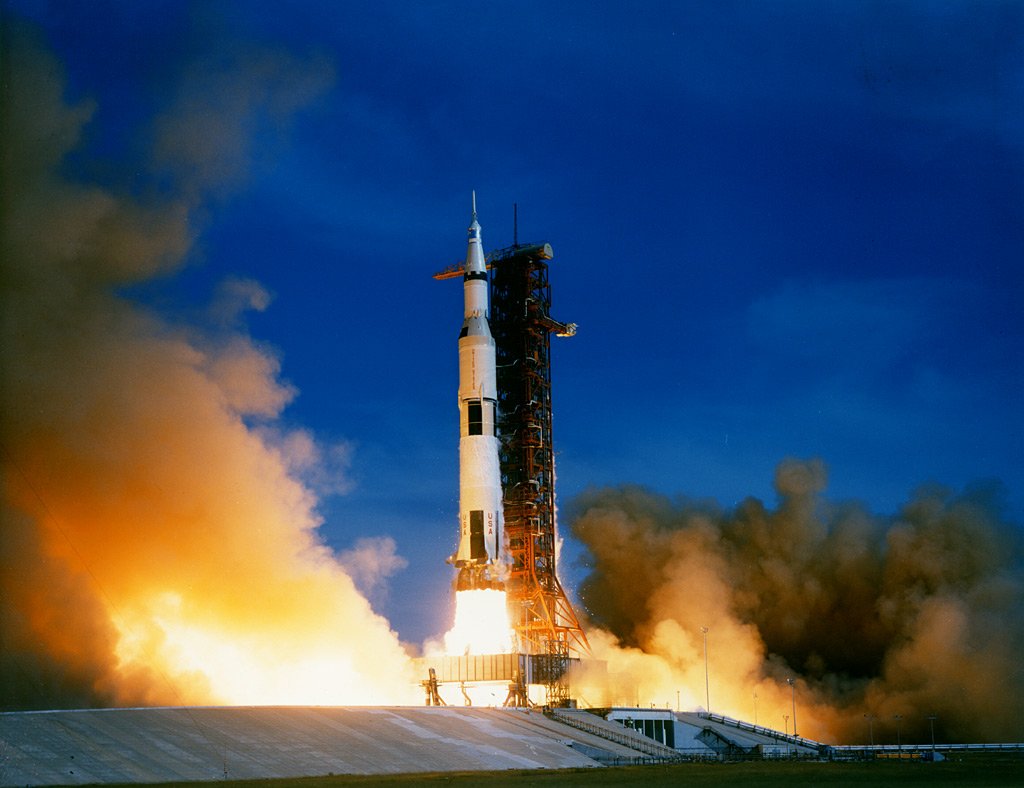
At last the three astronauts heard the word “Ignition”
in their headsets and at 2334 AEST (0934 USEDT) on Monday 26 July 1971 Apollo
15 left Pad 39A, and 11 minutes 44 seconds later entered a 91.5 by 89.6 nautical
mile Earth orbit. As they entered orbit the astronauts had a view of the full
Moon sitting right in the middle of the Command Module’s windows.
 |
|
Apollo 15 Lift-off from Cape Kennedy |
|
At Honeysuckle Creek we never saw either Earth orbit due to a launch azimuth
of 86°.
As usual, Carnarvon saw both, the second going right over the top of the station, and the ‘Go for the Moon’ was passed up through them at 0204 AEST on 27 July.
 |
 |
A 5 minute 56 second TLI burn was executed over Hawaii on time at 0224:02 AEST and Apollo 15 was on its way to the Moon. On the ground at Honeysuckle Creek we didn’t pick up the spacecraft until 8 hours 36 minutes after TLI. By that time the LM extraction manoeuvre had been performed, the Saturn IVB had been cast off, and the Passive Thermal Control (PTC) roll had been initiated.
It was 2300 spacecraft time (1400 AEST) before their day ended, a late night for the astronauts as they had been up since 0530, but before turning in they had to add chlorine to the water to stop bacterial growth, change the lithium hydroxide cartridges to keep the oxygen purified, and put up the metal window shades to block out the sunlight. They found the best way to get a restful sleep was for Worden and Scott to use their own outer couches while Irwin set himself up in a combined sleeping bag/hammock in the space under Scott, which gave them all more elbow room. They each took a turn wearing a headset so that they would be ready for a call from Houston.
We should note here that Carnarvon’s
FPQ6 radar tracked the IU for a record distance of 131,400 kilometres.
| HSK MISSION DAY 2 |
WEDNESDAY 28 JULY 1971 |
|
| TLC DAY 2 | ||
| Prime HSK |
Track Duration |
|
| CSM/IU | ||
| AOS : 1113:00 | LOS : 1130:00 |
17m 00s |
| Break track for IU | ||
| Handover CSM uplink from GDS : 1129:00 | ||
| Handover CSM uplink to Wing : 1134:00 |
||
| IU | ||
| AOS : 1132:00 AEST | LOS : 2300:53 |
11h 28m 53s |
| Handover IU uplink from GDS 1230:00 | ||
| Handover IU uplink to ACN : 2234:01 | ||
| Wing HSKX | ||
| CSM | ||
| AOS : 1105:00 | LOS : 2331:00 |
12h 26m 00s |
| Handover CSM uplink from Prime : 1134:00 | ||
| Handover CSM uplink to MAD : 2304:01 | ||
| Parkes | ||
| CSM | ||
| AOS : 1307:00 | LOS : 2128:00 |
8h 21m 00s |
Life aboard the Apollo spacecraft was different to our routines on Earth, even
for the simple daily chores like eating. First they had to find the meal for
that particular time of that particular day from the stowage map. All the food
containers were labelled A, B, C, D, E, and all meals were colour coded. Scott’s
were red, Irwin’s were blue and Worden’s were white.
Irwin commented, “So if a meal floated by and you identified it as being red, you could say, ’Hey, Dave, you’ve just lost your entree.’”
The meals came in a package the size of a large cereal box with six plastic bags containing the dehydrated food. They used a water gun to mix the packaged food with hot or cold water and had to wait 10 minutes for it to mix. Supplied by a restaurant, the freeze-dried and packed gourmet soups such as lobster bisque, crab, vichyssoise and romaine were the most popular food with the astronauts. Meats such as ham, turkey, and steak were packed in aluminium, but when they opened the packet the gravy slid out in blobs and floated around the cabin. To keep track of things they had Velcro all over the spacecraft and on the meal packages. With no dining table they would stick their dinner on the cabin wall in course order, then after eating they had to log down everything they ate, or didn’t eat, and advise Houston, who kept track of their energy levels.
Bathing was another chore. They dampened a washcloth and cleaned themselves all over as best they could. Only Irwin remembered to take along his own scented soap, “It was the high point of the day just to take out the soap from the container and let the scent waft around the spacecraft. It almost made us feel clean.”
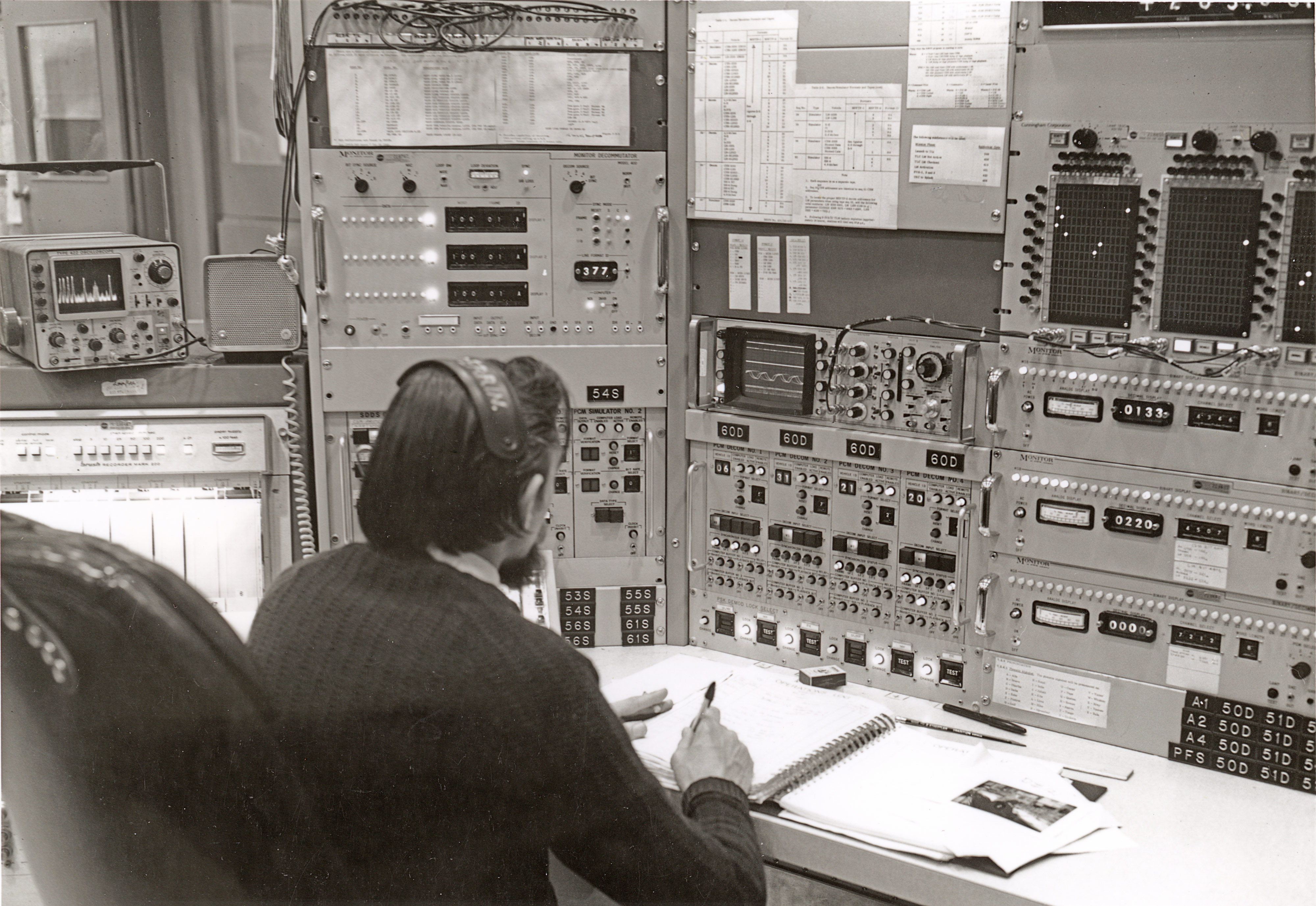 |
Bill Perrin at the telemetry monitoring console during Apollo 15 at 263 hours GET. |
During their evening, at 0930 AEST, Scott and Irwin decided to enter the
LM fifty minutes early to check it out, but when they opened the hatch they
found the cabin had broken bits of glass floating around. It was from the face
of a lunar landing range and range-rate tapemeter. This was dangerous as the
tiny shards of glass could cause damage to the eyes or lungs, but there was
also the worry the tapemeter may have been affected, as it was a critical instrument
for their landing on the lunar surface. A tapemeter is a meter which displays
its reading with a moving length of tape that unreels rather than a pointer
or digital display.
They promptly shut the hatch to stop any particles drifting into the Command Module and switched the LM’s air conditioner on, hoping to draw all the floating pieces to the exhaust screen where they could mop them up with adhesive tape wrapped around their hands. During the checkout good voice and data communications were established through Goldstone, and a successful TV transmission showing views of the Command Module and LM interior was completed.
Later they tried using a vacuum cleaner from the CSM to suck
glass particles from crevices and crannies. At Houston the engineers worked
on the tapemeter to see if its operation had been affected, but it seemed to
be working okay. Scott admitted, “That gave me a warm feeling to know that
they checked the thing out and it would work with a broken outer pane of glass.”
| HSK MISSION DAY 3 |
THURSDAY
29 JULY 1971 |
|
| TLC DAY 3 | ||
| Prime HSK |
Track Duration |
|
| IU | ||
| AOS : 1114:30 AEST | LOS : 1929:45 |
8h 15m 45s |
| Break track for ALSEP | ||
| Handover IU uplink from GDS : 1435:00 | ||
| Handover IU uplink to CRO : 1929:45 | ||
| ALSEP 1 and 3 | ||
| AOS : 1937:00 | LOS : 2251:00 |
3h 14m 00s |
| Break track for IU | ||
| Handover IU uplink to ACN : 2234:01 | ||
| IU | ||
| AOS : 2257:00 | LOS : 2346:30 |
49m 30s |
| Wing HSKX | ||
| CSM | ||
| AOS : 1121:00 | LOS : 2341:00 |
12h 20m 00s |
| Handover CSM uplink from GDS : 1327:00 | ||
| Handover CSM uplink to MAD : 2321:29 | ||
| Parkes | ||
| CSM | ||
| AOS : 1344:00 | LOS : 2138:55 |
7h 54m 55s |
At 0311 AEST the astronauts tried the first scientific experiment of the trip,
the Visual Light Flash Phenomenon by putting shades over the windows and their
eyes and looking for strange orange flashes in their heads reported from earlier
flights. They reported seeing 61 flashes, sometimes all three astronauts would
see the same flash. “They look like flashbulbs popping in a darkened arena,”
commented Scott. They are believed to be high-energy cosmic rays impacting the
eye’s retina, or perhaps the brain’s optical centre. The experiment
was repeated later in the mission.
During the ‘late afternoon,’ at 1734 spacecraft time (0834 AEST),
Scott and Irwin checked out the LM for about two hours, and collected about
60% of the broken glass. Everything checked out to specifications, including
the tapemeter.
Endeavour’s water leak
When Irwin went to chlorinate the water during their ‘evening’ at 1245 AEST he found quite a lot of water had started to weep out of the inlet fitting. Scott saw this as a serious situation – with no water, there would be no equipment cooling, which meant many critical CSM systems would be disabled, jeopardising their return to Earth.
The astronauts tried to explain, water doesn’t drip out in space it just makes a blob, and the blob keeps getting larger and larger. Looking for towels to mop up Irwin found, “Wouldn’t you know, about that time the locker door with all the towels in it jammed!” So while Scott was trying to stem the water flow, Irwin and Worden were trying to open the towel locker. Houston insisted on trying to estimate the flow rate, but soon Henize advised: "Okay, stand by. Lots of people are thinking down here now."
Scott tightened the valve and the flow stopped. "Yeah. All we have to do now is hang out a few towels to dry, but it looks like we’re in good shape,” he announced as they mopped up a litre of water clinging to the valve as a blob.
When they had finished at 1304 AEST there were wet cloths strung all over the lower equipment bay and up into the LM tunnel, reminding the crew of an old fashioned clothesline.
That query eventually ended up with us at Honeysuckle Creek via
Net 2 on 2 August.
While the astronauts were asleep that ‘night’ they crossed the equigravisphere
at 1529:20 AEST to come under the Moon’s gravitational influence. They
were now free falling ever faster down to the Moon.
 |
| HSK MISSION DAY 4 |
FRIDAY 30
JULY 1971 |
|
| END TLC : TLI AND BEGIN LUNAR ORBITS | ||
| SIM cover jettisoned 0140:47 GET 74:06:47 | ||
| Lunar Orbit Insertion (LOI) 0605:46 GET 78:31:46 | ||
| Madrid and Goldstone tracking. | ||
| Saturn IVB/IU impact on lunar surface 0658:42 recorded by ALSEPs 12 and 14. | ||
| Prime HSK |
Track Duration |
|
| CSM | ||
| Orbit 3 AOS : 1103:00 | LOS : 1205:00 |
1h 2m:00s |
| Orbit 4 AOS : 1243:00 | LOS : 1345:00 |
1h 2m 00s |
| Orbit 5 AOS : 1436:25 | LOS : 1539:00 |
1h 2m 35s |
| Orbit 6 AOS : 1630:01 | LOS : 1732:00 |
1h 1m 59s |
| Orbit 7 AOS : 1823:40 | LOS : 1925:30 |
1h 1m 50s |
| Orbit 8 AOS : 2017:00 | LOS : 2123:00 |
1h 6m 00s |
| Orbit 9 AOS : 2211:30 | LOS : 2316:47 |
1h 5m 17s |
| Orbit 10 AOS : 0004:32 (31 July) | LOS : 0030:00 (31 July) Moonset |
25m 28s |
| Total tracking time from first AOS to last LOS 13h 27m 00s | ||
| Wing HSKX | ||
| CSM | ||
| Orbit 3 AOS : 1118:00 | LOS : 1205:00 |
1h 2m 00s |
| Orbit 4 AOS : 1243:00 | LOS : 1345:00 |
1h 2m 00s |
| Orbit 5 AOS : 1436:25 | LOS : 1539:00 |
1h 2m 35s |
| Orbit 6 AOS : 1630:01 | LOS : 1732:00 |
1h 1m 59s |
| Orbit 7 AOS : 1823:40 | LOS : 1925:30 |
1h 1m 50s |
| Orbit 8 AOS : 2017:00 | LOS : 2123:00 |
1h 6m 00s |
| Orbit 9 AOS : 2211:30 | LOS : 2316:47 |
1h 5m 17s |
| Orbit 10 AOS : 0004:32 (31 July) |
LOS : 0022:50 (31 July) |
18m 18s |
|
Uplink transmitted at each acquisition. |
||
| Total tracking time from first AOS of group to last LOS 13h 4m 50s | ||
| Parkes | ||
| CSM | ||
| Orbit 4 AOS : 1319:00 | LOS : 1345:00 |
26m 00s |
| Orbit 5 AOS : 1436:25 | LOS : 1539:00 |
1h 2m 35s |
| Orbit 6 AOS : 1630:01 | LOS : 1732:00 |
1h 1m 59s |
| Orbit 7 AOS : 1823:40 | LOS : 1925:30 |
1h 1m 50s |
| Orbit 8 AOS : 2017:00 | LOS : 2123:00 |
1h 6m 00s |
| Total tracking time from first AOS of group to last LOS 8h 4m 00s | ||
As Apollo 15 approached the Moon, sailing through its shadow, they could see
it as a crescent through the windows of the Command Module. Scott noticed the
dark side of the Moon facing away from the sun was aglow with Earthshine, brighter
than moonlight on Earth. They could easily see the mountains and crater rims
glowing from the reflected light from the Earth.
Lunar Orbit Insertion
They prepared for the LOI burn as the spacecraft coasted across the front of the Moon at a height of 543 kilometres and circled behind, when they lost contact with Goldstone.
After a 6 minute 32 second burn for Lunar Orbit Insertion (LOI) at 0629 AEST, Apollo 15 slowed down to 5,600 kilometres per hour and was safely in orbit around the Moon. All of a sudden they plunged out of the darkness into sunlight and Scott was enraptured by the moonscape 96 kilometres below them. He said, “That first far-side pass is a mindblower – hard to do much but just stare in awe!” With no atmosphere all the features and shadow edges were sharply defined and he couldn’t believe the Moon seemed so big. The first large feature they spotted was Tsiolkovsky Crater gliding past with its light coloured high central peak surrounded by its circular dark ‘sea.’
 |
 |
|
Crater Tsiolkovsky on the far side of the Moon. |
|
It was the sunrises every two hours that impressed Scott the most, as he explains, “First of all these wispy streamers of light from the sun’s corona appeared above the lunar horizon, then the sun simply exploded over the horizon like a visual thunderclap, and within a second we were blinded by its bright light flooding the cabin.”
At 0630:19 AEST Goldstone and Madrid picked up the signal on the other side of the Moon:
Alan Shepard and Pete Conrad were listening to the spacecraft communications as they prepared for a TV interview. Test pilot Shepard growled, “To hell with that shit, give us details of the burn.”
Unable to hear Shepard’s gripe, the crew began to describe
the lurain they were flying over. Due to their higher latitude they were flying
over scenery never seen before by the other missions.
By the time Honeysuckle Creek acquired Apollo 15 in parallel
with Goldstone at 1103 AEST they were in orbit 3. For the next 2 hours the three
astronauts were busy with engineering and experiments as well as bringing the
SIM equipment to life, until they went to sleep at 1334 AEST. The spacecraft
voice channels went quiet during orbits 4 to 8 as the astronauts slept.
Before separation they dropped into a 15 x 72 kilometre orbit.
As they zoomed low over the lunar surface, Irwin realised that there were mountains nearly as high as they were, for instance the Apennines reach almost a quarter of the spacecraft’s altitude so the sensation of speed is heightened by their closeness. “You look out on the horizon and you see these high peaks and you are just skimming along. Now you really know you are moving fast. You are travelling about 5,000 feet per second, that’s Mach 5, or 3,000 miles per hour (4,820 kph). Your orbit is defined; you can’t dodge anything. You don’t have control over the vehicle, and if you did you probably couldn’t react fast enough. You just assume that Houston knows where the mountains are and how high they are. But you see the high mountains on the horizon and you move towards them very fast. You wonder if you are going to clear them.”
At around 0712 AEST the crew prepared for a scheduled 7.7 hour sleep period.
For us, of course, it was 7:12 am of a new day. The Flight Controllers kept an eye on the astronauts and the spacecraft’s systems while the spacecraft was behind the Moon by recording all the data on the Data Storage Equipment (DSE), rewinding the tape, and playing it back it through us each time they reappeared.
We were the only station tracking when Houston woke them up nice
and early at 0615 spacecraft time (2115 AEST) during orbit 8 to pass on flight
plan updates, followed by a TV session of the Moon’s surface from orbit,
including a preview of Hadley Rille and the Apennines.
 |
Hamish Lindsay snapped this Polaroid photo of the Servo area at 10:35pm while Apollo 15 was in lunar orbit 8. |
| HSK MISSION DAY 5 |
SATURDAY
31 JULY 1971 |
|
| LUNAR LANDING AND SEVA (Stand-up EVA) - DAY 1. | ||
| Undocking and separation 0413:16 GET
100:39:16 during CSM orbit 12 Madrid only tracking. |
||
| LM lunar landing 0816:29 GET 104:42:29
during CSM orbit 14 on Palus Putredinus, Lat. 26° 6’ 4” N Long. 3° 39’ 10” E GDS and MAD tracking. |
||
| SEVA 1016:49 GET 106:42:49 End of SEVA,
hatch closed 1049:56 Goldstone only tracking. |
||
| Prime HSK |
Track Duration |
|
| LM | ||
| AOS : 1148:00 | LOS : 0130:00 (1 August) Moonset |
13h 42m 00s |
| Handover LM uplink from GDS : 1204:00 | ||
| Handover LM/LCRU uplink to MAD : 0053:00 (1 August) | ||
| Wing HSKX | ||
| CSM | ||
| Orbit 16 AOS : 1153:00 | LOS : 1251:00 |
58m 00s |
| Orbit 17 AOS : 1336:00 | LOS : 1450:00 |
1h 14m 00s |
| Orbit 18 AOS : 1535:00 | LOS : 1640:00 |
1h 5m 00s |
| Orbit 19 AOS : 1733:00 | LOS : 1840:18 |
1h 7m 18s |
| Orbit 20 AOS : 1931:20 | LOS : 2040:15 |
1h 8m 55s |
| Orbit 21 AOS : 2129:50 | LOS : 2242:00 |
1h 12m 10s |
| Orbit 22 AOS : 2328:00 | LOS : 0040:40 (1 August) Moonset |
1h 12m 00s |
| Total tracking time from first AOS of group to last LOS 12h 47m 40s | ||
| Parkes | ||
| LM | ||
| AOS : 1642:00 | LOS : 1647:39 |
5m 39s |
| AOS : 1841:00 | LOS : 2307:00 |
4h 26m 00s |
| Total tracking time from first AOS to last LOS 6h 25m 00s | ||
At 0134 AEST Scott and Irwin began their transfer to the LM as the CSM began
its eleventh orbit, and spent a complete orbit activating and checking Falcon’s
systems. While out of contact with Earth, at precisely 0348:16 AEST Worden threw
the switch to release the two spacecraft. “I guess the major thing is that
everything was nominal, except when I went to Release on the probe Extend/Release
switch; nothing happened. Nothing!!” said a baffled Worden.
In the LM Scott and Irwin looked at each other; they couldn’t figure out what was wrong. Scott then told Worden to check the LM/CSM umbilical electrical connections to the docking equipment. Within four minutes, in the middle of this crisis, they came from behind the Moon and locked onto Madrid’s signal. Capcom Edgar Mitchell called the spacecraft from across the Atlantic, “Endeavour, Houston. Standing by for a Sep report.”
Scott replied with the unexpected news, “Okay, Houston; this is the Falcon. We didn’t get a Sep, and Al’s been checking the umbilicals down on the probe.”
They had 40 minutes to find the problem before the flight plan would have to be attacked. Houston noticed a temperature reading off-scale high on the probe assembly, which indicated that there was no electrical power to the probe. One reason for this could be the umbilical was either not connected or not firmly plugged in. Worden removed the hatch and re-plugged the connectors – and all the readings in Houston settled back to normal.
 |
|
|
CSM/LM Separation
At 0413 AEST the LM broke away from the CSM, just 13 minutes 56 seconds behind the flight plan scheduled time.
Scott and Irwin flew alongside Endeavour while Worden visually checked the LM was ready for landing with all its legs extended, before returning to a 120.2 by 100.6 kilometre orbit. The LM landing occurred 3 hours 32 minutes before our tracking day began – we were still going through our pre-pass SRT checks when they touched down.
 |
|
|
The landing at Hadley was timed so that the Sun was just 12° above the horizon, giving oblique lighting with lots of shadows and aiding landmark identification during the final phase of the landing itself. Though the Sun was illuminating the mountain peaks around the landing site, it had yet to reach the surface of the plain at Hadley.
The Landing
Scott concentrated hard on bringing Falcon down to the final stages of this tricky landing, a target at the bottom of a basin hemmed in on three sides by mountains, and on the fourth by a deep gorge. At a height of 2,440 metres above the valley surface, they were flying horizontally, feet-first, looking straight up before pitching forward at 1,800 metres to be able to see where they were. Both astronauts were suddenly startled to see the white flank of a mountain sliding past above them out of the left window! It was Mount Hadley Delta soaring up 3,350 metres from the valley. The simulator had never shown them this – was Houston aware how close it was!? What if they had been off course? Scott looked as far forward as he could but still couldn’t see any sign of Hadley Rille: “I looked out the window and could see Mount Hadley Delta. We seemed to be floating across Hadley Delta and my impression at the time was that we were way long because I could see the mountain out the window and we were still probably 10,000 to 11,000 feet (3,048 metres) high. I couldn’t see the Rille out the forward corner of the window, which you could on the simulator – out the left forward corner.”
Mitchell, “Falcon Houston. We expect you may be a little south of the site....maybe.. ....3,000 feet.” This was due to a slight error that had developed in the LM’s flight path.
When Falcon pitched over on time all Scott saw was a featureless plain below them. He was looking for Index Crater, where they were supposed to land,
Falcon landed on the lunar surface with the hardest of the Apollo landings at 2 metres/ second. Scott had by far the heaviest spacecraft to that date with the first Lunar Rover aboard. He was also very quick to switch the engine off, as he wanted to make sure the engine was off before the bell housing, which was longer than the earlier models, could contact the surface. “Okay, Houston. The Falcon is on the Plain at Hadley,” Scott advised Mission Control.
Irwin, “We just froze in position as we waited for the ground to look at all our systems. They had to tell us whether we had a STAY condition.”
As soon as they got the STAY order, the two astronauts pounded each other on the shoulder, celebrating their success, feeling real relief and gratitude, and started powering the LM down.
Falcon had landed at 0816 AEST on 31 July on the edge of Mare Imbrium, which stretched across the surface of the moon for at least 1,050 kilometres to the west. They were 548 metres to the north west of the planned landing spot. The LM had settled down straddled across the rim of a crater with a tilt back of 6.9° and a lean of 8.6° to the south. The descent engine bell had been damaged a bit, probably from pressure build up on landing and the rough lurain underneath.
SEVA – Stand-Up EVA
Two hours later, at 1016 AEST, (Goldstone were tracking, we were still 1 hour and 32 minutes from acquisition of the LM) Scott climbed up on the engine cover, opened the top hatch and gazed out on the lunarscape, the only pre-EVA reconnaissance conducted during the Apollo landings.
With all the simulations and study, plus his own imagination, he wasn’t prepared for the sight he now beheld. With the sun only 13° above the horizon the lofty Apennines to the south were heavily cloaked in shadows, their flanks glowing a pearly gold and brown in the early morning sunlight. Stark white craters scarred the soft beige of the flowing lurain. Scott commented, “Those are very, very big mountains, but they’re all rounded. The striking thing to me was that there are no sharp peaks.”
He tried to make out the footslopes of Hadley Delta and the routes they were to take in the Rover on Sunday and Monday – looking for outsize boulders or small ravines that might block their passage. Dark lines ran around the base of the mountains. Swinging his gaze to the south west he could clearly see St George crater scooped out of the side of Hadley Delta, their goal for tomorrow. He couldn’t make out any features that might prevent their progress. It looked good for excursions in the Rover.
Like a magnet his gaze was drawn up to the blue and white Earth glowing in the impossibly black sky the only colourful object in the whole scene before him. He spent thirty minutes just studying, photographing, and reporting his observations back to Mission Control in Houston. NASA Geophysicist Robin Brett said his descriptions were as good as a professional geologist, many agreeing it was the best geological description by an astronaut on the moon.
Feeling intruders in an eternal wilderness, they closed the hatch after 33 minutes, just before we acquired their signal. After re-pressurising the LM they continued observing the mountain through the window, trying to refine their exact location with Joe Allen in Houston. Nearly an hour later they turned in to sleep. It was an early lunar morning outside, late evening inside the spacecraft, and mid-morning the next day at Honeysuckle Creek. Trying to keep their day/night circadian cycle in synch with their home time zone on Earth, they prepared for a scheduled sleep period before setting out on the first EVA. They were the first astronauts to doff their spacesuits and sleep on the Moon in the comfort of their underwear.
At Honeysuckle Creek we acquired the spacecraft on moonrise at 1148 AEST with the crew just beginning a 7 hour sleep period, getting ready for the big events of the next day. The links were quiet with no TV or voice traffic while we just quietly tracked the LM’s signal from the lunar surface. The Wing was in a continuous cycle of AOS and LOS as the CSM circled the Moon, with Worden beginning a 7 hour sleep period on orbit 18 at 1155 AEST.
EVA 1
After a reasonably restful sleep the two astronauts in the LM began suiting
up at 2147 AEST. Irwin noted that he and Scott had more conversation while helping
each other suiting up than in all the previous couple of days. They had the
hatch open by 2313 AEST, and we picked up live television from the camera in
the MESA 13 minutes later, nicely in time to see Scott finish climbing down
the ladder, followed by Irwin.
Scott announced,
“As I stand out here in the wonders of the unknown at
Hadley, I sort of realise there’s a fundamental truth to our nature...
man must explore, and this is exploration at its greatest.”
 |
 |
 |
 |
 |
 |
 |
 |
|
|
|
 |
Commander David Scott steps onto the lunar surface, as seen on a monitor showing the TV downlink at Honeysuckle Creek. Preserved by Ian Grant, scan by Colin Mackellar. |
When Irwin reached the bottom and put his boot on the LM’s footpad it unexpectedly
spun around, and he had to grip the ladder hard to stop himself from losing
his balance and ignominiously falling down on his back. Mortified at the thought
of tumbling over in front of the TV camera, he recovered, bounced onto the surface,
kicking up a spray of black moondust. Then peering to the south, exclaimed:
"Oh, boy, it’s beautiful out here. It reminds me of Sun Valley."
As Irwin had a special love of the exhilaration and wild remoteness of great mountain ranges on Earth, going right back to his youth, he was looking forward to the first exploration of these Mountains of the Moon. The Apennine Mountains almost looked familiar to him, rounded and treeless. He thought they looked like promising ski slopes.
 |
Lunar Module Pilot Jim Irwin steps onto the lunar surface, as seen on a monitor showing the TV downlink at Honeysuckle Creek. Preserved by Ian Grant, scan by Colin Mackellar. |
After five days of being cooped up in the spacecraft, both astronauts felt the relief and pleasure of being able to move around again, the freedom of room to run in. They felt it was almost like walking on a trampoline, the same bouncy feeling, and falling down was quite different to Earth you seemed to go down in slow motion with only a light impact that they felt would never cause any harm.
At Honeysuckle Creek we crossed our local midnight into Sunday
with the two astronauts setting up the Rover for the first excursion.
| HSK MISSION DAY 6 |
SUNDAY 1
AUGUST 1971 |
|
| LUNAR SURFACE DAY 2 EVA – 1 |
||
|
EVA-1 Start 2313:17 (31 July) GET 119:39:17 Depressurise LM. |
||
| Prime HSK |
Track Duration |
|
| LM | ||
| AOS : 1217:00 | LOS : 0227:30 (2 August) Moonset |
14h 10m 30s |
| Handover LM uplink from GDS :
1654:00 Handover LM/LCRU uplink to MAD : 0204:00 (2 August) |
||
| Wing HSKX | ||
| CSM | ||
| Orbit 28 AOS : 1236:00 | LOS : 1259:00 |
23m 00s |
| Orbit 29 AOS : 1314:00 | LOS : 1421:00 |
1h 7m 00s |
| Orbit 30 AOS : 1512:00 | LOS : 1618:00 |
1h 6m 00s |
| Orbit 31 AOS : 1710:46 | LOS : 1817:00 |
1h 6m 14s |
| Orbit 32 AOS : 1908:51 | LOS : 2021:15 |
1h 12m 24s |
| Orbit 33 AOS : 2111:33 (late) | LOS : 2219:37 |
1h 8m 4s |
| Orbit 34 AOS : 2305:00 |
LOS : 0017:40 |
1h 12m 40s |
| This group of passes continued on 2 August. | ||
| Parkes | ||
| LCRU | ||
| AOS : 0033:00 | LOS : 0130:00 |
57m 00s |
| AOS : 2224:43 | LOS : 0227:30 (2 August) |
4h 2m 47s |
While Scott and Irwin were away Worden was endlessly orbiting the Moon, busy
with a continuous stream of experiments, mainly operating the SIM bay equipment.
To introduce some variety into the monotonous greetings each AOS every two hours, and to show a respect for other cultures, he thought it would be a good idea to use a different language for each “Hello Earth, Greetings from Endeavour.” So he sat down with Farouk El-Baz, a popular geologist working with the Apollo lunar program, and wrote down the phonetics for a number of languages and used them regularly as he appeared from behind the Moon.
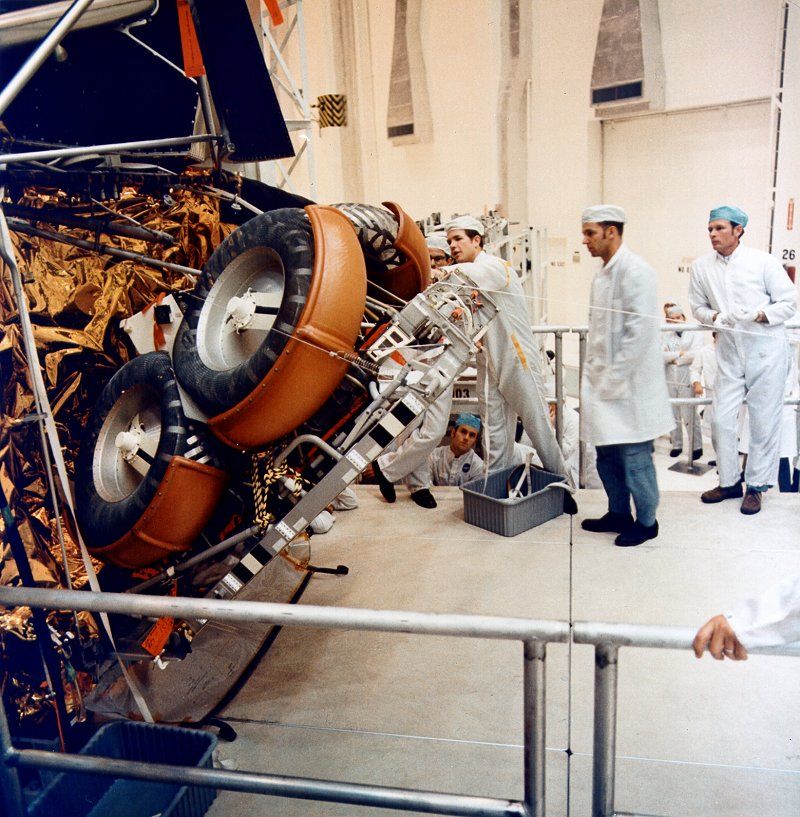
Lunar Rover deployment
Just before our midnight, at 2352 AEST 31 July, the astronauts
tugged the two "D" rings to release the $US40 million lunar rover
and it fell out, assembling itself as it dropped – the chassis folded into
position and the wheels flopped out. The astronauts only had to secure everything
with locking pins and load up to be ready to travel – the assembling operation
only taking 8 minutes.
 |
|
The Apollo 15 Rover being fitted to the LM. |
 |
|
Dave Scott inspecting the mounting assembly. |
After running through the checklist, Irwin stood by with the 16mm movie camera
while Scott put the Rover through its paces with a display of his driving skills.
The camera jammed so there are no movies of the first trials of the Rover, those
had to wait for Apollo 16. There was also a slight hitch with the Rover’s
steering, “I don’t have any front steering, Joe.” called
Scott. After cycling the front steering switches a few times, "Still
no forward steering, Joe." After physically trying to turn the wheels,
they gave up, and initialised and calibrated the Rover’s navigation system
before departing for the Elbow Crater excursion.
Luckily the front wheels were locked in the straight-ahead position.
 |
|
The Apollo 15 traverses with Stations numbered. A pre-mission NASA diagram anotated by Hamish Lindsay. |
The First Rover Excursion
As they set off for the first run at 0119 AEST, Scott said, “Okay,
Jim, here we go.”
Irwin, “Okay, Dave. We want a heading of 203.”
Scott, “Okay, 203.”
Unfortunately for us at Honeysuckle Creek the Moon sank below
our horizon at 0130 AEST just as Scott and Irwin were setting out. We only saw
12 minutes of the first excursion, so we missed all the excitement and spectacular
scenery of St George Crater. All the action was now going on through Madrid
as our equipment fell silent and the TV screens went blank. We then had to listen
to the rest of the excursion’s progress on Net 1 as we went through the
post pass procedures, feeling a bit left out, especially with no TV.
As the explorers headed south west Scott relayed his experiences:
Although the Rover only travelled at around 11 kilometres per hour, the two astronauts found they often became airborne as it flew over the lurain with a pitching motion rather like a cross between a boat in a lumpy sea and riding a horse. One of the fears had been that as the Rover sped across the surface it would vanish into a cloud of dust thick enough to block the astronauts’ view to see anything. Luckily this didn’t happen, the wheel fenders doing their job as designed. Scott noticed their wheels cut chevron-patterned tracks to a consistent depth of about 2 centimetres in the lunar soil.
Getting to sit on the Rover seat in a stiff pressure suit from the lurain was not so easy. The astronauts found they had to stand facing forward, then with an upward and sideways kick, jump up with their legs and arms stretched out ahead to hopefully land in the middle of their seat. Although a chore strapping them on, both astronauts were glad to be wearing seat belts as the vehicle rolled through hummocky craters and bounced over small boulders and fragments scattered along the way. With the one sixth g they often felt themselves floating in their seats, only held down by their seat belts. Scott frequently called out “Hang on” as the Rover hurdled yet another obstruction. The Rover’s suspension system reacted more slowly in the weaker lunar gravity, emphasising the wavy ride. Scott found they had to keep up a good speed to meet the planned activity schedules.
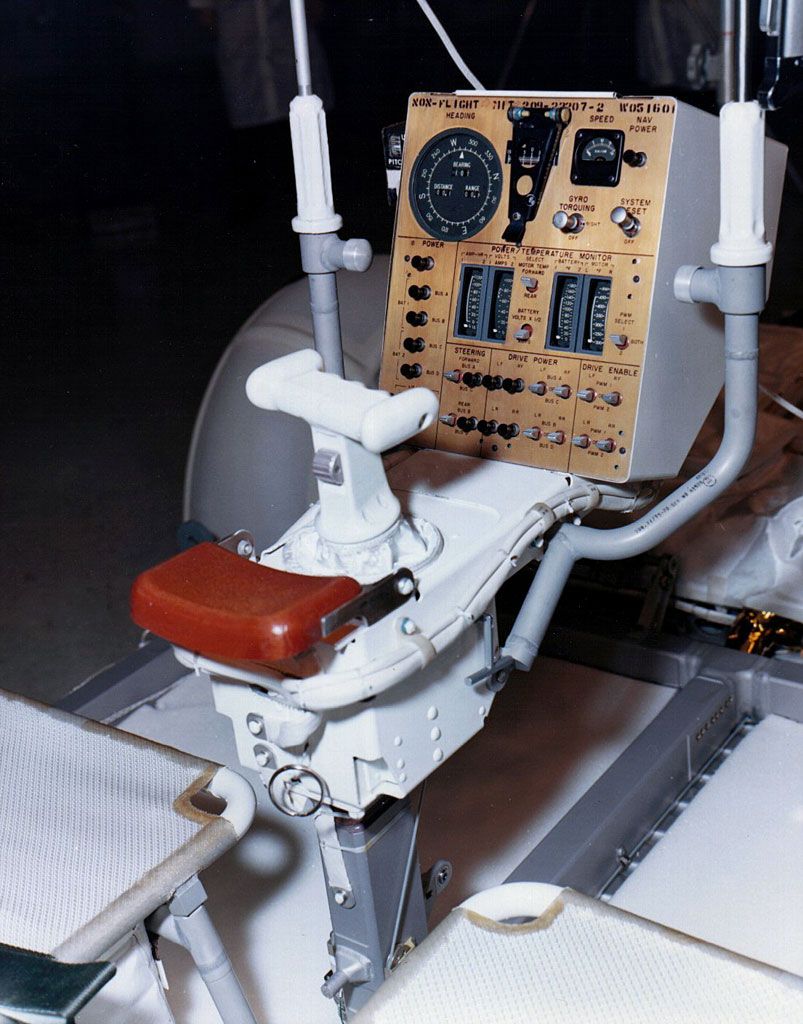
As Scott was the driver, sitting in the left seat, holding a “T” bar in his right hand, tilted slightly towards him to lessen fatigue. The bar gave full control of the Rover pulled to the left turns all four wheels for a left turn, right for right turn, pushing forward drives the vehicle forward, and pulling back can stop it in its own length. A switch on the base puts the Rover in reverse, with speed controlled by pulling the T bar back. As it didn’t have a rear view mirror, the astronauts sometimes preferred to just pick it up to turn it around as it only weighed 36 kilograms on the moon.
Power was provided by a 1/4 horsepower dc electric motor with a 80:1 reduction gear on each wheel, supplied by two 36 volt batteries with silver zinc plates in potassium hydroxide with the capacity to last twice the planned distances.
 |
|
The Rover’s driving stick and instrument panel. |
Though the Rover had quite sophisticated navigation facilities, in the beginning
they had some trouble locating their position, partly because they weren’t
sure of the exact location of the LM. Also, their photographic maps did not
always translate into what they could see around them.
By now the sun had risen to 20° above the horizon, and the
shadows were shortening. Apart from learning to drive the Rover on its first
outing, Scott wrestled with trying to keep the speed up, avoid obstructions
in their path, and absorb the spectacular scenery – all at the same time.
He found it was difficult to take his eyes off where they were going, even for
a second, so Irwin called the instrument readings. Because of all these distractions
Scott felt they were travelling much faster than 10 kilometres per hour, “I
think we could motor right on through the craters. The fresh ones with all the
debris we might have gone around.” As they breasted a rise they were suddenly
confronted with a deep crater, and Scott had to swing hard left, turning the
Rover on two wheels. They both feared it might flip over, pinning them underneath,
but thankfully it bounced back on its wheels.
Hadley Rille
They raced on to arrive at the edge of the chasm and turned to follow it southwards, steering a course of 165°, heading for Elbow Crater. Scott found it was smoother driving along a ridge about 80 metres back and parallel with the Rille edge. Looking ahead they could make out Elbow Crater – though it looked quite close, when they drove there they found it was still a good distance away. On the Moon they were finding everything appeared closer than it really is.
Scott scanned the lower slopes of Mount Hadley Delta, “Yeah, we’re in good shape. We can see Elbow, and we can see the Front all the way down to the Spur (Crater). And, there’s not a big block on it.”
On their right the lurain sloped down 360 metres to the bottom of the Rille on their side, but on the opposite side, about 1.6 kilometres away, it fell with steep cliffs, strewn with boulders.
Irwin was much more cautious – he felt he could not face the furore if they lost the Rover on the bottom of the Rille. If Scott wanted to go, Irwin wasn’t going to go with him, so he firmly said, “I’m sure we could drive down; I don’t think we could drive back out.”
Elbow Crater
They arrived at the southern lip of Elbow Crater to stop at Station 1 at 0144 AEST for samples, and to relay information back to a group of geologists in the Science Operations Room across the hall from Mission Control. At this point they had travelled 4.5 kilometres and were 3.2 kilometres from the LM.
The television was the sharpest yet seen from the Moon and the
geologists were living every moment of the astronauts’ experiences. The
TV camera on the Rover followed their every move, controlled by Captain Video,
Ed Fendell, sitting at his console in Mission Control.
 |
 |
 |
 |
|
The Rover was proving its worth – there they were, quickly and effortlessly
over 3 kilometres from the LM with plenty of consumables still to go and not
at all tired. Unable to resist sneaking glances at the spectacular views around
him while he worked, Scott raised his hammer on a knee-high boulder to chip
a piece off it before rolling it over and taking samples from under it.
Exuberantly he relayed his feelings to the gang at Houston, “Yeah, man! I wish we could just sit down and play with the rocks for a while. Look at these things! They’re shiny! And sparkly! ............. Look at all these babies here; gosh, man!”
After 12 minutes at Elbow they proceeded up the slopes of Mount Hadley Delta for another eleven minutes, climbing steeply, much more steeply than expected, towards St George Crater, the Rover slowing down to 7 kilometres per hour.
Looking back down the valley they were surprised at how high they had climbed, and were awestruck by the stark, stupendous scenery spread out before them. It was a panoramic moonscape with Hadley Rille winding away from their feet to disappear into the foot of Mount Hadley in the distance. The Rill’s eastern walls were veiled in deep shadows, while parts of the floor and western cliffs glowed in the early morning sunlight. From above, the featureless jet-black sky reached down to the horizon. Behind them, the lurain sloped up to the deep basin of St George Crater, though the crater itself was out of sight from their angle.
They couldn’t see the LM, but checking their instrument panel they found it was bearing 17° at a distance of 3.9 kilometres and the speedometer reading was 5.5 kilometres. They climbed down from the Rover to sink into a soft powdery dust. It was the first time any astronauts had experienced trying to walk through such a steep, deep powder and they found the going tough. They were both soon breathing heavily from the exertion.
They set up the TV before inspecting the metre-sized rock. It
appeared to be breccia on top of crystalline rock, with lots of vesicles, or
imprints of gas bubbles, and coated with glass beads. As his boss wielded the
geologist’s hammer, Irwin dug shallow trenches and collected samples and
fragments for his bag.
 |
|
Irwin’s trench. |
In the end St George did not provide the hoped-for key to the mountains –
there didn’t seem to be an ejecta blanket, rocks were rare and samples
turned out to be breccias (fragments of older material formed into a coarse-grained
rock) that contained more mare basalt than terra rock. They did not continue
on to the big St George Crater, named after the bottle of Nuits-St-Georges that
was drunk on the way to the Moon in Jules Verne’s epic, From the Earth
to the Moon.
With time running out and their limited consumables, Houston decided to drop
Station 3 due to these constraints and the less than enthusiastic observations
of the area by the astronauts.
They jumped on board the Rover for the trip back home at 0302 AEST. On the way back while still near Elbow Crater they unexpectedly spun around 180° and stopped facing back uphill. It happened so quickly there wasn’t time to do anything about it. The astronauts were so taken by surprise they laughed uproariously.
By the time they were back passing Station 1 they could see the LM again. It was comforting to see their home base and the vehicle waiting to take them back to Earth. It was the first time any lunar astronauts had been out of sight of the LM.
As they were driving along Scott spotted a piece of basalt that
looked different to anything around it and decided to pick it up for the collection.
It was sitting out there, all by itself with no other fragments around. Very
vesicular; very black and rounded. Scott felt, “That one, I could not pass
up. It was just too different.” Knowing Houston would not agree to their
stopping to pick it up, they pretended they were having trouble with their seatbelts,
when in actual fact Scott had stopped the Rover to pick up the sample. It was
a scoriaceous basalt with lots and lots of vesicles, or bubbles, and
was nicknamed the ‘seatbelt basalt.’
By the time they arrived back at the LM at 0333 AEST they had been away for
2 hours 15 minutes and driven a distance of 10.3 kilometres.
Setting out ALSEP and drilling cores
While Irwin set out the ALSEP science experiments 125 metres west north west of the LM, Scott reeled out the heat probe cables and began to drill two holes for them and a 3 metre deep core sample. He was soon in trouble. With the first hole the drill bit jammed about 170 centimetres into the surface when Scott felt he had hit hard rock. Although he wasn’t aware of it at the time, the drill flutes were clogging due to a faulty design and the whole drill simply jammed tight in the hole. With time running away, Houston decided the hole was deep enough and told Scott to insert the heat probe. Scott then extracted the drill bit using a vice, and began on the second hole, but again the drill bit jammed at the same depth. Already six hours into the EVA, there was only thirty minutes of Scott’s oxygen left. Houston decided to leave the remaining drilling for tomorrow.
Meanwhile, with only minor troubles, Irwin had finished setting out the ALSEP equipment, and had it up and running by 0452 AEST, when the first signals were received by Madrid.
The two astronauts drove the Rover back to the LM a tired Irwin
clambered up the ladder to load the lunar samples into the spacecraft. When
Houston told him to rest, Scott wanted to use his time left, so Houston suggested
he set up the solar wind experiment, scheduled to be done by Irwin the next
day.
 |
|
This is the last picture Scott took at the end of EVA-1. |
Calling to Irwin to talk him through the procedure from inside the spacecraft,
Scott set about assembling the equipment about 15 metres from the LM. After
pushing the mounting pole into the lurain without any trouble, he joined Irwin
in the LM and re-pressurised the cabin at 0546 AEST.
Once they were all inside, they found the cabin of the LM became covered with graphite-like dust from the suits and samples. Once settled down the two astronauts discussed with Joe Allen the situation with the drilling and their exact location for almost two hours. After the first day’s activities both astronauts were totally exhausted, both suffering unbearable pain in their fingers from working with the gloves that had to be physically held closed against the internal pressure. With fingernails a little too long, the constant pressure on the fingertips separated the nails from the quick and made their hands excruciatingly painful. Harrison Schmitt from Apollo 17 likened it to squeezing a tennis ball repetitively for nine hours. Irwin cut his nails right back, but Scott elected to suffer the pain. Some of his fingernails turned black before they returned to Earth.
When they took their gloves off the perspiration poured out, showing they had lost a lot of body fluid with their hard work. Irwin had been unable to get to his suit drink waterbag to release its contents, so never managed a drink during the whole excursion. He felt very tired and was suffering a raging headache from the day’s exertions and lack of fluids, “We really guzzled down the water that night. I had been seven hours without a drink and sweating like a jogger.”
At Honeysuckle Creek we began our pass for the day when the Moon
rose during our lunchtime at 1217 AEST with the astronauts asleep in the LM
until they were woken up at 1730 AEST and after an eat period began to prepare
for the day’s excursion. The first task given by Houston was to go find
a suspected leak as the LM had lost 11 kilograms of water since the day before.
Capcom Charles Fullerton suggested it might be behind the ascent engine cover
because of the angle of the LM. They found 11 litres of water so they scooped
it into some lithium hydroxide containers and threw them out the hatch.
 |
|
The layout of the Apollo 15 ALSEP. NASA diagram enhanced by Hamish Lindsay. |
The Second EVA
Three and a half hours after waking up and an hour after depressurisation, at 2244 AEST they were on their way for the second excursion, heading to station 4. To his surprise Scott found that after toggling the forward steering switches again, this time it worked, and the front steering was now fully operational.
It took Scott a while to adapt to the four wheel steering, it seemed too sensitive, especially going down hill, so he decided to go to front wheel steering only. But when he found that the rear wheels were drifting rather than tracking properly, he configured the Rover back to four-wheel steering, finding it could do amazingly tight turns. He soon got used to the four-wheel steering with practice.
The first excursion had shown that the scientists and geologists gathered in the back room at Houston were able to share the astronaut’s experiences through the remote controlled camera and voice communications for the first time. Though they couldn’t actually touch or study the minerals and rocks, they could see what the astronauts were doing and ask questions or offer advice in real time. The television was a great success.
The Second Rover Excursion
During the second EVA the sun had climbed to an angle of 34° above the horizon as the Rover took the two astronauts on a fairly rough 5 kilometre trip south (at an average azimuth bearing of 160°) across the plains, skirting Index, Salyut, Earthlight, Domingo and Dune Craters through Station 4 without stopping. As they drove along Irwin gave a commentary of what he was seeing. Usually he left it to his Commander to talk, but Scott had suggested he describe the sights to the scientists as they drove along, as he had to concentrate on driving the Rover.
In Houston, Capcom Joe Allen was the intermediary connecting the astronauts on the Moon with the scientists in the back room and the flight control team – he was the astronaut’s voice from the Moon, and the scientist’s and flight controller’s voice to the astronauts from Earth. As he had been on the support team and had been on all their training exercises, Scott had specifically asked for him to be the Capcom during their EVAs due to their relationship and his intimate understanding of their geological and technical tasks.
To help the scientists communicate with the astronauts Allen
had a television screen for written messages or questions from the scientists
as the excursions progressed.
 |
|
Dr Joe Allen at the Capcom position during the second EVA, holding a photograph of the Hadley/Apennine site. |
Irwin was very impressed with the tracking station communications
and commented, “Communications between us and Dr Joseph Allen, our Capsule
Communicator during the EVAs on the lunar surface were so clear that it was
hard to believe we were really on the Moon. It was as if ‘Little Joe’
was sitting on one of those mountains talking to us. This seemed to bring us
closer to home. Actually the radio signal (S-Band) suffered minimal loss going
through space. It was sent from Honeysuckle Creek, Australia, our prime station.”
Approaching Mount Hadley Delta the lurain smoothed out and they could see odd
craters splattered on the slopes of the mountain. At the base the craters thinned
out and there were less rocks lying on the surface, probably because they were
buried by Talus (rock debris collected at the base of a cliff by erosion of
material from above) tumbling down. It seemed that rocks are rare on the lower
slopes of lunar mountains. After 26 minutes of concentrated driving and dodging
obstacles, Scott found it tiring, and stopped for a two minute break.
Then the Rover carried them comfortably a kilometre up a steep slope that would have been a killer on foot, then they turned to the east and followed the contour of the mountain to pass Front Crater (Station 5), to stop at the most eastern point of their wanderings at Station 6. On the way there was little of interest, except Spur Crater and a large boulder on a steep slope above it.
Arriving at Station 6 at 2328 AEST, they found the thick dust
made walking hard for the astronauts, it was like walking on the slope of a
sand dune. The effort soon had them panting for breath.
 |
| Taken at Station 6 this picture shows the soft powdery dust the astronauts’ boots had to flounder through, while, just above, the Rover’s wheels rode comfortably over the top. |
They explored around for an hour and five minutes, picking up various types
of breccia samples. On the lurain they all looked the same as they were covered
in lunar dust. Scott looked up at Mount Hadley Delta rearing up above him and
remarked: “Boy, that’s a big mountain when you’re down here
looking up, isn’t it? My oh my! That’s as big a mountain as I ever
looked up.” There’s nowhere on Earth you can stand directly below
a 3,350 metre high mountain, while most of the high mountains have thick forests
blocking any views.
 |
|
Taken by Scott, this is an excellent picture looking northwards to show the view across the valley from Station 6. In the foreground, 2 kilometres away is Dune Crater in the South Complex, which they visited not long after. |
| HSK MISSION DAY 7 |
MONDAY 2
AUGUST 1971 |
|
| LUNAR SURFACE DAY 3 EVA – 2 AND 3 |
||
|
EVA-2 Start 2148:48 (1 August) GET 142:14:48 |
||
| Prime HSK |
Track Duration |
|
| LM | ||
| AOS : 1306:00 AEST | LOS : 0325:48 (3 August) |
14h 19m 48s |
| LCRU | ||
| AOS : 0033:00 | LOS : 0130:00 |
57m 00s |
| AOS : 2224:43 | LOS : 0227:30 |
4h 2m 47s |
| LCRU | ||
| AOS : 1907:50 | LOS : 0325:48 (3 August) |
8h 18m 48s |
|
Total tracking time from first AOS to last LOS 14h 19m 48s |
||
| Wing HSKX | ||
| CSM Group of passes continued from 1 August. |
||
| Orbit 35 AOS : 0103:00 | LOS : 0215:47 Moonset |
1h 12m 47s |
| Total tracking time from first AOS of group to last LOS 13h 01m 47s | ||
| Orbit 41 AOS : 1312:00 | LOS : 1423:25 |
1h 11m 25s |
| Orbit 42 AOS : 1445:37 | LOS : 1557:00 |
1h 11m 23s |
| Orbit 43 AOS : 1647:10 | LOS : 1758:38 |
1h 11m 28s |
| Orbit 44 AOS : 1846:20 | LOS : 1957:45 |
1h 11m 25s |
| Orbit 45 AOS : 2044:43 | LOS : 2156:07 |
1h 11m 24s |
| Orbit 46 AOS : 2248:10 | LOS : 2359:30 |
1h 11m 20s |
| This group of passes continued on 3 August. | ||
| Parkes | ||
| LM | ||
| AOS : 1525:00 | LOS : 0104:00 (3 August) |
9h 39m 00s |
| LCRU | ||
| AOS : 1907:50 | LOS : 0104:00 (3 August) Into antenna limits |
5h 56m 10s |
| Total tracking time from first AOS to last LOS 9h 39m 00s | ||
Finding little of geological interest and with no variety at Station 6, at 0031
AEST Joe Allen called them, “We’ll ask you to move back towards
the west, towards the large block you saw there, which we think is near Spur
Crater, and drive towards the fresh crater that you’ve described to us.”
Scott, “Okay, Joe.”
Obediently they turned back and on a bearing of 278° headed for the boulder they had spotted before, lying about 200 metres above Spur Crater.
A Green Boulder!!?
They arrived at the boulder (Station 6a) 3 minutes later. Scott parked the Rover about 15 metres west and uphill from the boulder. The rock was about a metre high, a metre wide, and about three metres long. Although it was partially buried and had obviously been sitting there for millions of years, it was easy to imagine the rock sliding down on them or their little car due to the steep 15° slope. Because of the slope and the soft powdery soil they both had difficulty getting out of the Rover.
Irwin looked down towards the boulder and grunted: "Gonna
be a bear to get back up here, y’ know!"
"Hey, troops," warned Allen, "I’m not sure you
should go downslope very far, if at all, from the Rover."
"No, it’s not far. Let me try it, Jim, you just stay there,"
replied Scott as he set off for the boulder, floundering through the soft
powdery lurain, feeling it crumbling downhill under his boots. He soon stopped
and decided it would be better to bring the Rover down to the boulder. He told
Irwin to wait while he drove it down very gingerly to park beside the eastern
side of the boulder. Scott was being ultra careful because at this stage nobody
had experience of the Rover’s performance on the Moon’s steep powdery
slopes.
Irwin joined him and they began to scout around for samples. Then without warning, the Rover began to slide downhill in the powdery dust, one wheel rearing up in the air. Scott leapt to grab it, conscious that it was a 5 kilometre walk back in their suits if they lost their vehicle. Their broadcast conversation hardly explained their antics.
Scott was getting ready to move on to Spur Crater, trying to figure out how they were going to get back onto the Rover’s seats, but stopped dead when he heard Irwin mention green. “You’re thinking about plagioclase and breccias and basalt and all that sort of stuff. And, all of a sudden, you find green, something that nobody had ever talked about.” Irwin took over holding the Rover while Scott inspected the rock.
Looking closely at the boulder Scott found it was green, perhaps
more a light grey. It was a big boulder of breccia, so he scraped off the crust
material with his tongs and prised a chip off for the sample bag. He then collected
some fragments and soil around it, hoping they would still be green when they
got back to Earth. They were bright green glass beads formed as the soil was
compressed by meteorite impact, later to add an important clue about the interior
of the moon.
 |
Spur Crater and the Genesis Rock
After about six minutes he worked his way back to their vehicle and managed to jump on the Rover first go. Not feeling as confident, Irwin offered to walk the 250 metres down to Spur Crater, Station 7, but changed his mind when Scott drove to a small crater with a flat spot for him to jump on.
They drove north north west down the slope to Spur Crater to park on its lower rim and ground their boots into more green-tinted soil at 0100 AEST. The Rover’s odometer showed they had driven 7.3 kilometres so far. Scott spent a few minutes trying to align the high-gain antenna to Earth and we received good TV at 0105 AEST. He found the best way to align the antenna was maximising the AGC (Automatic Gain Control) indication on the receiver, rather than trying to optically line the dish up with the Earth.
They foraged around for about 15 minutes when Irwin’s attention was drawn to an unusual rock, perched on a pedestal of breccia by itself, “I saw white, I saw light green, and I saw brown. But there was one piece of white rock that looked different from any of the others.” They worked their way across to it, picking up samples and taking photographs, before they stood in front of it. About the size of a clenched fist, it looked very impressive, sitting proudly by itself almost free of regolith dust. They had gone from volcanic rock to green glass beads and now they had found a crystalline igneous rock – a whole new domain. As Scott’s gloves scratched the ancient dust off, large white crystals sparkled at him – there was no doubt about what they had found. Here was a rock made up of 99% mineral plagioclase; and it was very different in character from the breccias and mare basalts that they had collected so far.
 |
|
|
Dubbed “the Genesis Rock” by a journalist following the excursion in Houston, they were looking at the oldest piece of rock yet found by the Apollo missions. They had been trained to look for the oldest piece of rock, hopefully a pristine piece of the original crust of the Moon, a material called anorthosite, and in the second excursion they had already found some. Back on Earth, this 269 gram rock, a piece of the original lunar crust, was dated at 4.15 billion years. As a comparison the oldest rock ever found on Earth so far is 3.3 billion years, so the youngest rock on the Moon is as old as the oldest rock on Earth. This Apollo 15 record went when Apollo 17 found the oldest chunk of Moon at 4.5 billion years.
They went on to find crystalline rocks from the deep lunar crust
and the only pieces larger than 25 grams of the Imbrium basin melt-rich ejecta.
As Scott put it, this crater turned out to be a geological gold mine.
From Spur Crater – about 60 metres higher than the LM, bearing 349°
and 4.7 kilometres to the south of it – they could just see sunlight glinting
off its gold foil. In the foreground was Dune Crater and the Southern Cluster.
On their left the Rille wriggled off into the distance towards Mount Hadley.
Dune Crater and back to the LM
After almost 50 minutes in Spur Crater the duo reluctantly pushed on 1.7 kilometres to Station 4 and Dune Crater, where they joined up with their outgoing tracks. They arrived at Dune Crater, the western-most crater of the Southern Group, at 0203 AEST. Due to the short stop the TV wasn’t switched on so we had to rely on vocal descriptions for this station. They took 17 minutes to collect more samples and take photographs.
From time to time during the drive, Scott and Irwin could see the LM out in front of them and were pleased to note that, with the nose of the Rover pointed at the LM, the bearing and heading indicators agreed precisely. It seemed they could rely on the navigation system of the Rover. While they were rolling along the scientists at Houston were watching the ALSEP’s sensitive seismometer recording the vibrations made by the Rover’s wheels, all the way out to the furthest point at Station 6. Neither of the astronauts felt comfortable judging distance yet. Without familiar objects to help them – trees, telephone poles, houses, and the like – and the clear vision with no atmosphere, it was almost impossible to judge sizes and distances.
Seven minutes after they set off for the LM from Dune Crater at Honeysuckle Creek the Moon dropped into the trees on the ridge of the western horizon. At 0227 AEST we lost the link with the Rover and Irwin’s chatty descriptions, and had to listen to Net 1 to hear the mission’s progress as we went through our post pass procedures. This time, though, we had seen all the action on the excursion.
It took them 22 minutes 25 seconds to reach their campsite at the LM. The excursion ended at 0242 AEST, 3 hours 58 minutes and 12.5 kilometres after they had set off for Mount Hadley Delta. Under Houston’s instructions the two astronauts split, with Irwin working on taking photographs around the LM followed by the Station 8 assignment, and Scott to continue drilling.
At 1351 AEST a message was verballed to us by Network on Net
2 that Scott had called down and asked if Cook’s original Endeavour
had had any leaks while in Australian waters. Could we help? Laurie Turner
in the Telemetry section looked up the information and the results were written
and edited by Len Litherland and read over Net 2 by Mike Evenett
from the Ops Console. The story was then uplinked to the astronauts by the Capcom
later in the day, and again on Wednesday.
 |
|
Hamish Lindsay took this classic photo of the station tracking Apollo 15 on Wednesday 4th August 1971. (See other photos further below.) |
That evening at Honeysuckle Creek I went out to get some fresh air after my
dinner. I walked outside to the grassy slope beside the antenna and joined a
group of kangaroos feeding on Bill Shaw’s lush green grass. They
took no notice of me, just kept on chewing at the grass. Apart from the whine
of the servos driving the antenna it was the quiet of evening.
I looked up at the Moon, shining brightly in the dark blue sky behind the antenna. The sun had set, but its afterglow was still brightening the western horizon.
Then I looked through the USB window into the television monitor and could see the astronauts Scott and Irwin with the Rover on the Moon’s surface and I thought how lucky I was. Here I was at the cutting edge of human endeavour, in the peace of the Australian bush with kangaroos cropping the grass beside me – not in a clamorous city.
Up there I could see the familiar Moon, but with all my tracking experiences I still found it hard to believe there were people actually walking around on it. I could confirm this by turning to my right to see the astronauts loping around the lunar surface on their second EVA. Inside the building, isolated from the natural world outside, surrounded by technology represented by the consoles and racks of electronic equipment, it was quite believable.
It was a special moment for reflection.
LM Site activities
Scott drove out to the ALSEP site and set up the TV at 0258 AEST before reluctantly tackling the unfinished drilling exercise. He managed to drill a second heat flow hole and ram the heat probes in before starting the deep core sample hole. The pain from his bruised fingers forced him to stand back and take short spells a number of times, shaking his arms to relieve the pressure. When he reached bedrock he tried to extract the drill but after a few centimetres it jammed tight. Houston again decided to postpone further work on the drilling.
At 0308 AEST Irwin joined Scott at the ALSEP site and skipped about taking more photographs, but this pleasant occupation was interrupted by Joe Allen in Houston calling him, “.....we’ve decided it’s about time you start on your Station 8 trench, if you would, please.”
With an obvious lack of enthusiasm Irwin agreed, “Thanks a lot.”
At 0322 Scott took a break from drilling and selected a piece of virgin ground for the trench. Irwin turned to his task of digging a trench for an analysis of the lunar surface, “If you think digging a ditch is dog’s work on Earth, try digging a ditch on the Moon,” he declared. With the sun rising ever higher above the horizon the temperature of the soil was getting very hot, approaching 50°C. He began to dig like a dog, bending forward, spreading his legs, and shovelling the dirt backwards between them, “I solved a dog’s job with a dog’s technique,” he grinned.
First he broke through a fine dark grey material like talcum
powder that got coarser as he dug down. It was very cohesive, the sides didn’t
crumble as he expected. He came across black and white fragments, as well as
beads of black glass. At 30 centimetres he struck a hardpan layer that he just
couldn’t dig through, which explained Scott’s difficulty with drilling.
He found the depth of the soil on the surface varied from a few centimetres
to 20 centimetres, the surface most likely pulverised to a consistent powder
by endless meteorites slamming into the surface over billions of years. He found
digging the required trench was easier than he thought it was going to be, only
taking 6 minutes to do the task.
Houston interrupted the proceedings, “Dave, we’ve got a lot of
time, we’re going to deploy the flag now, and need the TV, please.”
So they set up the TV for the flag setting ceremony. Irwin had already taken
the flag from the MESA and had it waiting nearby for the call from Houston.
Scott and Irwin didn’t want to stop working, they just wanted
to stop being interrupted by Houston for a while. They continued to work, talking
to each other until they heard Joe Allen in Houston request, “Jim, at
your leisure we’d like you to deploy the American flag please.”
It only took Irwin a couple of sentences to summarise the ceremony at 0427
AEST, “We picked a spot with Mount Hadley Delta well placed in the background
and I pushed the staff in and hit it a couple of times so it’ll stay up
for a few million years. Dave and I salute the flag – it’s beautiful.”
Unable to find a colour film magazine in time the flag ceremony
was only photographed in black and white.
 |
 |
They finished their work and climbed back in the LM and out of
their suits, before having a chat with their mate, ‘Alfredo’ Worden,
as he passed overhead in the CSM, on orbit 38 around 0730 AEST. Only Madrid
was tracking – the Moon was out of sight of both Goldstone and Honeysuckle
Creek.
As they were running 1 hour 50 minutes behind schedule with the
lift-off time set in stone for the next day, Houston was keen that the astronauts
have their proper rest, so told them, “We have a hard limit down here
of 7 hours from the time you crawl into the hammocks until the time we can figure
on your arising to start activities tomorrow. Do you understand?”
The crew had a break of almost 14 hours in the LM. After the talk with Worden
and preparing for the next day, the crew drifted off into sleep around 0850
AEST and had 6 hours 45 minutes of sleep before being woken by Capcom Charles
Fullerton at 1535 AEST. We had already acquired the LM’s signal at 1306
AEST when the Moon rose above our horizon during their sleep period.
The two astronauts were back on the lurain at 0406 am their time, 1906 AEST. Parkes and Honeysuckle Creek locked onto the Rover’s LCRU signal at 1907 AEST with a signal level of –125db. Houston decided the first job was to have another go at that drill core.
“We’re going to ask you, Jim, to help Dave with the core removal,” requested Joe Allen from Houston.
“Good,” said Scott, “That shouldn’t take him more than half an hour. I might just let him do the whole thing – he needs some experience.”
After a bitter struggle with the stubborn sample drill core Scott finally said, “I don’t think it’s worth doing, Jim. We’re not going to get it out.”
“Dave,” responded a now determined Irwin, “We’re going to do this. We’re going to get this drill out.”
Down in the Houston back room geologist Lee Silver was mentally urging them on, as that core was important to the geologists, in fact he was thinking that if they failed to extract the drill it would be regarded as an Apollo Program failure. Scott and Irwin both put their shoulders under the drill and once they got into synch, with a tremendous heave, it suddenly broke out, nearly throwing them off their feet and badly bruising Scott’s shoulder. Then they had trouble unscrewing the 3 metre long core into manageable lengths, Scott became more and more impatient as he saw the day’s Rover excursion under increasing threat as their time ran out. Mission Controllers also began to fret at the delay.
Due to a faulty vice Scott was unable to break the core samples
into its component pieces and ended up having to leave it in a three-part section
and a two-part section, to be collected on the way back. This core was the most
valuable sample returned from the Moon, containing 58 distinct layers of soil,
the deepest samples measuring half a billion years, a detailed record of a very
complex sequence of local impact events that had occurred in the mare.
 |
|
A picture of Scott’s agony. He is leaning to his right to pick up the recalcitrant drill. Image AS15-87-11847. |
The Third Rover Excursion
With the shortage of time due to the drill coring problems, the
third Rover excursion was drastically reduced to just visit the rim of the Rille
west of the LM, scrubbing the visit to the North Complex of craters. Scott hated
giving up these craters, as one of them was over 760 metres diameter, and deep
enough to have brought up very ancient material. The sun was now quite high
at 41° and its heat was beginning to be felt within the suits, outside the
soil temperature rising to 70°C.
Setting out from the ALSEP site at 2022 AEST Scott and Irwin thought it would
be a straightforward drive of 2 kilometres out to Hadley Rille’s edge,
but as they began to cross the plain they ran into three deep but extended depressions.
Wary of losing their bearings crossing the 60 metre deep depressions, Scott
detoured around them, until they approached the Rille’s edge. The two astronauts
noticed a small white crater that turned out to be the youngest ever visited,
just a million years old. They then arrived at Station 9 on the western edge
of the Rille at 2035 AEST.
Standing on the shoulder of the Rille, Irwin announced, “Boy, on the far side of the Rille there, Dave, I sure see layering, over at 1 o’clock.” From the eastern rim they could see across the kilometre wide chasm to the higher western edge and spotted outcropping ledges of 60 metre thick mare-basalt layers. To the south they could see more layering, indicating the Rille was probably a lava tube or drainage channel. Looking down, the astronaut/geologists were aware the surface they were standing on sloped down to the edge of the Rille, marked by an increasing number of light grey boulders. The bottom of the Rille was 400 metres below them. Parking the Rover at a safe distance from the edge, Scott and Irwin took pictures, sampled boulders, raked the soil near the Rover for a collection of small rocks, bagged soil samples, and drove two short core tubes into the ground. They darted about to collect over a hundred assorted pieces of basaltic rock, including a big 9.6 kilogram rock that became known as ‘Great Scott.’ These Rille rocks are the only exposed non-crater material seen by any Apollo mission.
Once they finished describing and photographing the far wall, they moved down to the boulders. Scott was quite confident that these were bedrock boulders, and the scientists in Houston were so interested in them that they readily agreed to drop a more conventional mare sampling site scheduled for the trip back to the LM to further explore this site.
The walls of the Rille gave a perspective into the underlying
structure of the landing site and the structure of the regolith, typically about
5 metres thick, thinning to bedrock and boulders at the last 25 metres to the
edge of the Rille.
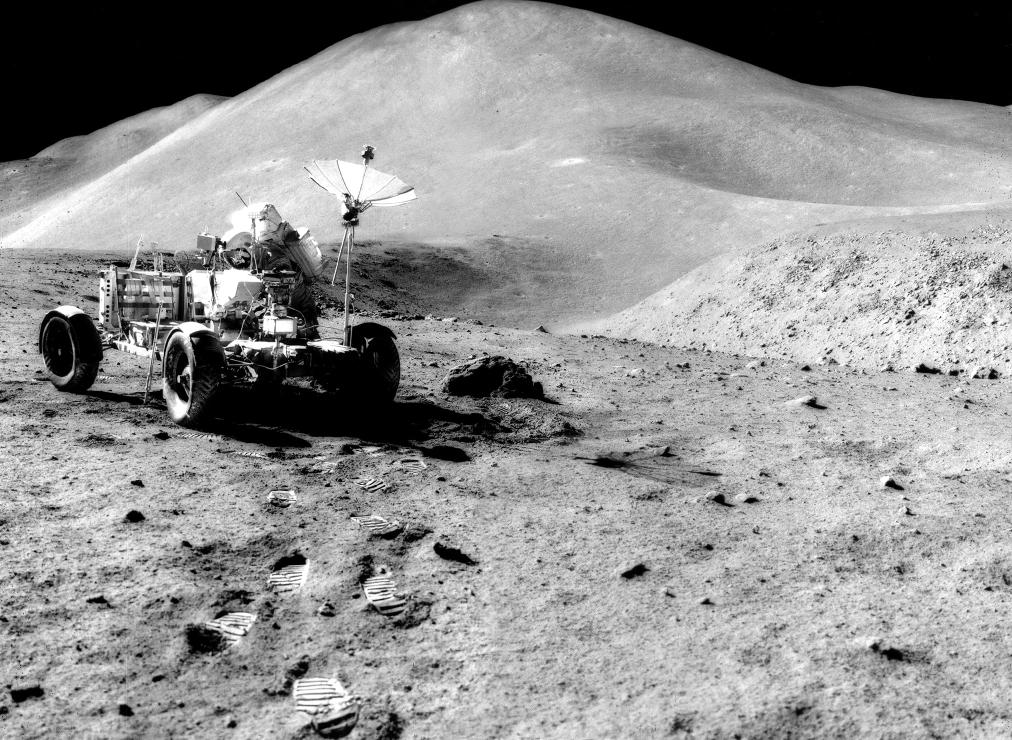 |
|
Dave Scott getting a camera from the Rover at Station 9. Behind him is Mount Hadley Delta with the large St George Crater on the right flank. On the centre right Trophy Point juts into the elbow of Hadley Rille facing Elbow Crater, the white patch on the opposite rim of the Rille just under the dish antenna. This view is looking back at the first day’s excursion route. |
After 15 minutes of intensive exploration the duo headed north about 200 metres
to photograph the far wall for making stereo pictures. At 2050 AEST our Ops
people logged they were surprised to find Scott and Irwin were driving with
the TV still on.
It was now only 5 hours to their departure time and there was still a lot to be done, so after 15 minutes of exploring they headed back to the LM, bypassing the planned visit to the North Complex of craters. Driving back both astronauts are impressed by the now bright sunlit slopes of the Apennines. Irwin found the sun was really getting hot, “......as we drove back I got the impact of the sun again; it was really fierce.” They were also aware the LM was not always visible due to the undulating lurain they were traversing.
They arrived at the ALSEP site at 2217 AEST. After collecting the drill core samples and taking more photographs at the ALSEP site they drove into the LM parking lot at 2220 AEST.
The third and last excursion by the Rover had lasted for 2 hours 41 minutes covering a distance of 5.1 kilometres.
| During Apollo 15 EVA 3, Neil Sandford took these Polaroid photos of the spectra of various configurations – they give a hint of the complexity of the USB downlink. |
 |
LM PLSS – Honeysuckle |
 |
LCRU Downlink PLSS – Honeysuckle |
 |
LCRU Downlink PLSS – incoming from Parkes |
At 2257 AEST, Scott cancelled a postage stamp using a standard stamp and ink pad, and demonstrated their “Galileo Experiment”; that all objects, whatever their weight, fall to the ground at the same speed in a vacuum. The original theory is actually attributed to Flemish mathematician Simon Stevin (1548–1620), not Galileo.
In front of a television camera, Scott demonstrated this theory by dropping a falcon feather from an Air Force mascot, and a hammer.
 |
They hit
the lunar dust together in 1.3 seconds. The feather was lost when Irwin inadvertently
trampled it into the dust, and he speculated on what sort of creature future
explorers would imagine it would belong to.
This mission was the first time a camera could video the LM lifting off. Everyone
was excited at the prospect of actually seeing the LM launch into space. Scott
and Irwin parked the Rover about 90 metres east of the LM and checked the camera
was looking at the spacecraft. Unfortunately during the EVA’s the camera
had developed a clutch problem in the tilt axis, suspected to be from excessive
heat, and the Flight Controllers deemed it too risky to try and tilt the camera
up during lift-off to follow the ascent stage, so for Apollo 15 the camera was
left fixed looking at the LM.
After a last look around Scott leaned a small red Bible on the Rover’s control panel, and next to the Rover placed a small plaque bearing fourteen names of astronauts and cosmonauts who died in the line of duty. He then gently dropped an aluminium figure to represent a fallen astronaut in front of it.
The two astronauts then climbed into the LM and prepared for
take-off. All the gear had to be stored away and the trash bags thrown out.
The rocks had to be weighed, and the precious core samples that had caused so
much anxiety were capped, taped together, and carefully placed on the floor
at the back of the LM.
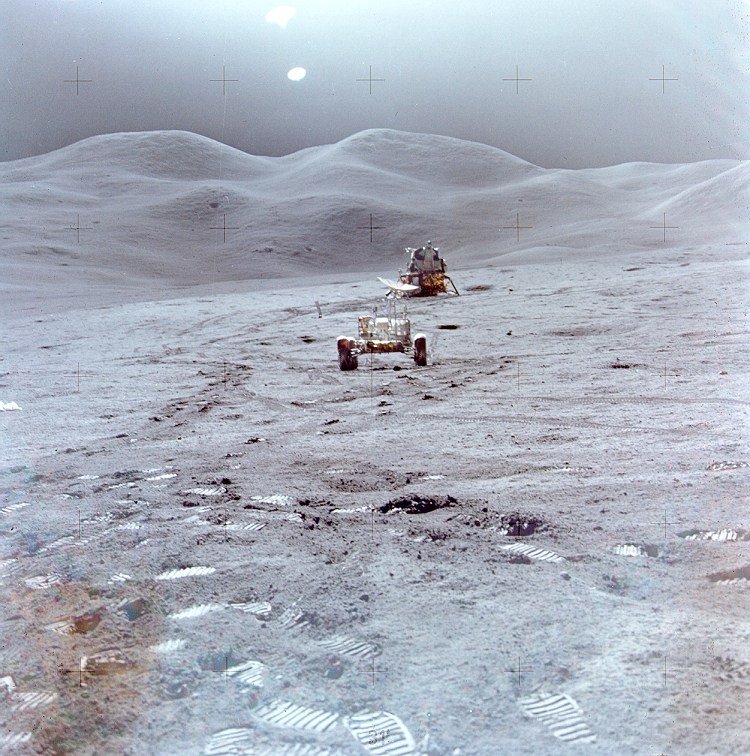 |
|
Irwin took this picture of the ‘Falcon’ and the Rover, with the Swann Hills in the background. |
We were the only station tracking at 2305 AEST when Capcom Karl
Henize finished our day off with a message to Al Worden on his 46th orbit:
Then our local analog clocks passed through midnight and we crossed
into Tuesday 3 August. For us, hidden away in the darkness of the Australian
bush, we felt we had earned another cup of coffee to keep on the ball through
the small hours.
 |
|
Paul Mullen, servo technician (left), reaches for another styrofoam cup for coffee, while Mike Linney, telemetry operator fills his for another fix of caffeine during the Apollo 15 mission. As you can see, we were expected to drink lots of tea and coffee to keep awake and alert during the night shifts. Photo: Hamish Lindsay. |
| HSK MISSION DAY 8 |
TUESDAY
3 AUGUST 1971 |
|
| LUNAR LIFT-OFF | ||
|
LM Lift off 0311:23 GET 171:37:23 during CSM orbit 48 CSM/LM docking 0510:25 GET 173:36:25 during CSM orbit 49 LM jettison at 1104:01 GET 179:30:01 (2h 9m 16s late) LM impact at 1303:37 recorded by ALSEPs 12, 14, and 15 |
||
| Wing HSKX |
Track Duration |
|
| CSM | ||
| This group of passes continued from 2 August. | ||
| Orbit 47 AOS : 0039:52 | LOS : 0151:17 |
1h 11m 25s |
| Orbit 48 AOS : 0238:00 | LOS : 0314:00 Moon set |
0h 36m 00s |
| Total tracking time from first AOS of group
to last LOS 14h 2m 00s Acquired CSM 2-way : 0238:00 Handover CSM uplink to MAD : 0309:00 (at 0.1° off HSKX antenna dead limits!) |
||
|
|
||
| Prime HSK and Wing HSKX | ||
| CSM | ||
| Orbit 54 AOS : 1426:00 | LOS : 1533:00 |
1h 7m 00s |
| Orbit 55 AOS : 1624:00 | LOS : 1732:25 |
1h 8m 25s |
| Orbit 56 AOS : 1822:30 | LOS : 1930:56 |
1h 8m 26s |
| Orbit 57 AOS : 2020:40 | LOS : 2127:30 |
1h 6m 50s |
| Orbit 58 AOS : 2219:03 | LOS : 2326:45 |
1h 7m 42s |
| This group of passes continued on 4 August. | ||
| Parkes | ||
| LCRU | ||
| AOS : 1540:00 | LOS : 1549:19 |
9m 19s |
| CSM | ||
| Orbit 55 AOS : 1624:00 | LOS : 1732:25 |
1h 8m 25s |
| Orbit 56 AOS : 1822:30 | LOS : 1930:56 |
1h 8m 26s |
| Orbit 57 AOS : 2020:40 | LOS : 2127:30 |
1h 6m 50s |
| Orbit 58 AOS : 2219:03 | LOS : 2326:45 |
1h 7m 42s |
| Orbit 59 AOS : 0017:25 (4 August) | LOS : 0130:17 (4 August) |
1h 12m 52s |
| Total tracking time from first AOS of group to last LOS 9h 50m 17s | ||
Lunar launch
Later, in the early hours of our morning at 0311AEST, Falcon blasted the launch area with hot gases and amazed everyone how quickly it vanished instantly out of the top of the picture, accompanied by an unexpected rousing version of the Air Force song “Off we go, into the wild blue yonder....” on our Net 1. The source of the music caused some consternation on the ground until it was located to be coming from the CSM down link. Scott had organised Worden in the CSM to switch their tape recorder on at the moment of lift off.
At Honeysuckle Creek we just saw lift off and Ed von Renouard got his series of pictures of the fast disappearing LM before the Moon sank below our horizon at 0325 AEST.
 |
Ed von Renouard snapped this photo of Falcon leaving the lunar surface – from his TV monitor in the Telemetry section at Honeysuckle Creek. Photo by Ed von Renouard, scan by Colin Mackellar. |
 |
Falcon’s descent stage sits abandoned on lunar surface – TV as seen at Honeysuckle Creek. Photo by Ed von Renouard, scan by Colin Mackellar. |
In the LM, as soon as they were weightless, all the lunar dust and particles
rose up and filled the cabin. They were glad they had their pressure suits and
helmets on to protect their eyes from the dust, remaining bits of broken glass
from the tapemeter, and other crud that circled around.
Meanwhile, in Endeavour, Worden had to get ready for the Falcon’s
return by altering the plane of his orbit. While his mates were away, the rotation
of the Moon had taken him away from the landing site so he had to initiate an
18 second burn to bring him back in line so they could follow the direct ascent
trajectory to meet in one orbit.
Rendezvous
It wasn’t long after insertion into lunar orbit before Falcon’s
radar located the CSM. At a distance of 70 kilometres they could see Endeavour’s
tracking light flashing away in the darkness. When Falcon crossed
the terminator and burst into sunlight Scott and Irwin could see the CSM getting
closer until they were station keeping at a distance of 30 metres. They took
photographs of each other before going in for docking at 0510 AEST and Worden
greeted them with a warm, “Welcome Home.”
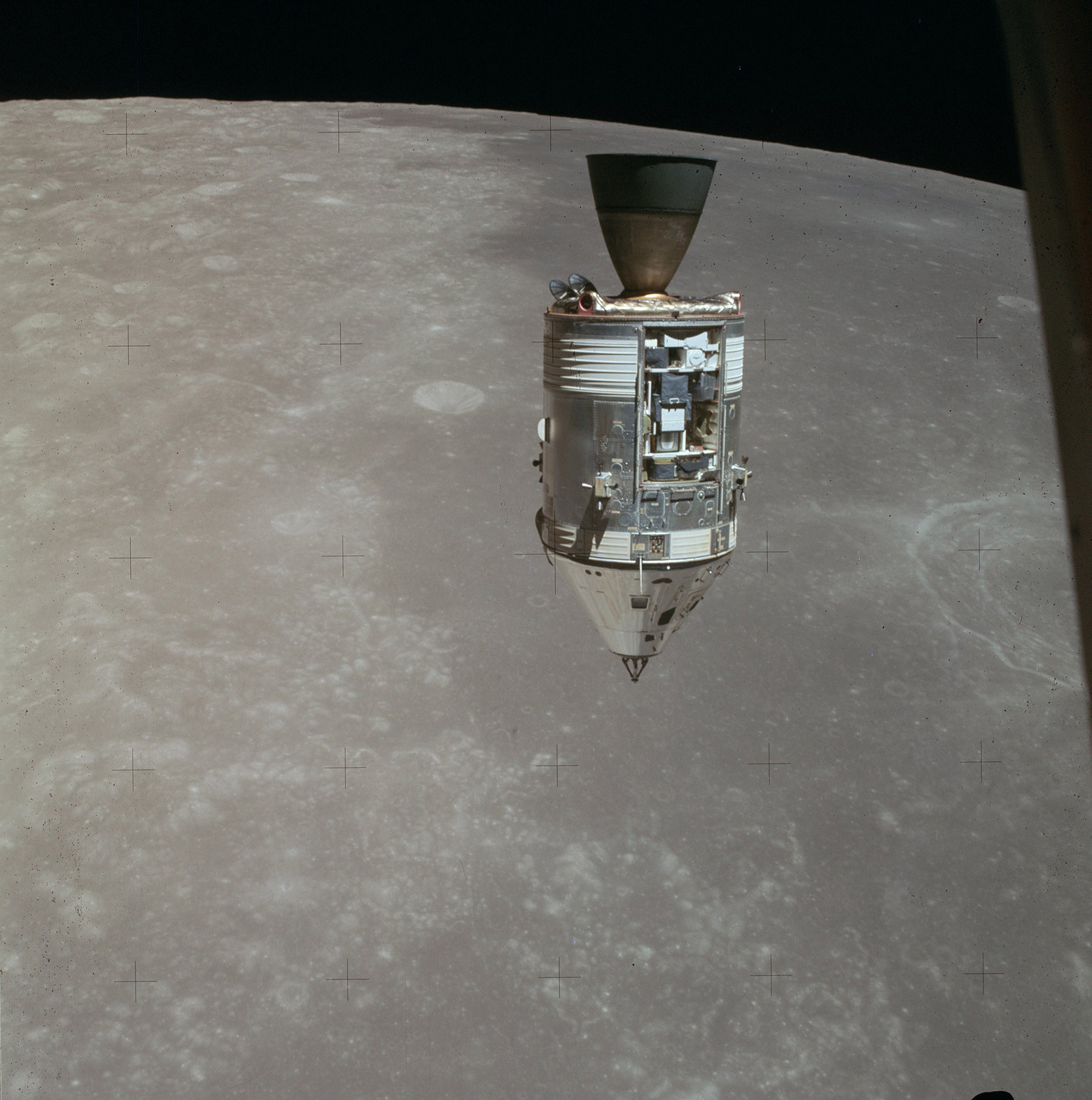 |
|
Al Worden in Endeavour flying high above a sun drenched Moon seen from the LM. |
Worden wasn’t so happy when all the crud from the LM began to float in and invade his spotless Command Module, and all the grubby boxes and bags were loaded aboard. They tried very hard to keep the dust out, but it was impossible. Scott and Irwin finally commandeered souvenirs of the LM and had a last look around before going through the checklist for the final burn to send the LM to destruction on the lunar surface.
Astronaut health concerns
Among the consoles at Mission Control in Houston there was rising concern for the state of the LM astronauts. Flight Director Milt Windler had led the Maroon shift through lunar liftoff and handed over his shift to Glynn Lunney during orbit 58. Lunney was supposed to supervise the jettison of the LM and then get the crew to sleep. Before shedding the LM, the procedures specified the crew had to check for leaks in the pressure suits and the CSM cabin.
Following the Russian Soyuz 11 tragedy only a month before, when three cosmonauts were killed due to a pressure leak in their spacecraft, the Apollo 15 flight plan was changed to make the astronauts wear their pressure suits when jettisoning the LM. The first scare was a suit failure at a water inlet fitting. After this was fixed Scott passed a comment that the tunnel pressure was dropping. This was serious. As it was suspected there might be a hatch leak, the LM jettison was postponed and the crew inspected the hatch seals. It is suspected the excessive dust from the lunar surface may have interfered with the seals and caused the pressure leaks.
On orbit 53 Scott had inadvertently depressurised the tunnel, so Lunney, feeling something was amiss, told him to repressurise it again and then gave the go ahead to jettison the LM. Listening to the conversation, Kranz, standing by to take over the next shift, sensed something was wrong too – he had never seen a spacecraft crew and ground control so out of kilter with each other. “I was spooked just listening,” he said.
Worden released the LM at 1104 AEST.
During these activities, Dr Chuck Berry, the long-standing astronauts’ physician, had been monitoring his readouts and crossed the floor to sit next to Lunney. He murmured in Lunney’s ear, “Glynn, we saw a bunch of heart irregularities on Irwin. We also saw some during the third EVA.”
He explained that it looked as though Irwin had a bigeminal rhythm,
where both chambers of the heart try to contract at the same time, with premature
ventricular contractions from over work.
But then trouble developed with the separation manoeuvre. The delayed jettison
time placed the spacecraft in a different location and attitude in the orbit.
Combined with some inaccurate terminology, both the crew and ground control
became confused with working out the correct SPS burn for separation, and Scott
thought if they followed Houston’s instructions they would collide with
the LM. He delayed the separation manoeuvre to the chagrin of ground control,
and it took a few minutes to sort out the confusion and separation burn was
initiated at 1124 AEST.
They watched the LM keeping them company until Houston
fired the engine by remote control to slow it down. Falcon fell back
and began dropping towards the Moon to smash into the surface at 1303:37 AEST,
93 kilometres west of Hadley/Apennine, and 24.1 kilometres from the planned
target. All three seismometers, Apollo 12, 14 and 15, recorded the impact.
| HSK MISSION DAY 9 |
WEDNESDAY
4 AUGUST 1971 |
|
| LUNAR ORBITS | ||
| Prime HSK and Wing HSKX |
Track Duration |
|
| CSM (continued from 3 August group of orbits) | ||
| Orbit 59 AOS : 0017:25 | LOS : 0130:17 |
1h 12m 52s |
| Orbit 60 AOS : 0218:20 | LOS : 0328:20 |
1h 10m 00s |
| Orbit 61 AOS : 0415:00 | LOS : 0424:00 Moonset |
9m 00s |
| Total tracking time from first AOS of group to last LOS 13h 58m 00s | ||
| Today’s group of orbits: | ||
| Orbit 67 AOS : 1504:00 | LOS : 1616:00 |
1h 12m 00s |
| Orbit 68 AOS : 1800:27 | LOS : 1910:39 |
1h 10m 12s |
| Orbit 69 AOS : 2001:00 | LOS : 2111:30 |
1h 10m 30s |
| Orbit 70 AOS : 2157:00 | LOS : 2309:50 |
1h 12m 50s |
| Orbit 71 AOS : 2355:20 | LOS : 0108:07 (5 August) |
1h 12m 47s |
| This group of orbits continues on 5 August. | ||
|
|
||
| Parkes | ||
| LCRU Checked for signal at 1524 AEST AOS: 1851:00 LOS : 1903:59 12m 59s Sudden LCRU signal loss, Track requested to keep HSK receiver 2 tuned to LCRU. |
||
| CSM | ||
| Orbit 67 AOS : 1504:00 | LOS : 1616:00 |
1h 12m 00s |
| Orbit 68 AOS : 1800:27 | LOS : 1910:39 |
1h 10m 12s |
| Orbit 69 AOS : 2001:00 | LOS : 2111:30 |
1h 10m 30s |
| Orbit 70 AOS : 2157:00 | LOS : 2309:50 |
1h 12m 50s |
| Orbit 71 AOS : 2355:20 | LOS : 0108:07 (5 August) |
1h 12m 47s |
| Orbit 72 AOS : 0153:30 (5 August) | LOS : 0254:00 |
1h 00m 30s |
| Total tracking time from first AOS of group to last LOS 11h 50m 00s | ||
The first event of Wednesday was to hear a more detailed story of Captain Cook’s
leak episode in the original Endeavour read up to the spacecraft at 0036
AEST during orbit 59. Again we were the only station tracking at the time. At
the end of a general news session to the crew, Joe Allen sent the following
message through our transmitter to the astronauts:
With the pressure now off, Irwin told his mates, “Just let me lie here for a little bit. I am physically exhausted.” He was unaware of his heart condition.
As they were preparing to settle down for a sleep period they heard Deke Slayton’s authoritative voice on the voice channel from Houston, “Okay, Jim. And, while we got you... – this is Deke. I’d like to have you and Dave, at least, take a Seconal (sleeping tablet) here before you go to sleep so you can really power down for the night. You guys need it. It’s up to Al whether he wants one or not.”
Irwin: “Okay, thank you, Deke.”
Unaware of the concern for his health on the ground, Irwin thought Slayton was joking, and laughing to himself, thought, “Yes, we have had a busy day.” Scott, on a high, thought the suggestion was ridiculous, so they ignored the instruction, and after a 22-hour day of stressful action, all three turned in for a good nine hours sleep.
Kranz admitted that for the first time in his career he was rattled.
He had been working with a chronically fatigued crew that were disoriented,
suffering memory loss due to dehydration, as well as changes in blood chemistry
due to over exertion. Their condition was aggravated by a drastic loss of potassium.
Irwin was okay for the rest of the mission, but it did catch up with him later.
Once the Moon rose at Honeysuckle Creek at 1504 AEST, it was a day of constantly
acquiring the CSM every hour and 55 minutes as it looped around the Moon. The
crew were asleep on our acquisition at moonrise, but woke up at the end of orbit
70, our fourth orbit for the day.
|
Some time after 4:00pm, Hamish took this photo of the Moon rising above the Honeysuckle Operations Building. (The Moon had risen at 2:25pm. Sunset was at 5:23pm.) The CSM was in its 67th revolution of the Moon |
|
As darkness fell, on Wednesday 4th August 1971, Hamish Lindsay took this photo of the Honeysuckle Creek antenna tracking the CSM in its 68th revolution of the Moon. Negative scan and image processing: Colin Mackellar. |
Despite his irresponsible heart, Irwin felt quite normal and
joined the other two busy operating the SIM equipment, analysing and photographing
the lunar surface. Worden had been operating the equipment by himself while
the other two were away, but Houston decided to keep Scott and Irwin busy and
every day they woke up they were greeted by pages of changes to the flight plan.
Scott and Irwin found they were having a hard time keeping up with Worden and
his intimate knowledge of the SIM equipment. They mapped the lunar surface,
assessed the Moon’s radiation and took endless photographs. With the Panoramic
camera alone they exposed 1,500 frames on 2 kilometres of film.
 |
|
An amazing view from orbit of two craters from different ages. On the right is partially filled Herodotus with a system of rilles and ridges, including the Cobra’s Head at the start of Vallis Schroteri. On the left is the much younger Aristarchus with a rille below it containing what appears to be ejecta flung out from the impact. |
We said goodbye to them on orbit 73, the last orbit for us as
the Moon set below the horizon. On board Endeavour the astronauts were
setting up to eject the P&F Subsatellite and for their TEI burn. When we
next picked them up they were well on their way home.
| HSK MISSION DAY 10 |
THURSDAY
5 AUGUST 1971 |
|
| TEI AND TEC DAY 1 | ||
| P&FS launch 0613:29 GET 222:39:29 TEI 0722:46 GET 223:48:46 during CSM orbit 74 MAD only tracking. |
||
| Prime HSK |
Track Duration |
|
| CSM (continued from 4 August group of passes) | ||
| Orbit 72 AOS : 0153:30 | LOS : 0306:10 |
1h 12m 40s |
| Orbit 73 AOS : 0351:40 | LOS : 0504:50 |
1h 13m 10s |
| Total tracking time from first AOS of group to last LOS 14h 0m 50s | ||
| CSM TEC – 1 | ||
| AOS : 1528:00 | LOS : 0529:36 (6 August) |
14h 1m 36s |
| P&FS | ||
| Orbit 7 AOS : 1748:00 | LOS : 1853:00 |
1h 5m 00s |
| Wing HSKX | ||
| CSM (continued from 4 August group of passes) | ||
| Orbit 72 AOS : 0153:30 | LOS : 0306:10 |
1h 12m 40s |
| Orbit 73 AOS : 0351:40 | LOS : 0504:50 |
1h 13m 10s |
|
Total tracking time from first AOS of group to last
LOS 14h 00m 50s |
||
| CSM TEC-1 | ||
| AOS : 1528:00 | LOS : 0514:27 (6 August) |
13h 46m 27s |
| Handover CSM uplink from GDS : 1834:01 Handover CSM uplink to MAD : 0510:10 (6 August) |
||
| Parkes | ||
| CSM | ||
| AOS : 1803:00 LOS : 1820:00 Broke track to check system |
17m 00s |
|
| AOS : 2004:00 | LOS : 2057:00 |
Power failure 53m 00s |
| AOS : 2058:00 |
LOS : 0307:00 (6 August) |
6h 9m 00s |
| Total tracking time from first AOS to last
LOS 9h 4m 00s |
||
The CSM was set into a 140.7 by 100.6 kilometre orbit to eject the Particle
& Fields Sub-satellite during orbit 74 at 0613 AEST on 5 August. Only Madrid
saw the P&FS go.
Scott announced the launch, “Three, two, one...... launch. We have a barber pole...... and a grey.”
Allen, “We confirm that.”
Scott: “Tally Ho!”
Sent into a 141.3 by 102.0 kilometre orbit the P&F Sub-satellite
carried two experiments:
(1) Magnetometer. The strength and orientation of the magnetic field near the Moon was measured. Because the Moon lies within the Earth’s magnetic field, the magnetic field at the Moon varies as it completes each month-long orbit around the Earth. In addition, some localized magnetic features were discovered on the Moon, such as at the craters Reiner Gamma on the lunar nearside and Van De Graaff on the lunar farside.
(2) Charged Particles. The density and energy of electrons and protons near the Moon were measured. These quantities vary with time as the Moon moves through the Earth's magnetic field and during eruptions such as solar flares on the Sun.
A third experiment, using the sub-satellite’s S-band transponder signal of 2282.5 MHz, required no additional equipment. Accurate tracking of the sub-satellite from Earth allowed details of the Moon’s gravity field to be mapped, which provided information about the distribution of mass in the Moon’s interior. Changes in the spacecraft’s velocity are due to the force of gravity acting on the spacecraft. The primary gravitational influence on the spacecraft is the Moon's gravity. Other objects, particularly the Earth and Sun, also affect the spacecraft, but the contributions of these objects can be readily calculated. As a result, this experiment provided maps of how the Moon’s gravity varies with location across its surface. In turn, this information was used by geophysicists to study how material is distributed inside the Moon. This was a continuation of the S-Band Transponder Experiment during the main Apollo 15 mission.
On the ground we tracked the sub-satellite until support was terminated on 22 January 1973. Unlike Apollo 16, there are no details of the fate of the Apollo 15 sub-satellite.
Then, just over an hour after releasing the sub-satellite, at
0722:46 AEST, a 2 minute 17.8 second TEI burn boosted them out of lunar orbit
and set them on the path back to Earth. Irwin commented that the view of the
Moon as they left it was breathtaking, “When I looked out of window 5,
my window, I was looking north, and I got a half moon view. You could see the
Moon all in one gulp! At the terminator it was this striking gunmetal grey,
shading out almost to white at the subsolar points. The whole mass had a dramatic,
unreal look.”
Houston were still trying to lock on to the Rover’s LCRU, sending an
uplink through Goldstone, but the Mars 64 metre antenna could not find any return
signal, so Track requested Honeysuckle Creek to configure Receiver 1 to the
LCRU frequency, but we only received a background noise spectrum generated by
the Moon, so reconfigured the Prime system for P&FS, in its seventh orbit,
and acquired it at 1748 AEST, with Guam and Goldstone.
Meanwhile at 1819 AEST Parkes was suffering 50 kilometre per
hour winds and were unable to acquire any signal and checked their system on
ALSEP.
After Endeavour passed out of our view at 0505 AEST, and Madrid took
over, Houston took their night off because low level communication lines across
the Atlantic were playing havoc with the Quindar tone operation, and the Capcom
had to call “Apollo 15, Apollo 15” twice to establish proper contact.
With that brush off, as the astronauts settled down for the ‘night’
they felt a bit like three kids whose parents had gone out for the evening.
Contact with Houston was always a parental comfort to the flight crew.
At 1920 AEST the crew were woken up and began to prepare for the next major
event, Al Worden’s TEC EVA. By this time we were tracking them again. They
crossed back over the equigravisphere and re-entered the Earth’s gravitational
field at 2130 AEST.
| HSK MISSION DAY 11 |
FRIDAY 6
AUGUST 1971 |
|
| TEC DAY 2 | ||
| TEC EVA 0131:12 GET 241:57:12 Hatch closed 0207:00 GET 242:33:00 |
||
| System 1 configured to P&FS No record of any tracking. System 2 configured to CSM |
||
| Prime HSK |
Track Duration |
|
| CSM | ||
| AOS : 1536:00 | LOS : 0547:16 (7 August) |
14h 11m 16s |
| Handover CSM uplink from Wing : 0519:00 (7 August) | ||
| Handover CSM uplink to MAD 0529:01 | ||
| Wing HSKX | ||
| System 3 configured to CSM | ||
| AOS : 1536:00 | LOS : 0525:50 (7 August) |
13h 49m 50s |
| Handover CSM uplink from GDS : 1934:01 | ||
|
Handover CSM uplink to Prime : 0519:00 (7 August) |
||
| System 4 configured to LM | ||
| Parkes supported the TEC EVA | ||
| CSM | ||
| AOS : 2058:00 (5 August) | LOS : 0307:00 |
6h 9m 00s |
| Parkes released from further support of the mission after EVA. | ||
Honeysuckle Creek and Parkes were the only stations in contact
with Apollo 15 for the 35 minute 48 second TEC EVA. Goldstone had just lost
the signal over their horizon, and Madrid had yet to pick it up.
TEC EVA to retrieve the SIM experiment films and cassettes
Worden now faced his big moment – the first interplanetary spacewalk in history.
At 0131 AEST the cabin was depressurised and the hatch opened for the EVA. Irwin described the moment they opened the hatch, “It was just like a vacuum cleaner pulling all the loose stuff from inside out into space. Everything started to float out. My toothbrush floated by; a camera came by – we were all leaping around trying to catch the important stuff.”
Worden pushed himself through the hatch, “I just went outside the hatch, grabbed the first handrail, and positioned myself just outside the hatch until Jim got in the hatch to observe and to watch the umbilical.” Irwin set up the television camera and we received a picture at 0134 AEST.
Worden’s first trip to the SIM bay was to recover the mapping camera cassette, “I went hand-over-hand down to the SIM bay and to the left around the Mapping Camera. I just floated myself over the Mapping Camera instead of going around it down into the SIM bay. I put my feet in the foot restraints and just stood there for a minute, resting and looking at the SIM bay, and waiting for Jim to get himself positioned in the hatch.”
Worden handed the mapping camera cassette back to Irwin who passed it to Scott for stowing away.
With the second trip he returned with the pan camera cassette,
and on the third visit he checked the condition of the instruments in the SIM
bay, but was unable to find a cause for the failure of the mapping camera to
retract or the faulty pan camera velocity/altitude sensor.
 |
|
Al Worden’s EVA. The first interplanetary EVA. A frame from the
16mm movie showing Al Worden climbing along to the SIM bay to collect
the data cassettes. |
The two astronauts were very conscious of the coal black void all around. Irwin
said, “It was scary and eerie out in that black abyss of space.” They
couldn’t see the stars because of the sunlight reflecting off the CSM,
but behind loomed a huge yellow Moon.
Worden’s most momentous and beautiful sight of the whole mission was floating in space with Irwin framed by the Moon’s orb. The National Geographic Magazine published a stunning painting of the scene in the February 1972 issue.
At 0202 AEST the TV transmission ended and by 0207 the hatch was closed again.
Worden, “I went back in the hatch, pulled the quick release on the TV camera bracket. I sent the pole in the hatch, backed into the hatch myself, and pulled the hatch closed. I thought that went very easy. It took hardly any force at all to close the hatch. It operated very smoothly and very freely. I pulled it right down to the point where it was closed. A couple of pumps on the handle, and the latches were over and off.”
After his freedom outside Worden found it somewhat claustrophobic back in the CSM cabin, “I said, I wish I were back outside. It’s hell in here.”
Scott, “You should have stayed longer.” When asked why he came back in so soon Worden simply answered that the scheduled jobs were finished.
At Honeysuckle Creek we left the three astronauts enjoying a
meal at 0547 AEST before their sleep period as the Moon set below the horizon
for us.
At 1536 AEST we acquired the CSM again, cruising homeward with the astronauts
asleep until 2104 AEST when Houston played music up to the CSM to greet the
astronauts with the news that the TV camera on the LCRU was no longer transmitting.
They had been panning and zooming at the surrounding mountains when it had suddenly
just cut out.
 |
Alan Foster and Lisa Jensen at work on the receivers in the USB Paul Hutchinson at the APP is in the background on the left. |
 |
Taken at the same time as the above photo, from behind the Servo console. |
 |
Key to the above photo. |
| HSK MISSION DAY 12 |
SATURDAY
7 AUGUST 1971 |
|
| TEC DAY 3 | ||
| Prime HSK |
Track Duration |
|
| CSM | ||
| AOS : 1619:00 | LOS : 1816:00 | |
| Due to X axis glitches break track to change ISO Amp. | ||
| Reacquired : 1823:00 | LOS : 2353:00 |
7h 34m 00s |
| Break track for ALSEP (8 August) | ||
| Wing HSKX | ||
| CSM | ||
| AOS : 1611:00 | LOS : 0627:00 (8 August) |
13h 49m 50s |
| Handover two-way from GDS : 1629:00 | ||
Witness of an eclipse of the Moon by Earth from space
Beginning at 0435 AEST Scott, Irwin and Worden were watching and photographing a spectacular eclipse of the Moon by the Earth. From a privileged position they saw the Moon go through its phases, from a light grey to a bright yellow to a dark orange as the shadow of the Earth went across it.
Just over an hour later, at 0547AEST, we lost Endeavour’s
signal among the trees and went through the post-pass and pre-pass procedures
through the morning and afternoon before acquiring the spacecraft again at 1619
AEST with the crew asleep.
Return to Earth
At 2204 AEST Houston sent Hawaiian music down Net 1 for the Wing to transmit the sugary sounds of the tropics to the spacecraft, and the crew stirred themselves to prepare for reentry and return to Earth.
Worden described the return, “We were coming in over the
Indian Ocean. I could see a few white clouds. We did that roll manoeuvre, I
looked out, and on the horizon were some snow-capped mountains of New Zealand.
It was a beautiful sight. We were coming back from the Mountains of the Moon
to the Mountains of the Earth.”
| PART MISSION DAY 13 |
SUNDAY 8
AUGUST 1971 |
|
| REENTRY AND SPLASHDOWN | ||
| CM and SM separation at 0617:55 AEST GET 294:43:55 Entry Interface at 0632:54 AEST GET 294:58:55 Splashdown at 0645:53 AEST GET 295:11:53 |
||
| Prime HSK |
Track Duration |
|
| ALSEP 1, 2 and 4 | ||
| CSM | ||
| AOS : 0059:00 | LOS : 0340:00 |
2h 41m 00s |
| Break track for P&FS | ||
| P&FS | ||
| AOS : 0346:00 | LOS : 0407:56 |
21m 56s |
| ALSEP | ||
| AOS : 0408:00 | LOS : 0613:00 |
2h 5m 00s |
| CSM | ||
| AOS : 0614:48 | LOS : 0627:00 |
12m 12s |
| Final LOS for mission | ||
| Total track time from first AOS to last LOS 5h 2 8m 00s | ||
| Wing HSKX | ||
| CSM | ||
| AOS : 1611:00 (7 August) | LOS : 0627:00 |
14h 16m 00s |
| Final LOS for mission | ||
| Handover CSM uplink to Guam : 0034:01 | ||
They then moved over towards Australia, crossing the track of Cook’s original
Endeavour just south of Sydney, and headed for a point about 1,600 kilometres
south-west of Cape Leeuwin, before they caught up with the turning Earth and
reversed their direction. The spacecraft entered the final approach over the
West Australian coast at Esperance and arced across to Townsville at an altitude
of 3,200 kilometres and a speed of 40,200 kilometres per hour. At 0618 AEST
they cast the Service Module off and prepared for Entry Interface.
Reentry
Over the Pacific Ocean west of the Hawaiian Islands they struck
Entry Interface and now the three astronauts were suffering nearly seven times
their own weight as they bored into the thickening atmosphere. It was physically
impossible to raise an arm to reach for a switch in the instrument panel, in
fact it was difficult enough just to breathe. It did not help that their bodies
and systems had become lazy in the zero g environment of the last three days.
At an altitude of 7,600 metres the drogue parachutes burst out, flogging wildly
in the slipstream before the three main chutes took over at 3,000 metres to
slow the spacecraft to a relatively lazy drift through the atmosphere.
The crew noticed one chute was bunched up under its drogue, so they were only coming in to land with two chutes – it was going to be a hard landing. Although the crew had spotted the partially deployed parachute, the Okinawa radioed the spacecraft: "You have a streamed chute. Standby for a hard impact. No sweat – you can make it on two," as they saw that Endeavour was swinging down under only two fully deployed parachutes.
The Command Module sprang out of a cloud right above a recovery
helicopter, its startled pilot looking up at the spacecraft directly above him.
 |
|
Endeavour descending on only two good chutes. |
Splashdown
Because they only had two parachutes Apollo 15 recorded the fastest
Entry Interface to splashdown time of 12 minutes 8 seconds. Splashdown was beside
the recovery Landing Platform-Helicopter USS Okinawa in the Pacific,
288 nautical miles north of Pearl Harbour, at 0645:53 AEST (GET 295:11:53) on
8 August. As soon as they hit the water at a speed of 35.4 kilometres per hour,
Irwin threw the circuit breakers to release the chutes. They landed 32 seconds
earlier than if they had three chutes, just a mere 12 seconds behind the flight
plan. The only consequence of the harder landing was an optical alignment sight
broke from its stowage bracket and fell on the aft bulkhead.
The mission had lasted for exactly 12 days 7 hours and 12 minutes. Of those
295 hours Honeysuckle Creek tracked the spacecraft for 250 hours, and Parkes
85 hours.
When we dropped track for the last time I felt an anticlimax, an empty feeling
with a certain amount of sadness as the antenna headed for the stow position.
I went about following post track procedures, clearing all the gear and tapes
away. As the morning sun flooded in the window, I listened to the end of the
mission on Nets 1 and 2. I could hear the recovery forces calling to each other,
until we heard the crew were safely on board the recovery ship.
Then, during the drive home there was a feeling of relief of having been part of a successful mission with no major equipment breakdowns, and we could look forward to a day at home to unwind.
Until the next mission.
So ended what some of the top scientists felt was, “one of the most brilliant
missions in space science ever flown.”
Jim Irwin enjoyed profound religious experiences on the Moon and went on to
devote his energies to his faith, but it seems some of his exertions took its
toll and long periods without drinks combined with heavy loss of body fluids
at times leached out potassium, which can damage the heart muscles. From 1973
he suffered several heart attacks, succumbing to a fatal one in 1991.
The Apollo 15 crew took a small block of wood from the sternpost of Captain
Cook’s Endeavour and left behind the falcon’s feather and a
four-leafed clover. Later Scott, who spent the most time in space of all the
astronauts during Apollo, wrote,
 |
|
Commander Dave Scott at the lectern in front of members of Congress – the House of Funds, on 9 September 1971. A unanimous standing ovation. |
NASA images with thanks to NASA.
Many of the images were scanned by Hamish Lindsay from photos from the NASA Canberra office which were destined for the rubbish dump!
The Apollo 15 mission patch was preserved and scanned by Hamish Lindsay and enhanced by Colin Mackellar.


