DSS-41 was the first Deep Space Tracking Station to be built outside the US. It was built for the Deep Space Instrumentation
Facility – which became the Deep Space Network in December 1963. Until the DSN was formed, the station was known as DSIF-41. (Likewise, Tidbinbilla, the second Australian DSIF station, was known initially as DSIF-42.)
The Woomera station was the second of three stations to form the first global tracking network.
The first DSIF 26m (85 foot) antenna had been built at Goldstone in California in 1958. Island Lagoon was built in 1960, and the Johannesburg station was built in 1961.
Construction
In early 1959, a location for the Woomera station had been selected in a natural depression on the north-eastern shore of the Island Lagoon dry salt lake – and construction began in May 1960.
The 26 metre (85 foot) polar-mounted antenna was assembled by the Blaw-Knox company under the supervision of a JPL team led by Walt Larkin. The antenna design was the same as that of DSIF-11, the Pioneer Station at Goldstone in California.
Between August and November 1960, Richard K Mallis from JPL supervised the JPL / Collins Radio team as they installed the electronics. Dick had earlier assisted in the construction of the Pioneer Station. Soon after, he supervised the same work for the third (virtually identical) DSIF station at Johannesburg.
|
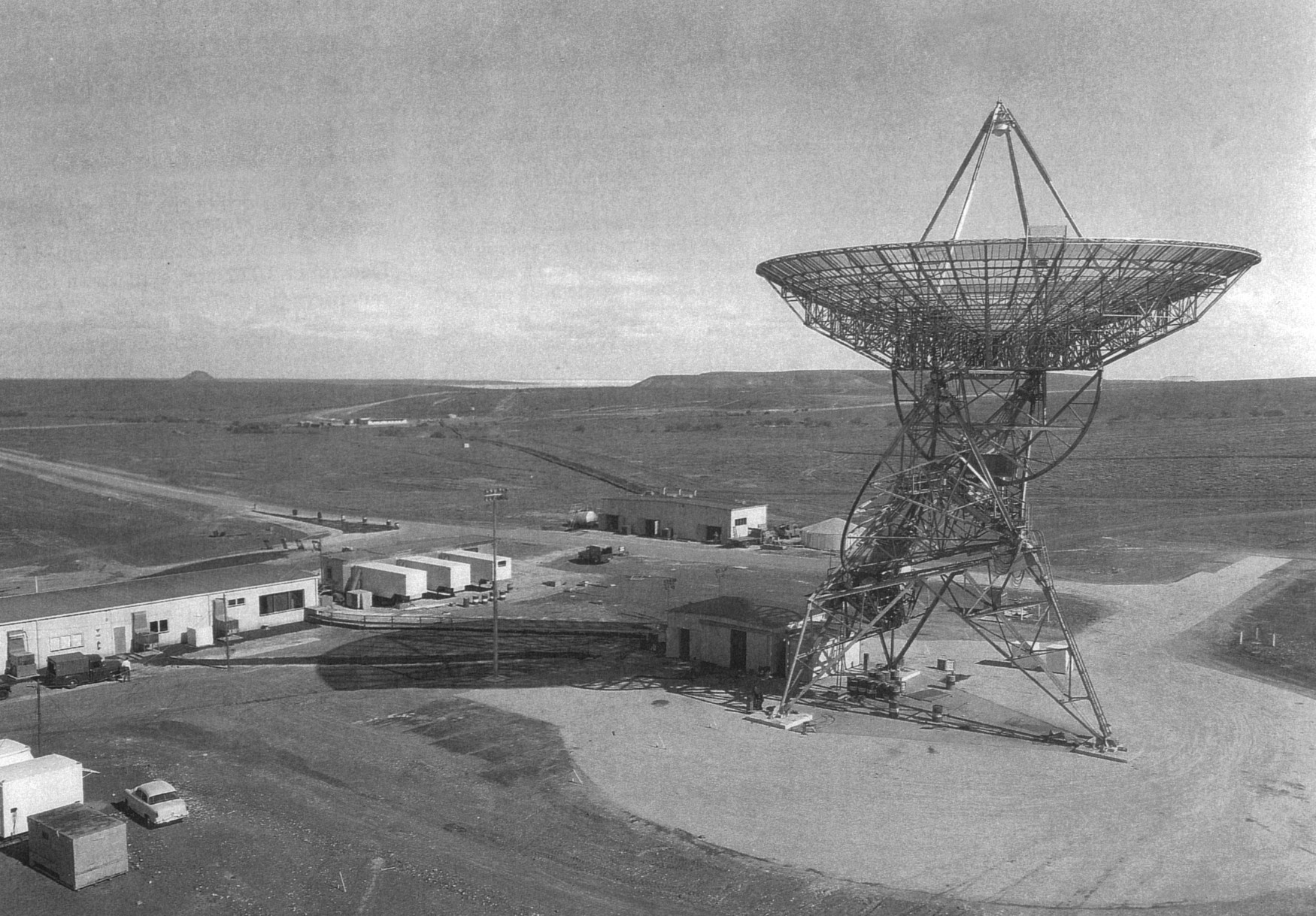
DSS-41, Island Lagoon, early days.
Richard Mallis explains that the control building was not finished in time for the launch of Ranger I (launched 23 August 1961), so various subsystems, housed in four trailers, were interconnected via a long shed near the antenna.
He writes,
“When you examine the photo you can see the building with the trailers on the right. To the left is the new building. This photo must have been taken during the transition from the trailers to the new building.
If you look carefully you can see that one of the four trailers has departed but three still remain.”
Click here for a larger version, or here for a 1.1MB version.
Photo with thanks to Richard Mallis – sourced from the Picture Album of the Deep Space Network, compiled by N A Renzetti and D Worthington. (Mike Dinn recalls that Dr Renzetti had photos of the various stations displayed along the corridors at JPL.) Scan: Colin Mackellar. |
|
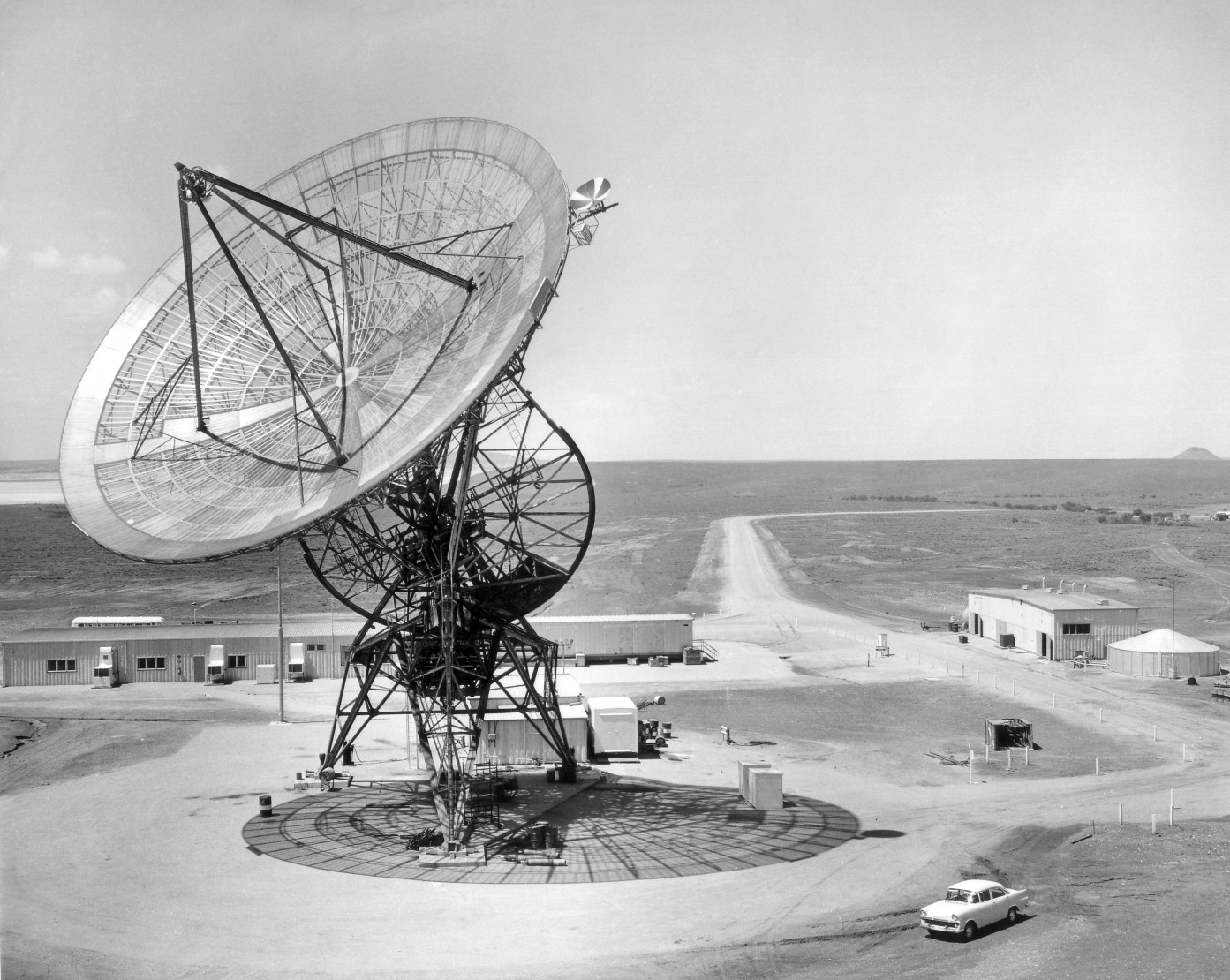
DSIF-41, Island Lagoon, 14th December 1961.
This is the original L-Band configuration which was used mainly for the Ranger missions. See the full size scan here. (1.4MB) Scan: Jan Delgado. |
DSIF-41 became operational on 3 November 1960, when voice and teletype messages were received from Goldstone via Moonbounce.
On 10 February 1961, Island Lagoon was officially opened. Again using the Moonbounce technique, Australian Minister of Supply Alan Hulme received greetings from NASA Deputy Administrator Hugh Dryden in Washington, via Goldstone.
|
Opening ceremony?
What appears to be the opening ceremony of DSIF-41 on 10th February 1961. It
was found in “Two Centuries”, published by the Australian News and Information Bureau in 1970.
The crowd is being addressed by someone standing on the edge of the dish. The white attachment at the far left on the end of the quadripod – is the L-Band Acquisition Aid. It was later transferred to the edge of the dish.
Large, Larger.
Scan: Colin Mackellar. Thanks to Don Gray for the Acquisition Aid info. |
DSIF-41 was operated by the Department of Supply, whose Weapons Research Establishment managed the nearby Woomera range. The US – Australian Agreement stipulated that Australian staff would operate the station under the auspices of the Department of Supply for NASA.
|
DSS-41, Island Lagoon, c. 1963.
This is the original L-Band configuration which was used mainly for the Ranger missions. With thanks to Don Gray.
Scan: Colin Mackellar. Large, Larger. (larger versions on request.) |
Antenna upgrade
DSIF-41 was originally equipped to transmit and receive in the L-Band (UHF around 960MHz). This is the configuration in the photo above.
Don Gray (Senior RF Engineer at Island Lagoon and later Station Director at Tidbinbilla and then Honeysuckle) writes –
“The changeover from L-Band to S-Band was driven by a number factors. The frequencies 960 Mhz uplink and 890 Mhz downlink were not among the frequency bands set aside for space research by the 1959 Geneva Telecommunications Agreement and were in fact at the lower edge of a TACAN [TACtical Air Navigation] band giving rise to problems of frequency registration and protection. Cosmic noise was relatively high and manmade interference was not uncommon.
However with Ranger, Mariner and early Atlas-Centaur missions using L-Band, and later Mariner and Pioneer missions using S-Band, scheduled through to late 1965, and it was necessary to maintain both L-Band and S-Band capability through that period in the original DSIF network, (Woomera, Johannesburg and Goldstone Pioneer sites). The L/S Band system became operational at DSS41 in August 1964.”
(See this photo of the DSS 41 team at JPL for checkout and acceptance of the L/S-Band conversion.)
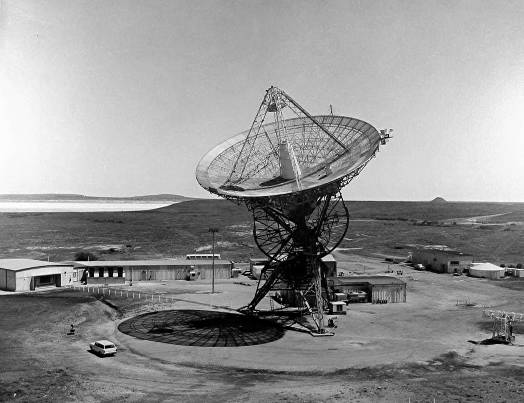 |
Another view of the station circa 1964.
Here, the antenna has been modified for L-Band and S-Band operation in order to support the Lunar Orbiter and later missions.
Scan: Glen Nagle, CDSCC, Tidbinbilla.
|
|
DSS-41, Island Lagoon, 1966.
The antenna is here configured for both L-Band and S-Band operations.
Photo: Taken by Pat Delgado from the cherry-picker. |