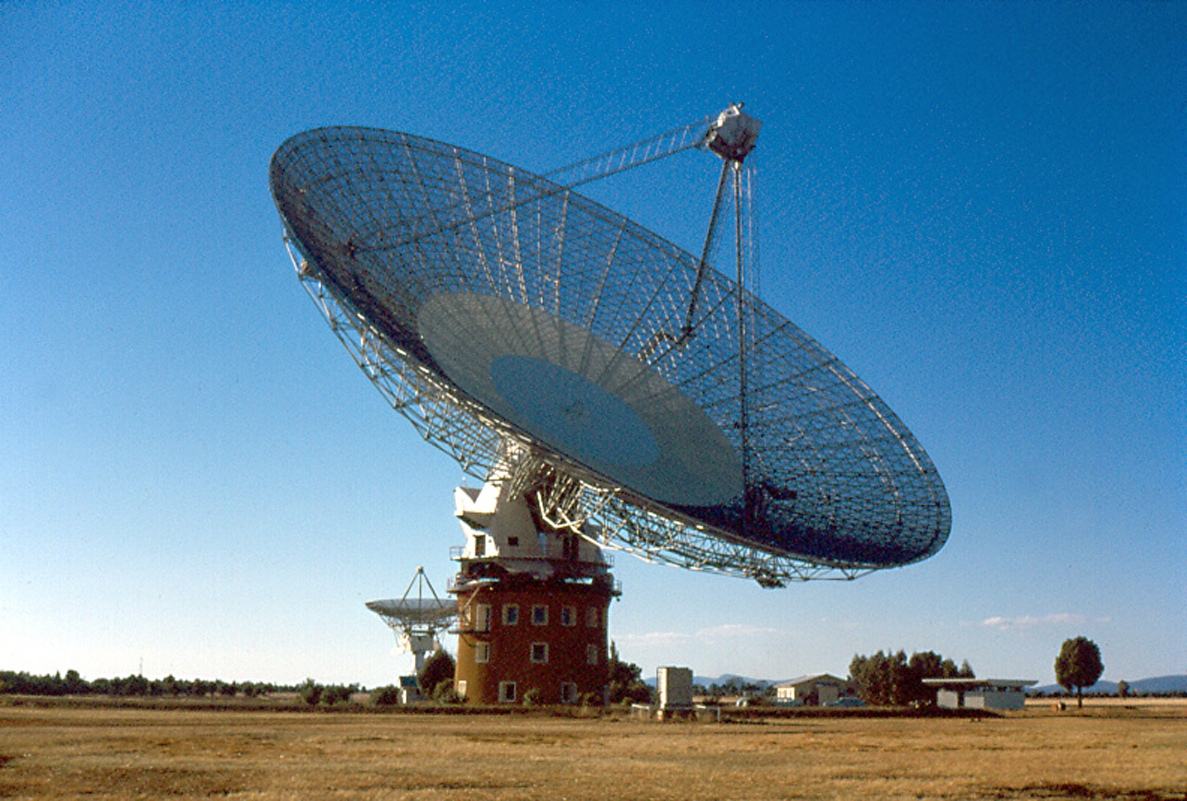
The Parkes Radio Telescope


Parkes - by Keith Aldworth

The Parkes Radio Telescope, New South Wales

The smaller 60' antenna of the 2-element interferometer is in the background. (The smaller dish, still on site, was decommissioned in 1982.)

Photo by Keith Aldworth – probably taken around the time of Apollo 15 in 1971.


The Parkes Radio Telescope is probably the best-known astronomical observatory in Australia.

Construction of the giant 210 foot (64 metre) parabolic dish for the CSIRO was begun in 1959 and it was completed and commissioned in 1961.

The design was adapted for the Deep Space Network’s 64 metre antennas at Goldstone and Tidbinbilla (which were later enlarged to 70m) and the 70m at Madrid. The telescope uses an altazimuth mount, but uses a small master equatorial mount to which the alt-az structure is slaved – hence the dish can be driven as if it were on an equatorial mount.


Parkes and Apollo

As a radio telescope, Parkes is receive-only, lacking a transmitter.

CSIRO agreed, at NASA request, to provide mission support on a number of key occasions during the Apollo Program – this was to provide additional signal level margin, and antenna/tracking redundancy. Parkes used NASA payments to enhance the capabilities of the facility. This arrangement has continued to the present day.

During Apollo, Parkes was not always called up because the radio telescope cannot point below an elevation of 30° – thus reducing potential tracking time.

For Apollo 11, a team from the Goddard Space Flight Center (led by Robert Taylor) were stationed at Parkes (assisted by John Crowe, who had worked at Honeysuckle). At Honeysuckle Creek, Mike Dinn was responsible for co-ordinating Parkes’ telemetry through to Honeysuckle, where it could be used as another source (as was the telemetry from Honeysuckle’s wing at Tidbinbilla).

For later Apollo missions, Manned Space Flight Network personnel from Tidbinbilla, spent considerable periods at Parkes. Keith Aldworth – who was a part of the team at Tidbinbilla – writes,

“When the Apollo missions began, Tidbinbilla’s 64 metre antenna had not been built and as we all know, Parkes Radio Telescope was seconded to NASA for periods of about six weeks around the Apollo missions. At the Parkes site, the equipment necessary for these missions was installed and remained there throughout. A team of people from Tid was detailed to man the Parkes site. I was not on that team until Apollo 14 and I was nominated to take the place of Mil Perrin, who no longer wished to be away from home for the extended periods necessary. My responsibility there was for telemetry and video recording and the ground communications to Canberra.

During the lead up to missions, the group travelled up to Parkes to prepare and install equipment. We commuted weekly and stayed in either The Coach House Motel or The Park View Motel. At weekends, we went home to Canberra. The two motels had their advantages and disadvantages. The Park View was a little bit out of town and the Coach House was in the centre of town. The two specialised in different cuisines. The Park View’s steaks were superb, whereas the Coach House served wonderful seafood.

During the pre-mission periods, we preferred to stay at the Coach House but during the mission periods, the peace and quiet of the Park View was preferred.

We worked for up to sixteen hours per day during the actual mission periods and did not get to go home until the mission was completed and our equipment [was released from support].”

(from Keith’s biographical note.)

When Parkes was used for Apollo support, the Parkes telemetry was available at Honeysuckle Creek as an alternate source to its own antenna and that at Tidbinbilla.


See photos taken at Parkes during Apollo here.


After Apollo

After Apollo, Parkes has often participated in tracking Deep Space missions.

During the Voyager II encounter with Uranus, for example, Parkes and the antennas at Tidbinbilla (CDSCC) were arrayed to substantially increase the rates at which science data could be received from the spacecraft.