
Visitors to Honeysuckle Creek
Over
the years, many visitors came to Honeysuckle Creek, including a number of astronauts.
|
Harrison (Jack) Schmitt – 03 May 1973
 |
|
Honeysuckle had visits from many of the astronauts, some giving the station staff a talk. |
 |
|
Photo: Hamish Lindsay. |
 |
Dr. Harrison Schmitt (Apollo 17) signing the master signature sheet in the canteen during his visit to HSK on 3 May 1973. |
 |
Dr. Schmitt presented this memento during his visit. |
William Pickering – 12 January 1969
 |
|
Dr. William Pickering is pictured being seen off by Station Director Tom Reid on 12th January 1969. |
 |
Here’s a higher resolution scan of part of the image. From the Tidbinbilla archives. Scan by Glen Nagle. |
 |
 |
|
Australia’s first astronaut, Dr Philip Chapman (left) came to have a look at Honeysuckle Creek and was shown over by Deputy Director Ian Grant on 09 December 1970. |
 |
Full frame of the above photo by Hamish Lindsay. |
 |
In the video section. |
 |
Dr. Chapman’s official NASA publicity photo, 1967. |
In December 2004, Dr. Chapman visted nearby Tidbinbilla.
George E. Mueller and the Manned Space Flight Network Inspection Team – 6 January 1967
 |
On 6 January 1967, members of the Manned Space Flight Network Inspection Team, led by George Mueller, visited Honeysuckle Creek. They visited the Wing at Tidbinbilla the next day. Photo: Ken Sheridan, image enhancement Colin Mackellar. Here’s the Visitors Book entry for the day. |
 |
Members of the MSFN Inspection Team pose in front of Honeysuckle Creek’s Servo Console. Left to right: Larger, much larger (5.2MB). Photo by Hamish Lindsay, scan and image repair by Colin Mackellar. |
 |
Someone wrote the names on the back of the photo. |
 |
Members of the MSFN Inspection Team at Honeysuckle Creek. Lloyd Bott appears to be pointing Ozro Covington to the Collimation Tower, while Bryan Lowe chats with George Mueller. Photo by Hamish Lindsay, scan by Colin Mackellar. |
 |
Here’s a key to those in the photo who could be identified with confidence. |
 |
Members of the MSFN Inspection Team at Honeysuckle. Photo by Hamish Lindsay, scan by Glen Nagle. |
 |
|
On 6 January 1967, the Manned Space Flight Network Inspection Team visited the three tracking stations in the ACT. Hamish Lindsay writes, |
 |
Members of the MSFN Inspection Team at the Honeysuckle Creek servo console. In the foreground, left to right: George Mueller, Bryan Lowe, Wes Moon, Brian Bell. Photo by Hamish Lindsay, who is standing between the servo console and the window out to the antenna pad. 2021 scan by Colin Mackellar. |
 |
Members of the Inspection Team check out the Honeysuckle Creek 85 foot (26 meter) antenna. Photo by Hamish Lindsay, scan by Colin Mackellar. |
 |
Members of the Inspection Team on the Honeysuckle Creek antenna pad. From the Tidbinbilla / CDSCC Archives. |
 |
Members of the MSFN Inspection Team at Honeysuckle Creek. George Mueller leads the group as they walk back to the Operations Building. Photo by Hamish Lindsay, scan by Colin Mackellar. |
 |
Station Director Bryan Lowe with Inspection Team leader George Mueller. From the Tidbinbilla / CDSCC Archives. |
 |
Members of the MSFN Inspection Team walking down to the Powerhouse. Photo by Hamish Lindsay. 2021 scan by Colin Mackellar. |
George E. Mueller – 1st December 1969
 |
Dr George Mueller returned to Honeysuckle on Monday 1 December 1969. (He visited Tidbinbilla the following day for the groundbreaking ceremony for DSS43.) Here, in the Honeysuckle Creek Conference Room, he is presented with a copy of Hamish Lindsay's photo of Honeysuckle Creek tracking Apollo 8 on its first lunar orbit, 24 December 1968. Left to Right: Photo: Hamish Lindsay. Scan of print by Glen Nagle; ID by Colin Mackellar and Mike Dinn. |
 |
Dr George Mueller with his framed photo of Honeysuckle tracking Apollo 8 on its first lunar orbit. Left to Right: Photo: Hamish Lindsay. 2024 negative scan by Colin Mackellar. |
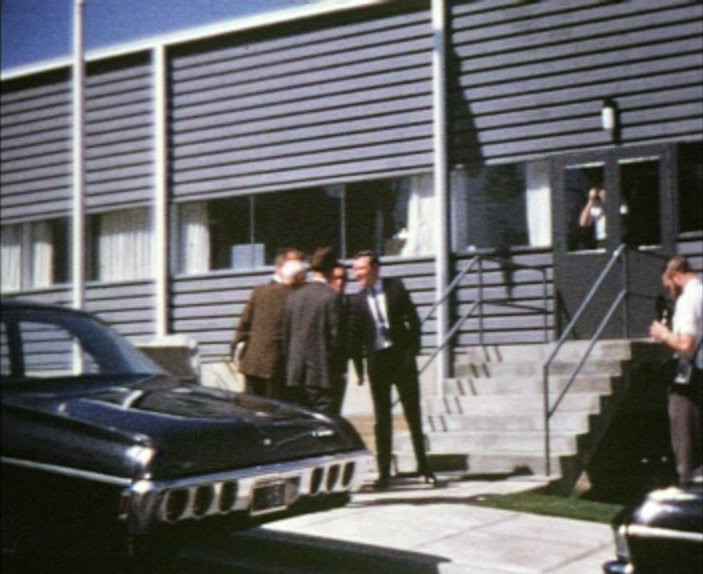
Alan Shepard and Eberhard Rees – 09 September 1968
 |
 |
|
|
 |
 |
 |
|
Astronaut Alan Shepard visits Honeysuckle on 9th September 1968. |
 |
 |
 |
 |
 |
Thomas Paine – 25 February 1970
 |
|
NASA Administrator Dr Thomas Paine came to see Honeysuckle Creek on 25 February 1970. |
 |
Honeysuckle Station Director Don Gray (right) shows NASA Administrator Dr Thomas Paine the Operations Console. Operations Supervisors John Saxon and Ken Lee look on. |
 |
Honeysuckle Station Director Don Gray (left) shows NASA Administrator Dr Thomas Paine the Servo Console. L-R: Don Gray, Lewis Wainwright (background), Thomas Paine, Ian Grant, unidentified visitor, unknown visitor (background), Tony Cobden (>). |
 |
NASA Administrator Dr Thomas Paine addresses a gathering under the antenna at Honeysuckle Creek on 25 February 1970. |
 |
Key: 1. ?; 2. Don Gray (newly-installed Honeysuckle STADIR); 3. Des O’Connor (Deputy Secretary of the Department of Supply); 4. Walter Rice (US Ambassador to Australia); 5. ?; 6. Dr. Thomas Paine (NASA Administrator). 7. Tony Cobden (STC Company Manager); 8. Willson Hunter (NASA Senior Scientific Representative to Australia); 9. ?; 10. Bob Leslie (Assistant, American Projects Branch); 11. Dennis Willshire (Orroral Valley STADIR); 12. ?. Thanks to Mike Dinn for help with the identification. |
 |
|
Astronaut John L. Swigert was born in Denver, Colorado, on 30 August 1931 and was a fighter pilot in Japan and Korea before joining NASA on 4 April 1966. He was Assignment Support for the Apollo 7 and 11 missions and rose to back-up crew for Apollo 13. He replaced Ken Mattingly for the ill-fated Apollo 13 voyage to the Moon in April 1970. |
 |
Left to right: |
 |
Jack Swigert and HSK Station Director Don Gray during Jack’s visit on 2nd May 1972. Photo preserved by Milton Turner. Scan: Colin Mackellar. |
 |
|
Lieutenant General Tom Stafford was born in Weatherford, Oklahoma on 17 September 1930 and enjoyed an illustrious space career. |
 |
Lieutenant General Tom Stafford Tom Stafford – astronaut, departing Honeysuckle, 12 January 1970. |
Ozro Covington, Dale Call, Willson Hunter – 07 February 1969
 |
|
On a sunny summer day, 7 February 1969, Ozro M. Covington and Dale W. Call from the Goddard Space Flight Center in Maryland paid Honeysuckle Creek a visit. |
Governor-General Lord Casey – 28 August 1967
 |
|
Lord Richard Casey, Governor-General of Australia, visited Honeysuckle Creek on 28th August 1967. |
 |
Ambassador Renzo di Carrobio and General Robert Aubinière – 08 May 1970
 |
Mike Dinn welcomes members of the ELDO Council to Honeysuckle on 8th May 1970. This photo was taken at the Servo console. |
 |
Mike Dinn with members of the ELDO Council at Honeysuckle on 8th May 1970. |
 |
This photo taken at Honeysuckle on 8th May 1970 appears to be of the same ELDO group. |
Howard Kyle – 26 April 1969
 |
Johnson Space Center Director Christopher C. Kraft presents an award to Howard Kyle at Houston in 1981. Excerpt from Howard Kyle trip report; April 16 – May 4, 1969: |
Unidentified –
 |
 |
 |
Jim Irwin – 09 November 1972
 |
Station Director Don Gray with Apollo 15 LMP Jim Irwin on 9th November 1972 – just before Apollo 17. |
 |
Hamish Lindsay took the photo of sunrise behind the dish from the roof of the Ops Building during Apollo 15. |
 |
This photo of Apollo 15 LMP Jim Irwin with Station Director Don Gray with was published on page 5 of Goddard News Vol 20 No 11 February 1973. |
 |
Ed von Renouard snapped this photo of Jim Irwin chartting with Don Gray (right) and John Vanderkly (?) at left. |
Viking Lecture Team – February 1976
 |
The Viking Lecture Team visited DS44 Honeysuckle in February 1976. |
Back to the People & Stories main page.
Back to the Honeysuckle Creek home page.