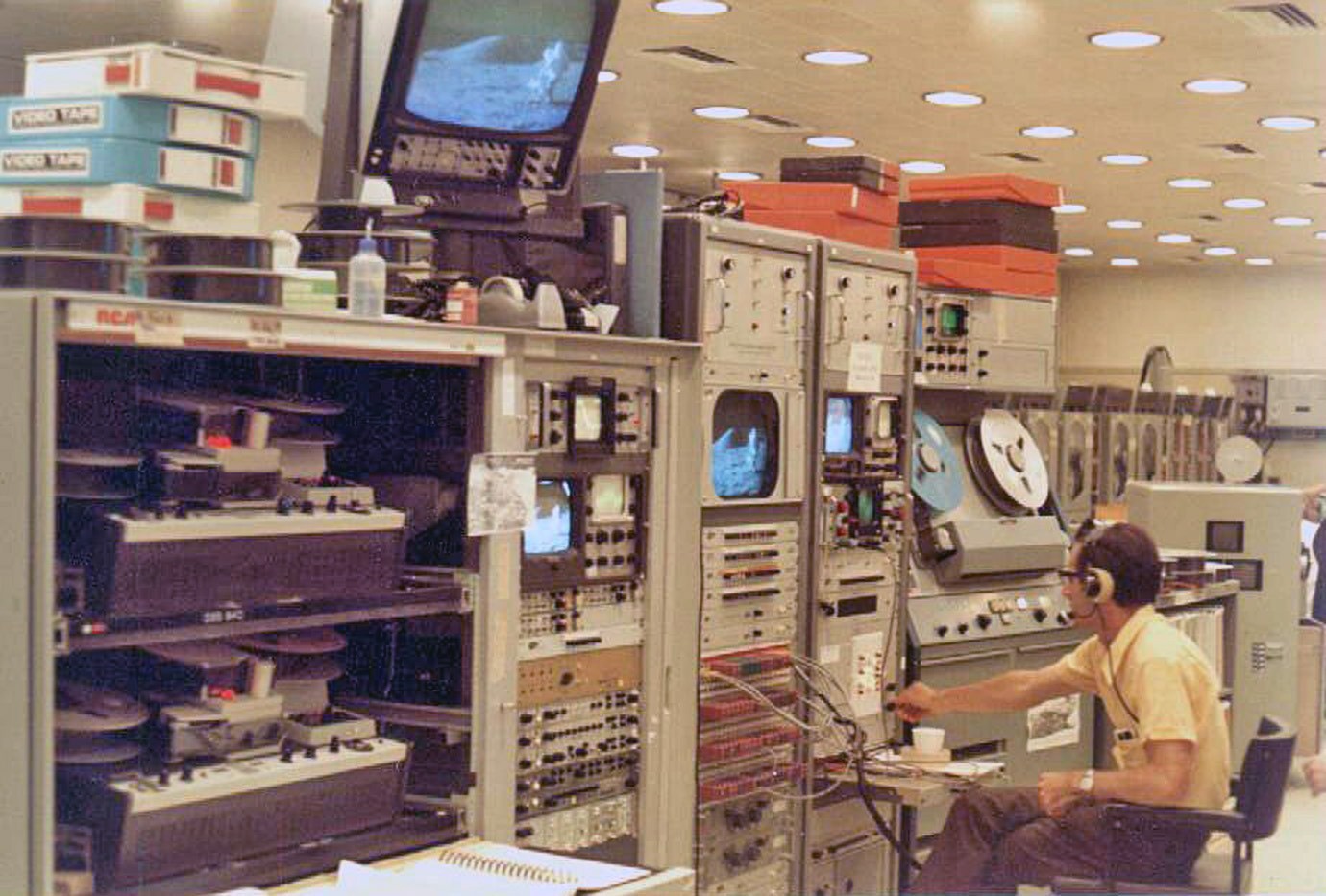
Early video configuration
|
|
|
Ed von Renouard
(“Video Von”) is seated at the initial installation of the RCA
scan converter before the slow scan rack was installed (note the camera
in the top left corner of the rack). This probably would have been in
1967 or 68.
Compare it with the photo below, taken during Apollo
12 in November 1969.
Scan: Ed von Renouard. |
|
|
|
Ed
von Renouard at the video console during the Apollo 12 mission. The slow
scan rack is on the left.
Scan:
Hamish Lindsay. Large, Larger. |
Mincom M22 telemetry recorders
For Apollo 11, the slow scan television signal was modulated
with the telemetry from the Lunar Module (including PLSS data).
A back-up recording of the Apollo 11 LM TV downlink was
made in case there were problems with the RCA Slow Scan converter used at the
stations. Instrumentation recorders were used – an Ampex FR1400 at Goldstone
and Mincom M22s at Honeysuckle Creek and Parkes.
|
|
|
Ed
von Renouard and the Mincom M22 data recorders.
During
the Apollo 11 EVA, the television was not only video recorded on the Ampex
VR1100, but the slow scan video data was also recorded along with the
rest of the telemetry from the Lunar Module. These – along with the
videotapes – were shipped to Goddard and Houston after the mission.
Polaroid scan: Ed
von Renouard. Exact date is unknown.
Image enhanced by Colin Mackellar. |
Ed von Renouard writes,
“for Apollo 11 we had the M22 telemetry recorders
going at 120 ips (reel change every 1/4 hr for the duration of the mission)
which also recorded the narrow-band slow scan TV downlink, and we
had an ageing broadcast quality Ampex VR1100 4-head desk-size video recorder
with 2-inch tapes to record the scan-converted NTSC-standard output TV fed to
the US. This machine overheated during the downlink and kept on blowing fuses
so we ended up opening its rear doors and positioning two desk fans to keep
it cool. This worked and we were able record the rest of the TV.”
See also Apollo
11 TV.
|
|
|
Ed
von Renouard loads a tape on one of two
Ampex VR 660C helical-scan video tape recorders, mounted above
one another which were used instead of the VR 1100 after Apollo 14.
Photo:
Hamish Lindsay. |
|
The Ampex VR660 recorders and associated equipment.
Photo: Ed von Renouard. |
Photos of the video section during Apollo 17
Ed von Renouard writes:
“From Apollo 15 onward we had two Ampex VR660
helical-scan video recorders which are the ones you can see in the photo [on
the left].
The scan converter had been retired and the downlink was
now all-singing-and-dancing frame-sequential NTSC-standard colour TV as evinced
by the RCA colour monitor on top of the rack (frame-sequential because of the
RGB colour wheel in front of the vidicon camera used on the moon, the reference
colour was green).”
|
|
|
Honeysuckle Creek Test Equipment Supervisor Nevil Eyre
in the video section during Apollo 17.
Note the two Ampex VR600 2-inch helical scan video-tape
recorders on the left and the older Ampex VR1100 on the right.
Polaroid photo scanned by Ed von Renouard.
|
|
|
|
Another photo of Nevil Eyre at the video equipment
during an Apollo Lunar EVA.
On the monitor – the Rover-mounted TV camera
is looking down at the rover. One of the Astronauts is visible in the
distance on the right.
From a Polaroid scanned by Nevil Eyre.
|
For more Video Section photos from during Apollo 17, see “Apollo 17 TV” in
the Apollo 17 section.
Honeysuckle video configurations
|
|
|
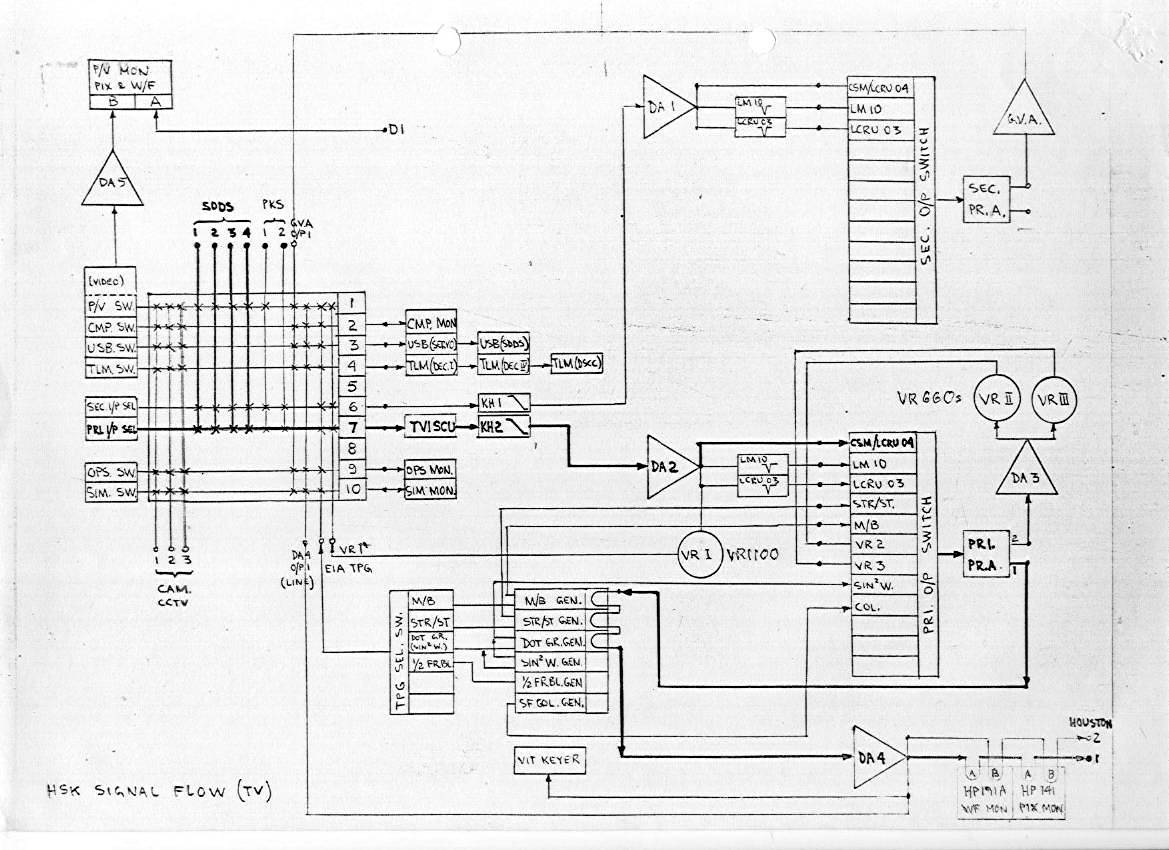
HSK Signal Flow
Diagram by Ed von Renouard.
|
|
|
|
HSK Sync, VIT and
TPG Configuration
Diagram by Ed von Renouard.
|
|
|
|
HSK Closed Circuit
TV Configuration
Diagram by Ed von Renouard.
|