MA-6 “Friendship 7” – 20th February 1962
After many frustrating delays, Lt. Colonel
John Glenn was launched into orbit on his Mercury-Atlas 6 three orbit flight,
at 10:47pm Western Australian Standard Time, on February 20 1962.
|
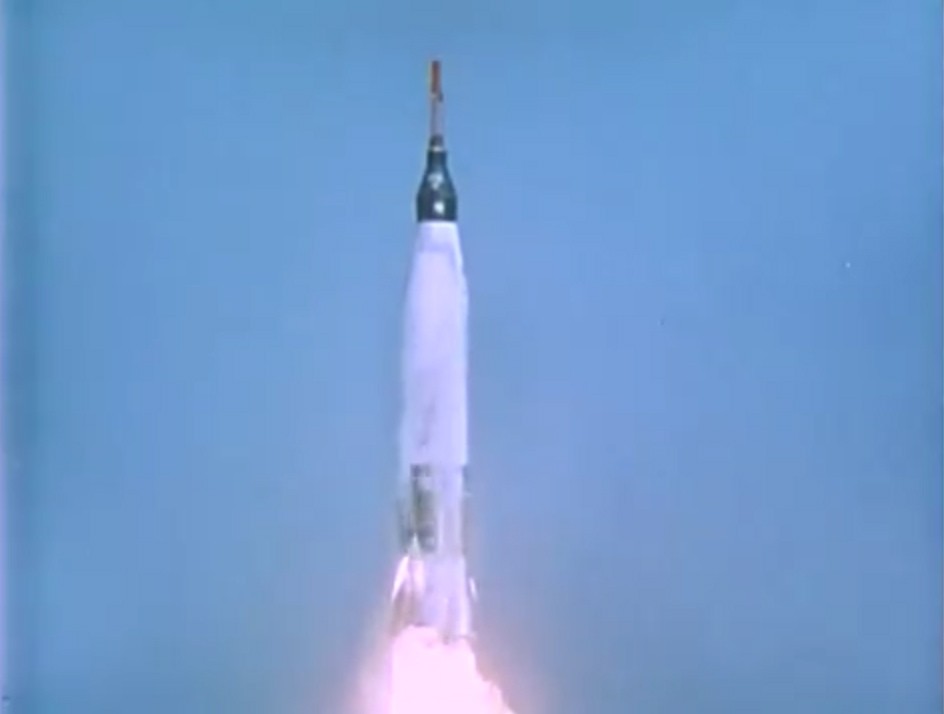
The Atlas launch vehicle carrying Friendship 7 launches toward orbit. |
The stations of the Mercury Space Tracking Network, as well as support and Recovery forces, stood by to play their part.
|
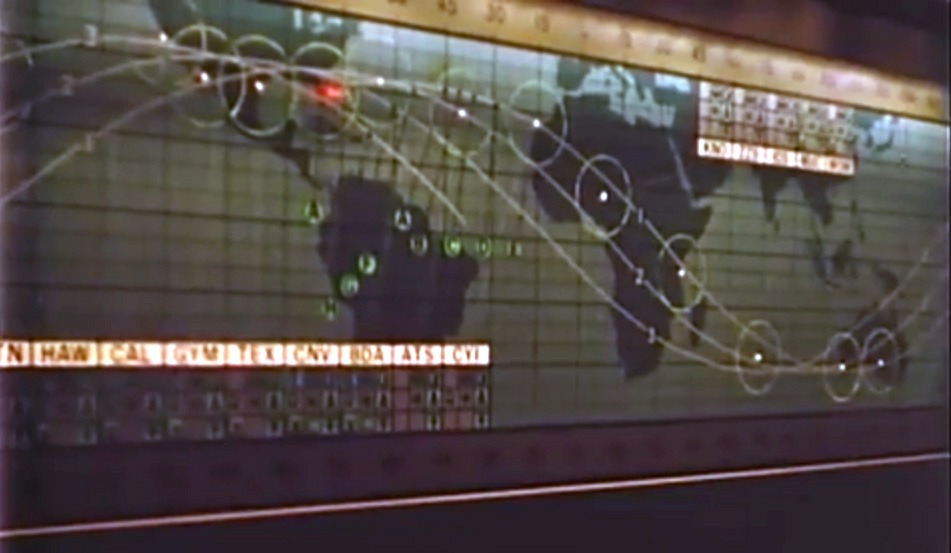
The Mercury Space Tracking Network plotboard in Mercury Control shows the positions of each of the Network stations, as well as the groundtrack of Friendship 7’s three orbits. |
|
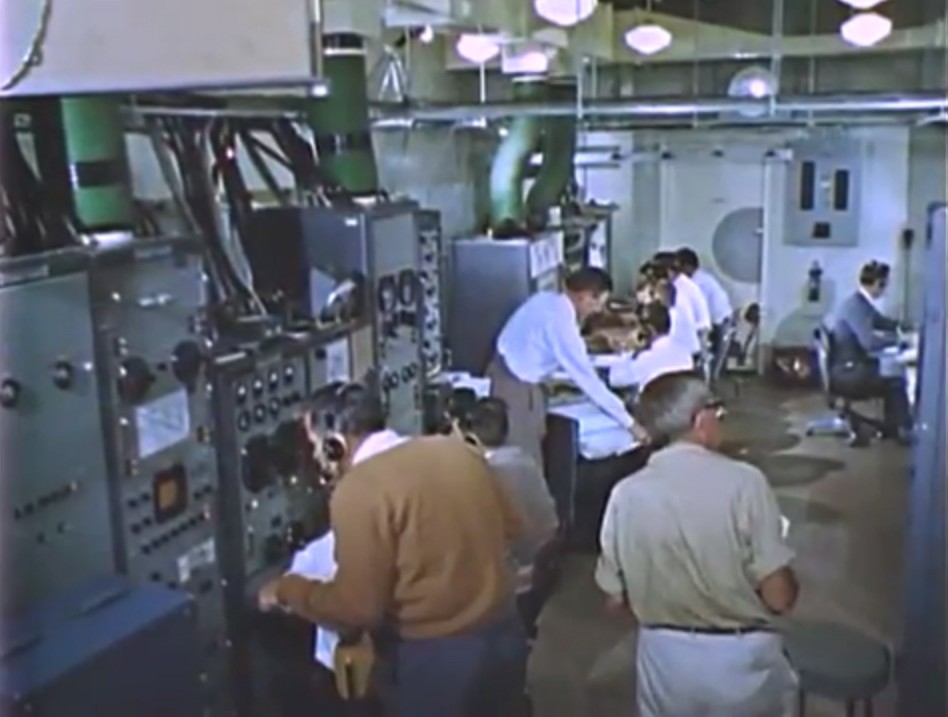
This view at Muchea shows the Acquisition area in the foreground, with the Control area in the far section of the room.
In the distance at far right, Comm Tech Gerry O’Connor stands by ready to call Friendship 7 when it comes in range. Labelled photo. |
Both Muchea and Red Lake (Woomera) Tracking Stations tracked Friendship 7 on all three passes across the Australian continent.
On his first orbit, Col. Glenn successfully communicated
with the Capcoms stationed at Bermuda, Canary
Islands, Kano (Nigeria) and Zanzibar.
After he had passed into darkness, he then flew
over the Indian Ocean Tracking ship, the Coastal Sentry Quebec (CSQ).
|
 Mercury
Control (the voice of Colonel John ‘Shorty’
Powers) describes Friendship 7’s position over the Indian Ocean
ship.
Mercury
Control (the voice of Colonel John ‘Shorty’
Powers) describes Friendship 7’s position over the Indian Ocean
ship.
168kb mp3 file. Runs for 43 seconds. |
|
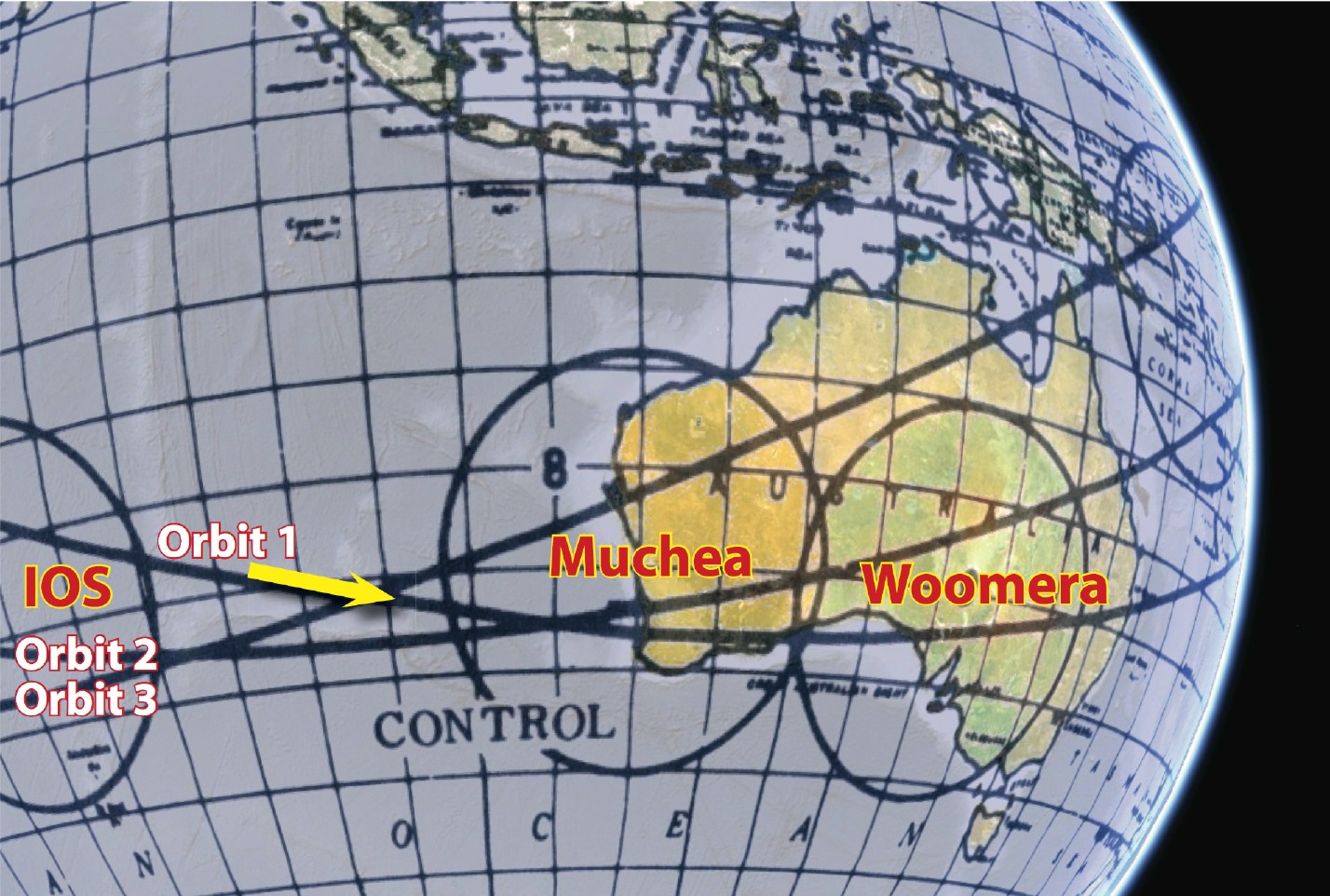
A plot of Friendship 7’s trajectory is here draped over a globe to show the groundtrack of John Glenn’s three orbits. ‘IOS’ is the Indian Ocean Ship.
The circles represent the nominal 700 nautical mile tracking range of each station.
Graphic: Colin Mackellar. |
Listen to this recording of Friendship 7’s
first pass over Muchea and Red Lake (Woomera) Tracking Stations.
At 15:37 UTC (11:37 pm Western Australian Standard Time), Muchea Comm Tech Gerry O’Connor succesfully calls John Glenn. This is at 49:21 Ground Elapsed Time, and Friendship 7 is still 1,640 km to the west.
Six minutes and 37 seconds later, Glenn has crossed Western Australia and is within range of the Mercury Tracking Station at Red
Lake, Woomera at 15:44 UTC (1:14 am Central Australian Standard Time on Wednesday 21 February).
Onboard recording courtesy of NASA’s
Kennedy Space Center archives.
|
Hear
the full pass over Muchea and Red Lake on Orbit 1 –
from Friendship 7’s onboard flight recorder. 3.1MB
mp3 file – runs for a total of 13'39". |
48 minutes into his flight, Glenn is approaching
the coast of Muchea, Western Australia where Capcom L. Gordon Cooper
is waiting.
00'01" Muchea’s Comm Tech, Gerry O’Connor is just audible at the spacecraft as he calls to establish contact.
00'14" Not realising that Muchea is calling, Glenn
transmits in the blind, and describes his night observations. |
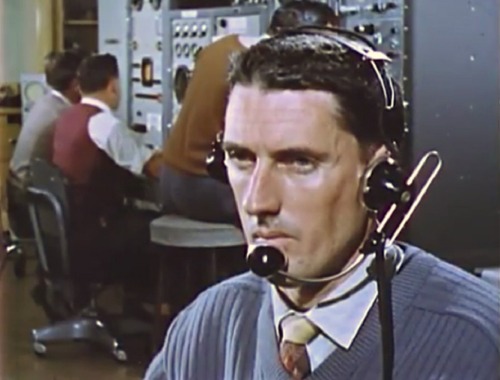 |
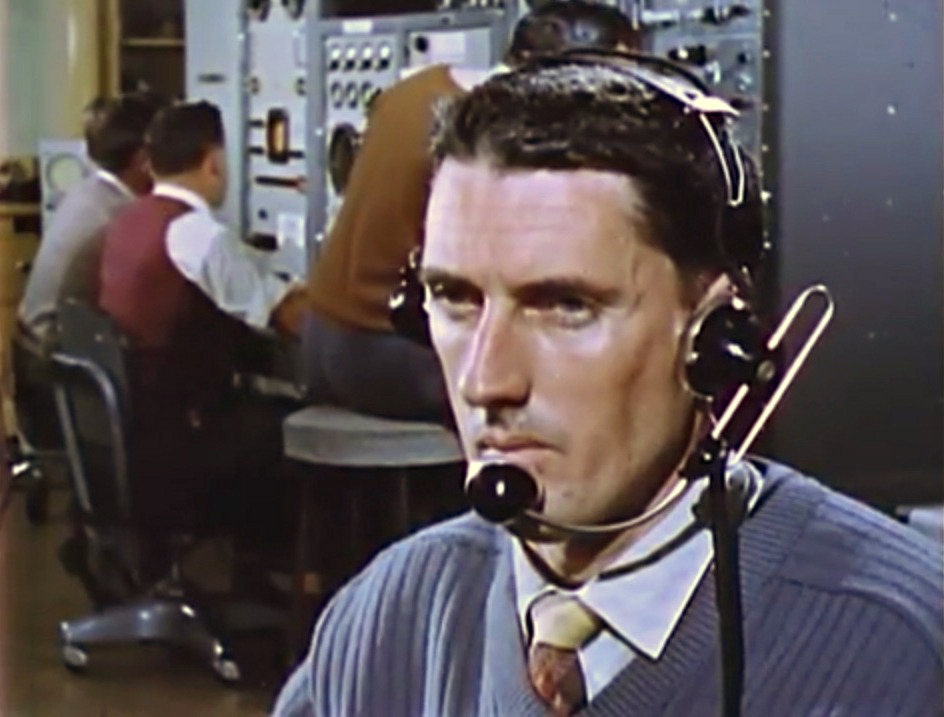
Muchea Comm Tech Gerry O’Connor during the MA-6 flight.
The Acquisition Team (Jack Duperouzel, Jack Walker and Jack Moir) are visible behind him. |
01'07" Friendship 7 has risen high enough above
the horizon for Muchea to acquire the signal. Comm Tech Gerry O’Connor
makes another call, and this time John Glenn answers. Having established communications, O’Connor hands over to the Capcom.
01'18" Muchea Capcom, astronaut L. Gordon Cooper,
replies. |
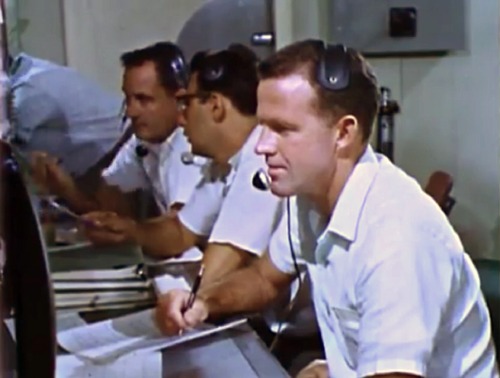 |
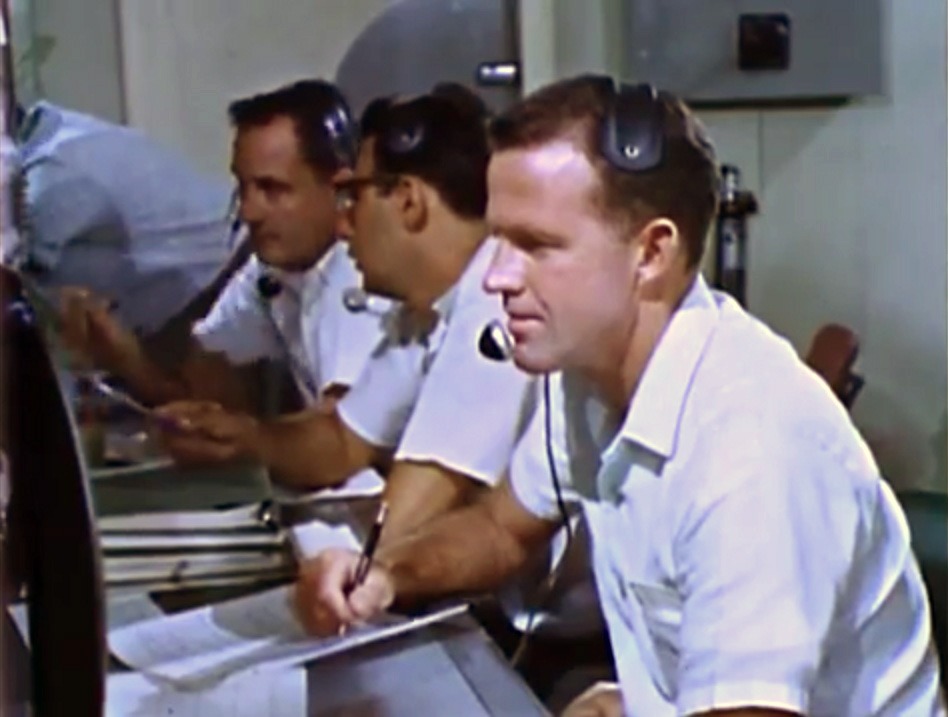
Muchea CapCom Astronaut Gordon Cooper speaks with John Glenn as he passes overhead. (From a NASA film of the event.)
|
03'06" Cooper suggests Glenn look for the lights
of Perth. He can’t see them yet.
05'42" 54 minutes into his flight, John Glenn reports
that he can see the lights (of Perth and Rockingham).
“Just to my right I can see a big pattern of
lights apparently right on the coast. I can see the outline of a town
and a very bright light just to the south of it. ...
The lights show up very well and thank everybody
for turning them on, will you?” (1 minute 8 second, 204kb
mp3 excerpt.)
The bright light to the south is almost certainly the Kwinana Oil Refinery just north of Rockingham. The refinery flared for Glenn’s pass. (Thanks to Leo Hanley’s son John for that info.)
06'37" Within a few seconds, Glenn is racing across the Australian
continent towards Red
Lake Tracking Station, north of Woomera. Woomera Capcom calls.
Due to cloud, Glenn is unable to see any lights at Woomera.
The Woomera pass runs until 13'34". The next tracking
station, Canton Island in the Pacific Ocean, is still seven minutes
away. |
|
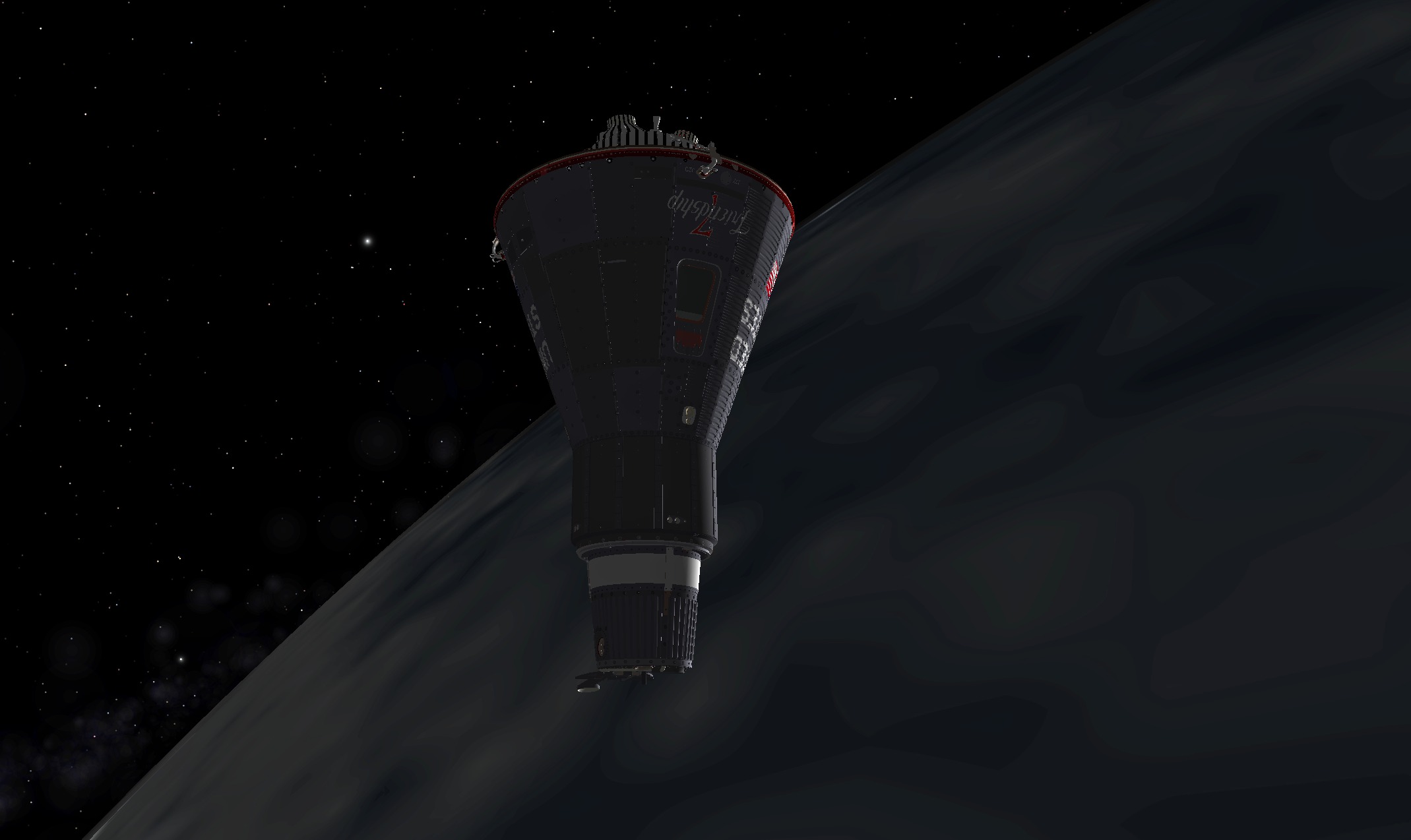
A computer generated image of Friendship 7 made using Celestia and a digital model by James R. Bassett. |
|
Mercury
Control (the voice of Colonel John ‘Shorty’
Powers) announces that Friendship 7 is over Muchea and is speaking with
Gordon Cooper. The voice communications are being recorded and soon
will be replayed at Mercury Control.
168kb mp3 file. Runs for 42 seconds. |
|
Mercury
Control announces that John Glenn has seen the lights
of Perth.
172kb mp3 file. Runs for 43 seconds. |
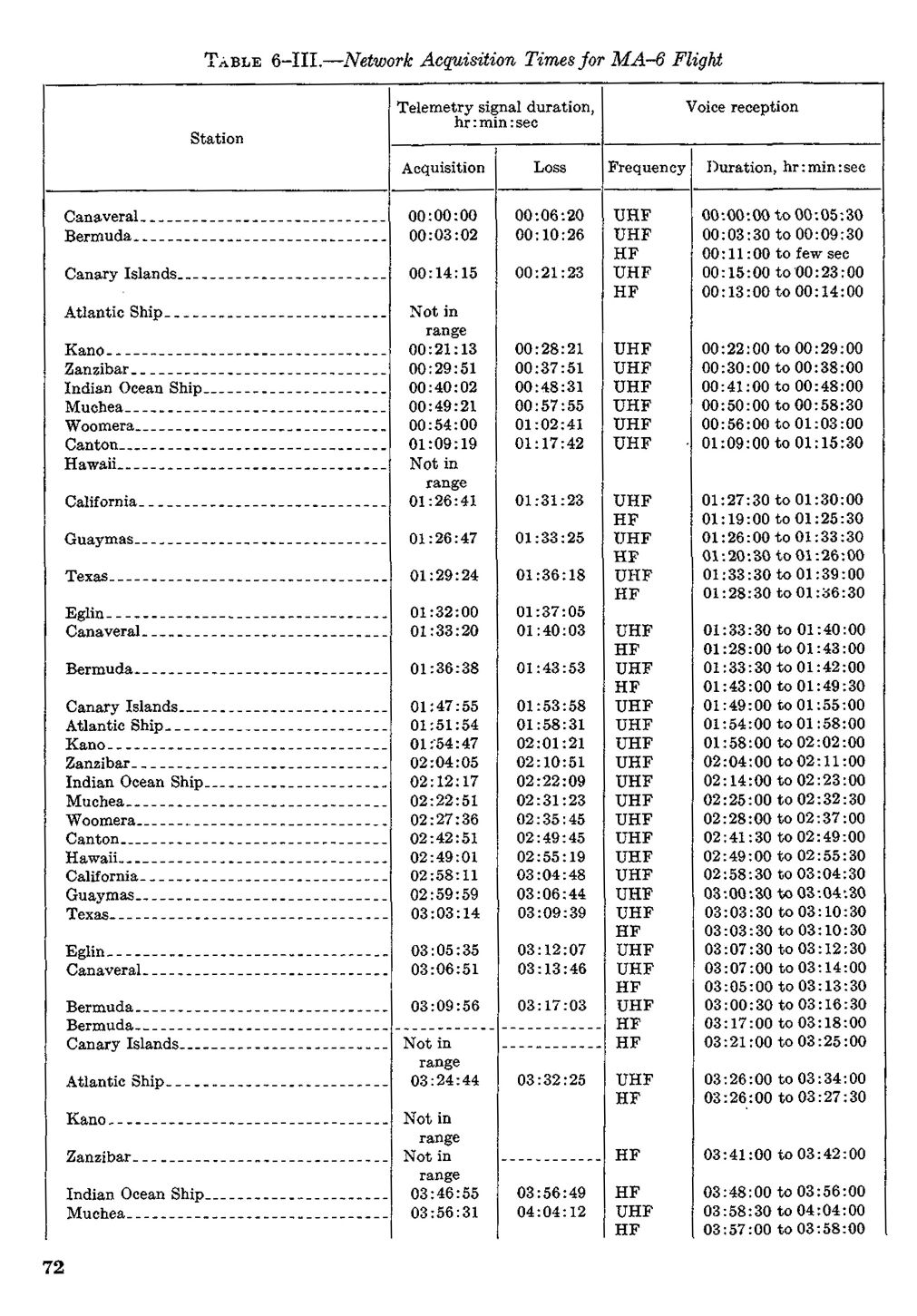
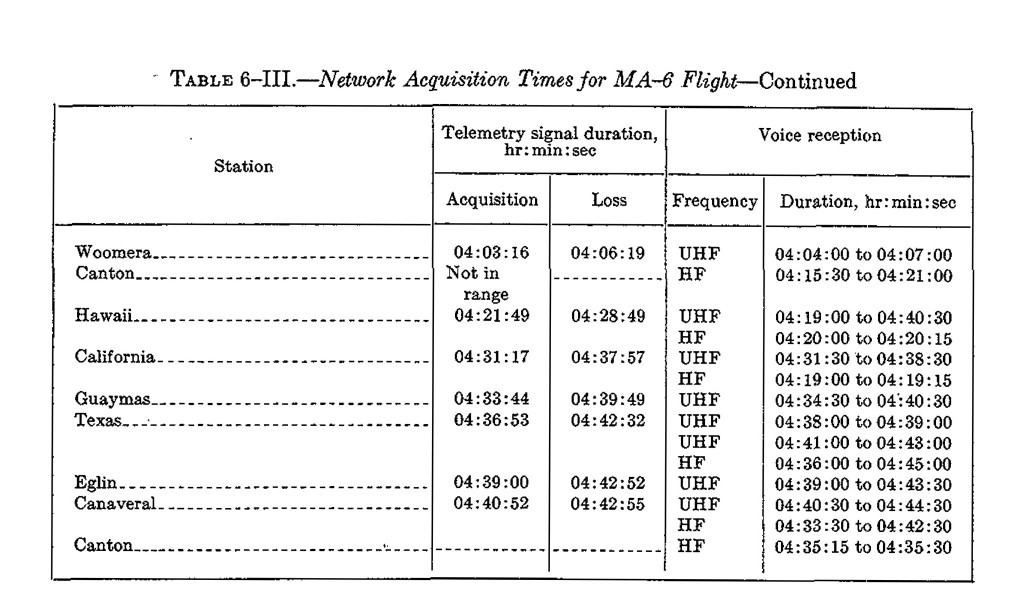
These tables summarise station coverage for all three orbits.
Note that AOS on HF is typically a little earlier than the line-of-sight UHF.
|
Mercury Tracking Network Acquisition times for MA-6. Part 1.
From the Manned Spacecraft Center publication “Results of the First United States Manned Orbital Space Flight, February 20, 1962”. Page 72. Larger, Largest. |
|
Mercury Tracking Network Acquisition times for MA-6. Part 2. (from page 73.) Larger, Largest.
Interestingly, from the above chart, it seems favourable propagation allowed the Canton Island station to receive voice on HF when Friendship 7 was over the Atlantic Ocean. |
|
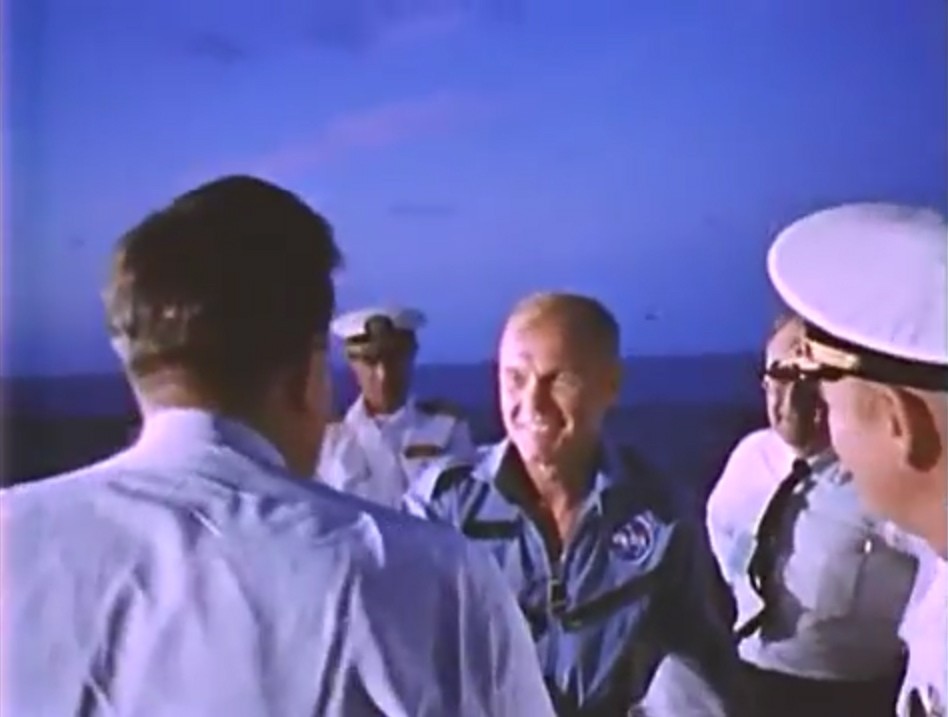
John Glenn is welcomed aboard aircraft carrier Randolph after being transferred from the recovery destroyer Noa. |
|
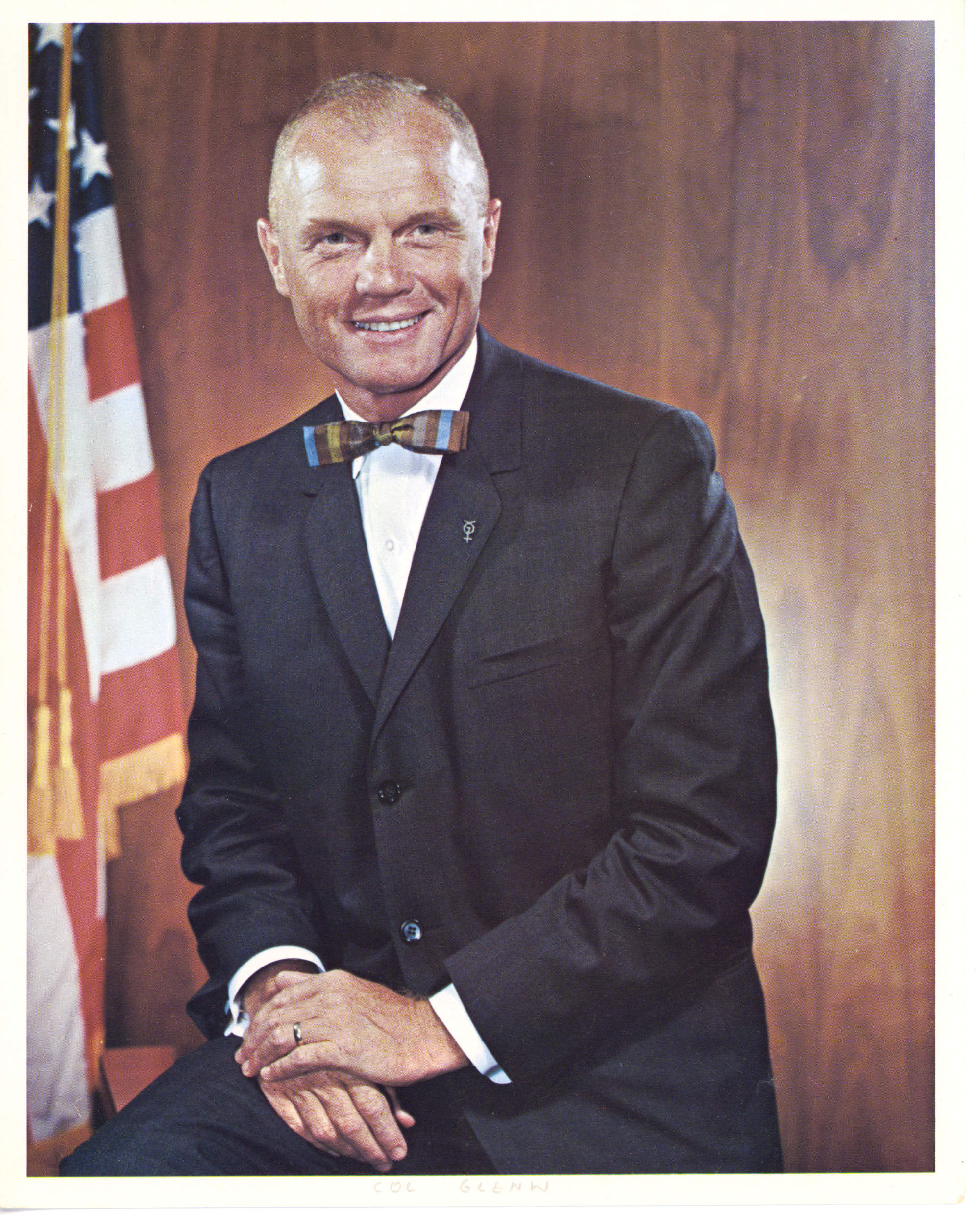
Colonel John Glenn. NASA photo preserved by John Lambie. |
For more, see
|
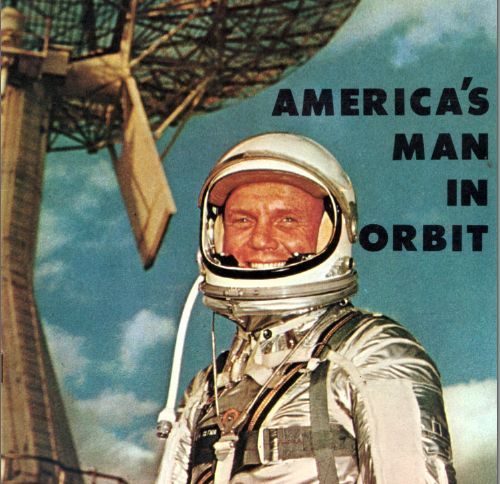
America’s Man in Orbit is a 20 page booklet on John Glenn’s
flight.
Preserved by Jack Duperouzel, PDF assembled by Colin Mackellar.
Click on the image to download the 10MB PDF file. |
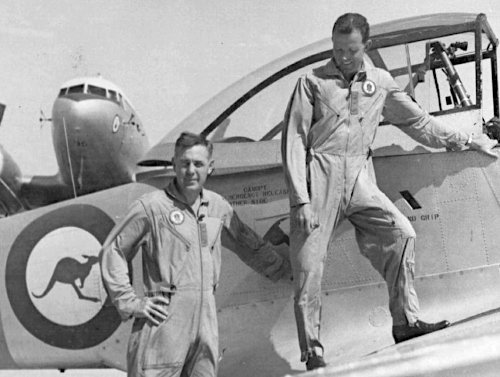 |
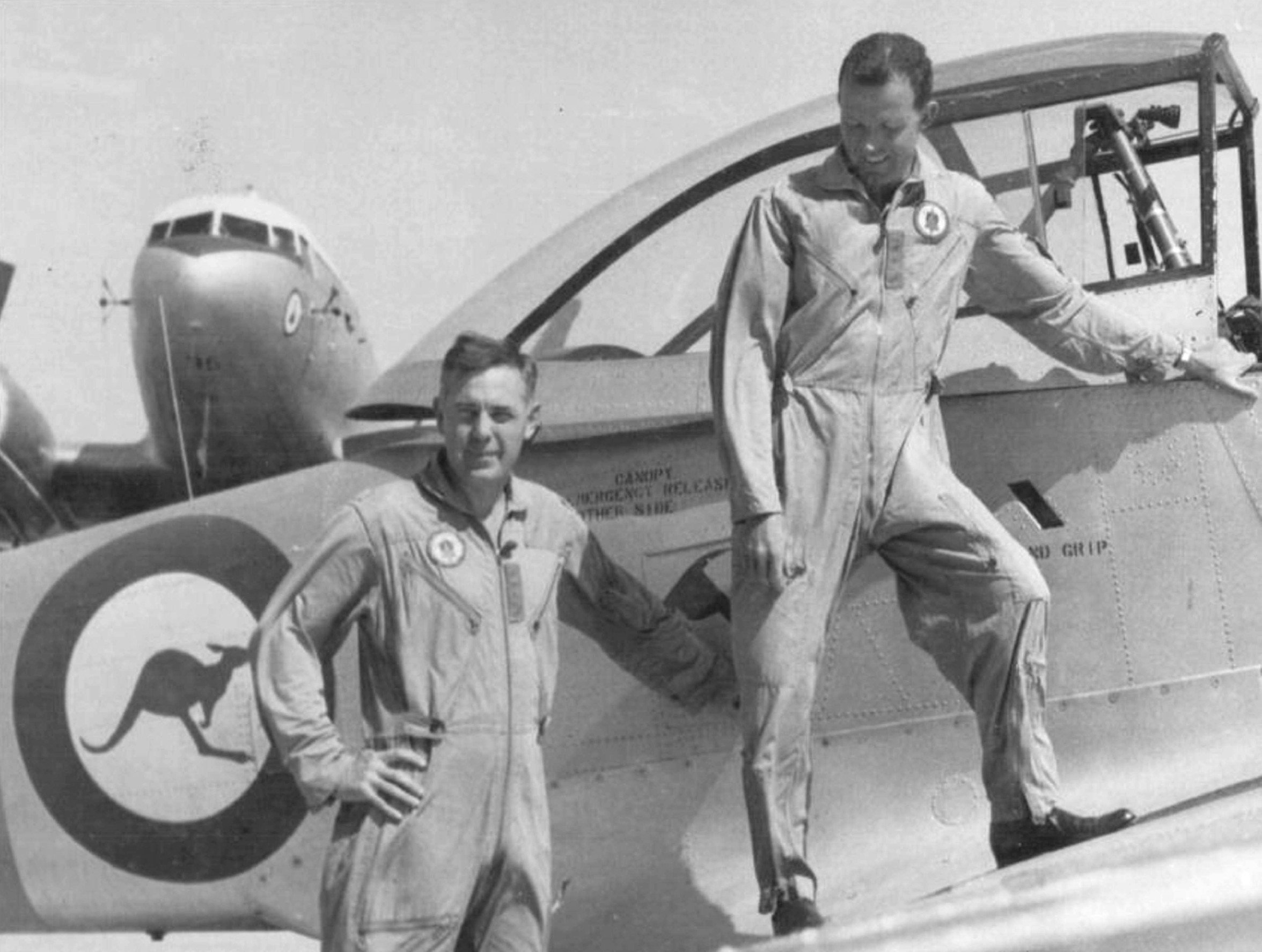
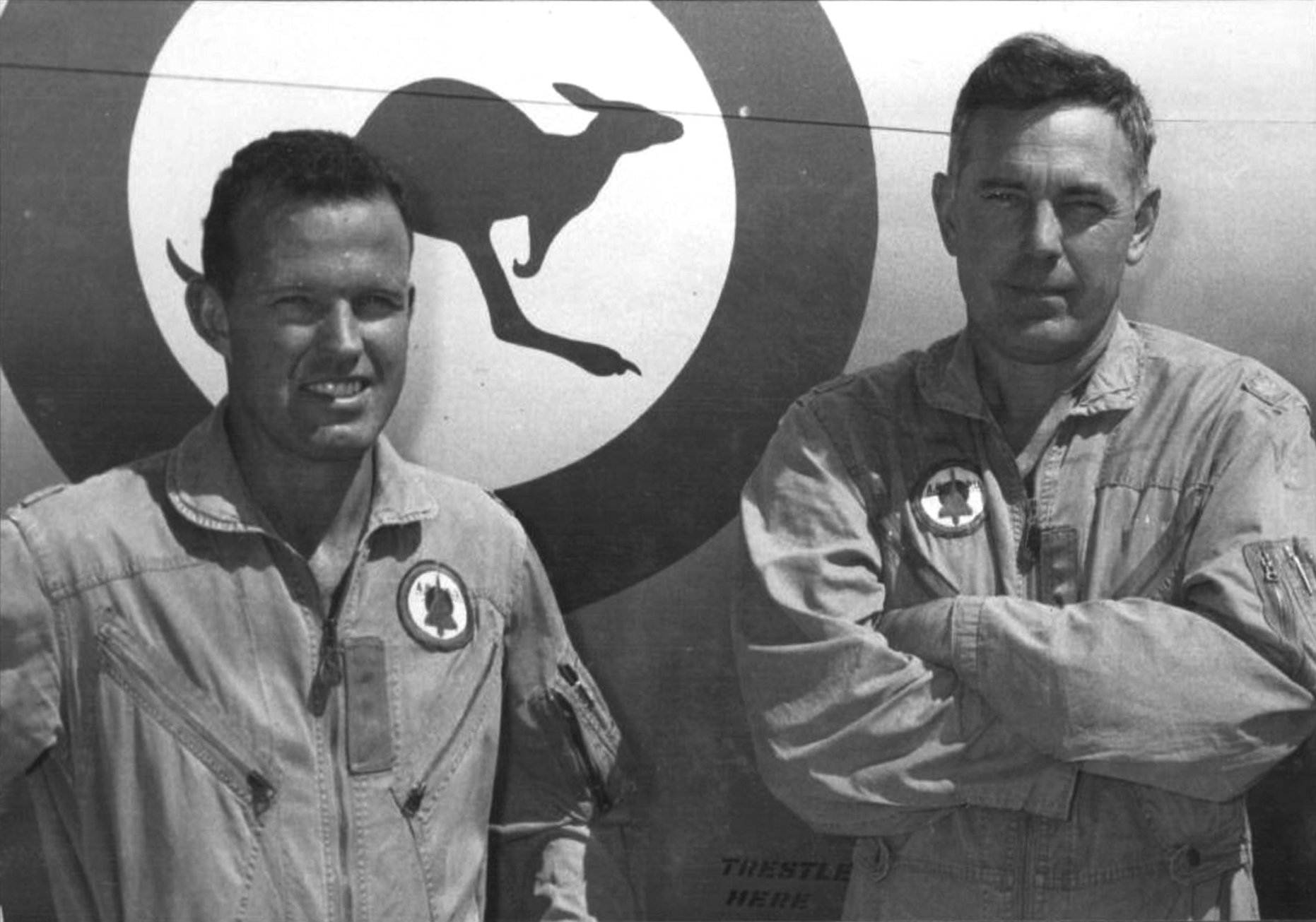
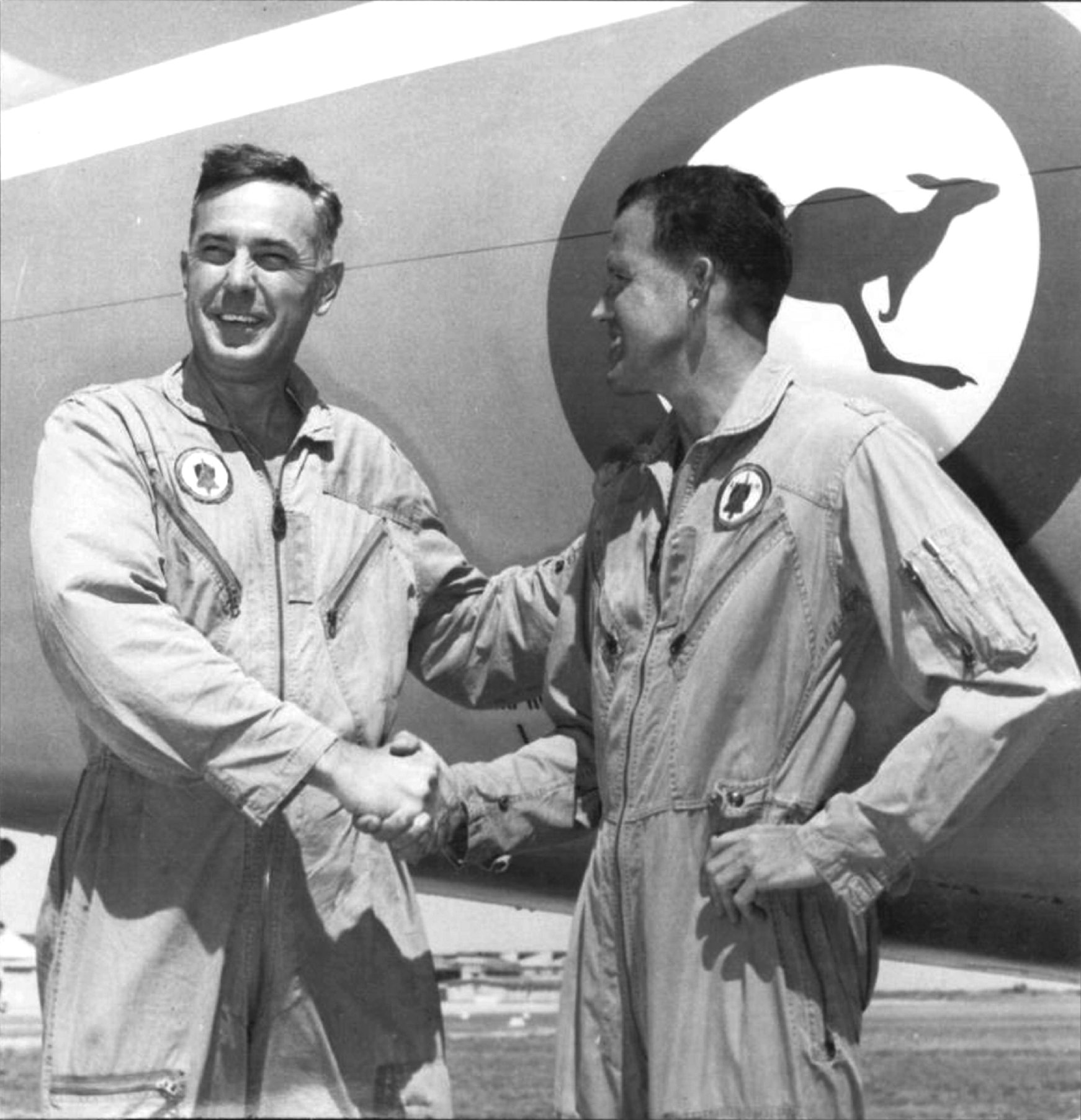
On the way home from serving as Capcom at Muchea for Friendship 7, Gordon Cooper chats with friend Maj. Tom Risher at the RAAF’s Aircraft Research and Development Unit (ARDU) at Laverton, Victoria.
Major Risher USAF was serving as an exchange test pilot at ARDU. He knew Cooper from the Flight Test Center at Edwards AFB.
Cooper is standing on the wing of a Winjeel, built by the Commonwealth Aircraft Corporation. Scan: Mike Dinn. |
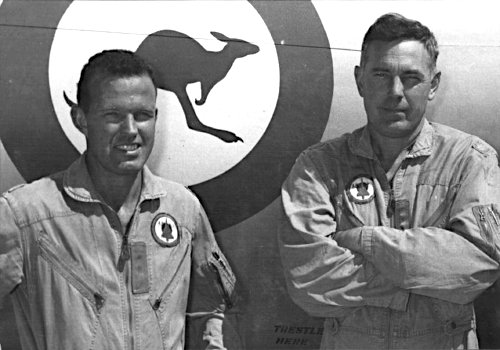 |
Gordon Cooper and Tom Risher at ARDU at Laverton, 1962.
Scan: Mike Dinn. |
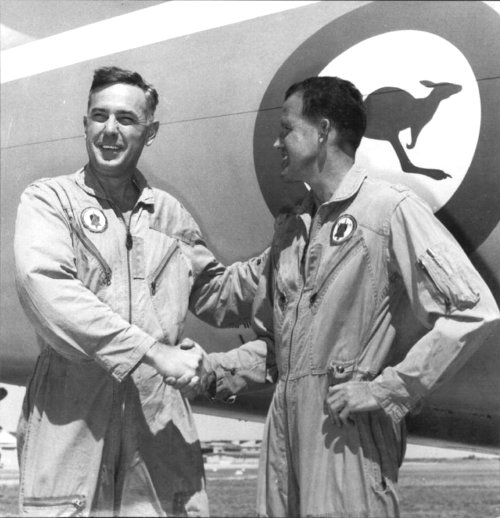 |
Gordon Cooper and Tom Risher at ARDU at Laverton, 1962.
Scan: Mike Dinn. |
Unless otherwise stated, the photos are frames from a 1962 NASA documentary
Friendship 7, captured and enhanced by Colin Mackellar.
See also:
Audio of Friendship 7, as recorded at Red Lake / Woomera.
Hamish Lindsay’s Friendship 7 Essay.
Back to
the main Muchea page.